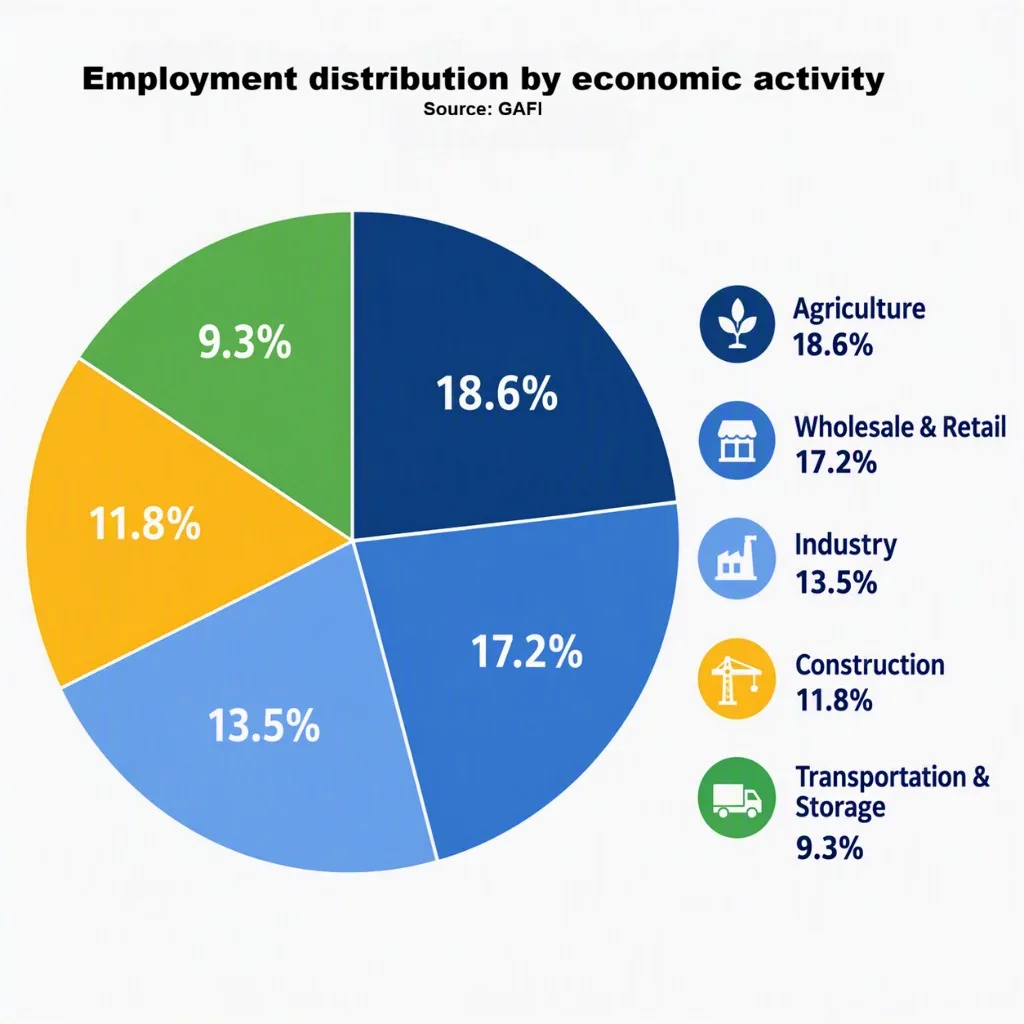
The government’s ambition to raise manufacturing’s share of GDP from 12.8 per cent is more than an industrial policy goal. It is a strategic bet on Egypt’s ability to generate sustainable foreign currency earnings through production and exports rather than relying on volatile external inflows.
Egypt’s factories would need to grow about 17 per cent a year through 2030 to deliver the manufacturing share Industry Minister Khaled Hashem promised at Egypt Forum 2026 this week: 20 per cent of GDP, up from 12.8 per cent at present. That is roughly double the pace his own figures imply.
The gap matters because a country that funds imports with remittances, portfolio inflows and one-off asset sales stays hostage to sentiment; one that exports what it makes does not.
Hashem said non-oil manufacturing added about 1.1 percentage points to GDP growth of 5.1 per cent. A sector’s contribution equals its share of output multiplied by its own growth rate, so 1.1 points on a 12.8 per cent base implies expansion near 8.6 per cent.
Hold real GDP growth at 5 per cent and that pace lifts the share to only about 14.6 per cent by 2030. Reaching 20 per cent takes roughly 17.4 per cent a year for four years, based on constant prices, assuming the 12.8 per cent reflects fiscal 2025/26.
The domestic industrial sector’s objectives and policies are aimed at increasing investment rates in a sustainable way to deepen and localise industrialisation. The ultimate objective is to raise local supply chains and deepen interconnections.
Vertical integration into global and regional value chains is another key target through boosting the competitiveness of domestic manufacturing industries for more exports in the future.
Why dollars point to the factory floor
Non-oil exports rose 17 per cent to $48.6 billion in 2025 while the trade deficit narrowed 9 per cent to $34.4 billion, the Ministry of Investment and Foreign Trade reported.
Gold shipments more than doubled to $7.6 billion, a windfall from bullion prices rather than industrial capacity; remove them and the remaining basket is about $41 billion. Building materials ($14.9 billion), chemicals and fertilisers ($9.4 billion) and food ($6.8 billion) lead it. Engineering and electronics, where assembly can graduate into components and design, managed $5.9 billion in the first eleven months.
Capital inflows are just as lumpy: about $3.5 billion of the $13 billion in net foreign direct investment over the nine months to March traced to a single coastal real-estate deal, central bank data show.
Portfolio money has been faster still: roughly $9.5 billion left in the first quarter as the Middle East war began, and an estimated $7–8 billion returned in June alone, a pattern that rewards the yield, not the economy.
The bear case
Three obstacles stand out. Energy comes first: Prime Minister Moustafa Madbouly said the gas import bill alone rose $1.1 billion a month once the regional war began, an input cost that bites hardest on cement, steel and fertiliser producers. Trade policy is second.
Washington’s Section 301 duty, a tariff imposed after a US Trade Representative finding of inadequate forced-labour import controls, set Egypt’s rate at 12.5 per cent from July 24, and the treatment of Qualifying Industrial Zone shipments remains unclear.
Against that stand real assets. UNCTAD credited Egypt with $15.5 billion in FDI last year, Africa’s largest inflow; the Suez Canal Economic Zone counts 205 operating factories; pharmaceutical makers already supply roughly 90 per cent of domestic medicine demand.
The open question is whether those assets convert into exports faster than energy costs, tariffs and a soft pound erode the margin.
The bottom line
Egypt’s long-term objective is tipped to focus on export-push sectors. In a study titled “Structural Reforms and Productivity Growth in Emerging Market and Developing Economies”, the International Monetary Fund (IMF) linked the gains of reforms to the types of reforms being implemented.
The North African country may focus on a raft of labour-intensive industries through the creation of value chains for food, pharmaceuticals, medical supplies, cosmetics, engineering, cars and household appliances and ready-to-wear manufacturing.
The post How manufacturing can strengthen Egypt’s growth model appeared first on Egyptian Gazette.