Dubai: Between the solidity of marble and the delicacy of memory, Emirati artist Aisha Al Hammadi searches for a visual language that transcends the limits of ornamentation to touch the human experience in its deepest dimensions.
She revives Islamic geometric patterns, but in her works they do not appear as mere fixed forms that recall a visual past. Rather, they transform into a living language, in which memory intertwines with place, silence with contemplation, and repetition by the act of sculpting itself. Through the hammer and chisel, Aisha rereads this geometric heritage, attempting to transfer it between familiar ornamentation in a contemporary space that leaves room for the viewer to interpret and discover meaning.
Regarding her work, Aisha said at the beginning of her interview: “I explore geometry, memory, and material transformation, and I contemplate silence and repetition. My focus is on transforming Islamic geometric patterns from being a fixed decorative structure into a sophisticated language that expresses the experiences and feelings I have encountered during my life journey. By doing so, I present a contemplative space that invites viewers to engage in a slow confrontation with structure and space.”
Environmental impact
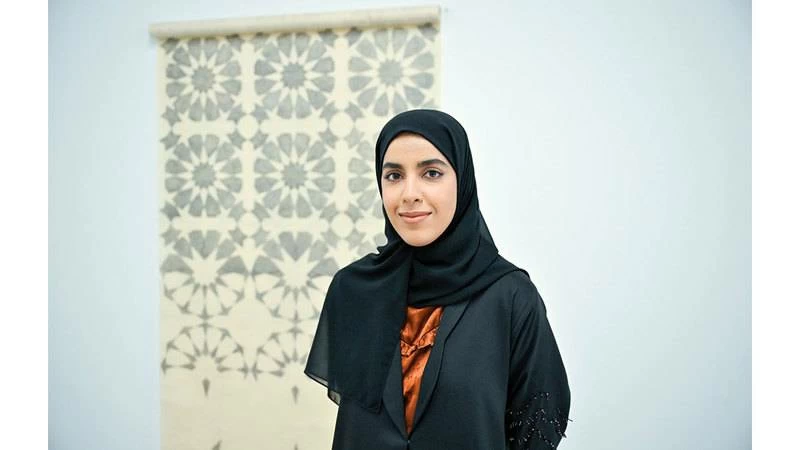
She said: "My focus is on transforming Islamic geometric patterns from being a fixed decorative structure into a sophisticated language...". Picture credit: SuppliedThe young artist, who recently participated in a group exhibition at Dome Art Projects in Dubai, added: “I draw my practice from the rhythms of my surrounding environment, from architectural forms and domestic spaces, and spatial memories, all of which influence the texture and forms of my work. The reason I chose marble as a medium among the other media I know is that I wanted to connect the heritage of carving Islamic geometric patterns found in many of our regions in the past with the present, and to use it to develop this heritage into a new feature.”
She explained that she does not seek a fixed decorative structure in her work, but rather sought to transform it into something that people can still appreciate in our time, which prompted her to pick up the hammer and chisel and start carving. She pointed out that the connection between the themes she presents in her artistic practice and the act of carving itself gives her works more depth and adds to the meanings she wants to put in art. Moreover, the solidity of the marble material allows for the preservation of what has been carved and engraved and for it to last for a long time.
Work challenges
Regarding the challenges of working with marble, Aisha described her experience with it as surprising, as she did not know that she would go in this direction. However, after meeting the artist Adel Jabbour and undergoing a sculpture workshop, she was able to turn curiosity into passion and a real love for the material, which carries many challenges, especially since working with it is very slow and requires a great deal of energy and patience. She expressed her belief that passion enables the artist to overcome all difficulties.
She confirmed that she worked on developing her sculpting skills to do something closer to three-dimensional sculpture, and here, she applied for a grant from the Ministry of Culture. When she received it, she joined a three-week workshop in Italy to learn more techniques, and it was a unique experience. She pointed out that the sculpture she does depends on the rhythm of repetition, part of which is visual, and part of which is the act of sculpting itself, which is the hidden part that the public does not see, but it is in fact repeated.
Regarding the concept of silence in her work, she believes it draws the viewer into a state of contemplation. When silence is present, she embodies it through deliberate decisions about the patterns or forms she chooses to reveal and those she wishes to conceal. This explains the presence of sculpted and non-sculpted elements within the work; this balance between positive and negative space is fundamental. She expressed a feeling that she can speak through absence, leaving the viewer the freedom to decide how to interpret the work and how to connect it to their own personal experience.
Experiences that shaped her art
Aisha elaborated on her particular interest in Islamic geometric patterns: “When I was in my final year of university, I wanted something that resonated with me, something close to my heritage and identity. I turned to what would allow me to revive these Islamic geometric patterns, because people perceive them in only one specific way. I wanted to bring them back to life and present them in a different light, and that’s what led me to choose Islamic geometric patterns as a language.” She noted that the pattern she exhibited at Dome Art Projects was one she found in Sharjah, and it caught her attention because of the abundance of modern buildings.
She explained that when she speaks of memory and spatial memory, she is referring to those events and experiences — such as wandering or even driving around the city, and stopping at specific times — which she sought to portray in her work. She noted that Abu Dhabi, which has been her home for a long time, has greatly influenced her work, particularly the vision of the beach, green spaces, and neighbourhoods, in addition to the sea, which has been significant in her creative output.
Multimedia artist
Artist Aisha Al Hammadi's work tends toward a variety of artistic mediums. Her initial interest was in photography, and she was initially drawn to this medium because she would pause to observe specific moments and reflect on the actions she witnessed.
The medium came first, followed by the idea, during the execution of the work. She noted that she later began using different media and realised that the work originates from the idea, not the medium.
She now chooses the medium that best lends depth to the piece. She praised her experience as an artist residency at Dome Art Projects, describing it as very fruitful, as she needed a suitable environment to return to sculpture.