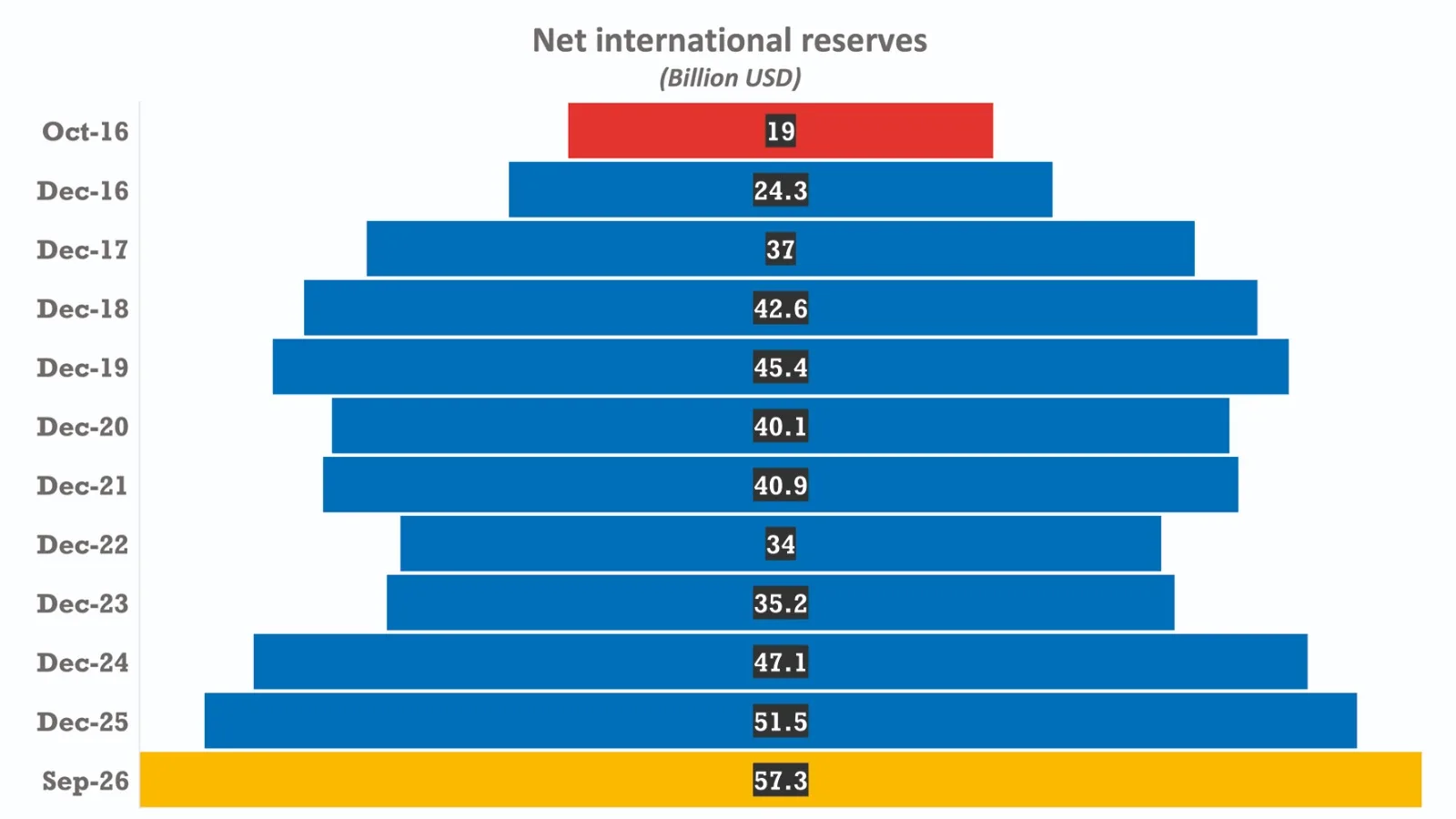
10 years after the Egyptian pound was first floated, the measurable gains are embedded in the economy. Something happened in Egypt on November 3, 2016, and it truly transformed its economy. Ten years ago, Egypt’s economy was running on borrowed time. Reserves fell to roughly $19 billion in October 2016. A parallel market had opened a wide gap against the official rate as dollars were scarce enough to stall factories. However, only two months after the November currency float, reserves rose to $24.3 billion in December 2016, according to the Central Bank of Egypt (CBE). The November reform programme, anchored by a three-year, $12 billion International Monetary Fund (IMF) Extended Fund Facility, has offered some relief. The Covid-19 test The pandemic then tested those gains, and Egypt was among the few emerging economies to avoid a contraction in 2019/20. Another test was the eruption of the Russia-Ukraine war in February 2022 that triggered portfolio outflows estimated at around $20 billion. There have been three pound devaluations since then. Urban inflation peaked at about 38 per cent in September 2023. The March 2024 reset differed in kind from the 2016 original. The first float was a one-off shock administered alongside austerity. The second unified the official and parallel rates, lifted the overnight deposit rate by 600 basis points to 27.25 per cent, and expanded the IMF programme to roughly $8 billion, alongside the Ras El-Hekma land deal with the UAE, worth about $35 billion, and a European Union support package. A flexible exchange rate The most visible achievement is the end of the dual-rate economy. The parallel market that starved banks of dollars has collapsed. The formal system is now capturing flows that once were informally channelled. In the fiscal year ending June 30, 2025/26, Egyptian remittances reached $47.3 billion, up 29.6 per cent from the previous year. As of September 2026, CBE data indicate that reserves had recovered to close to $57.3 billion from $44 billion before the pandemic. Monetary policy The CBE adopted a formal inflation-targeting framework, with a 7 per cent target, for the fourth quarter of 2020, stepping down to 5 per cent, for the final quarter of 2026. The 2024 hike and the easing that followed as inflation retreated showed that the machinery working. The overnight deposit rate now stands at 19 per cent against core inflation of 14.7 per cent, a positive real return that anchors the policy and is also its cost. Core inflation remains well above the target band, so the framework’s credibility is still being earned rather than banked. Robust banking sector Egypt’s banks passed through three devaluations and a sovereign-stress year without a systemic episode. Non-performing loans have remained in low single digits. Capital adequacy stood comfortably above the regulatory minimum of 12.5 per cent, according to CBE data. The 2020 banking law modernised supervision, while financial inclusion rose from roughly a third of adults in 2017 to more than half by 2021, according to the World Bank’s Findex survey, helped by the InstaPay instant-payments network and mobile wallets. Markets have deepened too: the IMF estimates nonresident holdings of local-currency debt at about $36.4 billion by late June. The caveat is that large holdings of government paper tie the banks’ health to the sovereign’s. What the record does not show The composition of the recovery matters as much as its size. The $36.4 billion of foreign debt holdings is portfolio money: nonresidents pulled out a net $4.4 billion in the nine months to March, then returned in force, and the instruments they favour, six-month treasury bills yielding around 26 per cent, are chosen by investors who want to be able to leave. Foreign direct investment looks stronger, with UN Trade and Development crediting Egypt with $15.5 billion last year, Africa’s largest inflow for a fourth straight year. Yet, roughly $3.5 billion of the $13 billion in net FDI over the nine months to March traced to a single real-estate deal, and manufacturing activity, measured by a Purchasing Managers’ Index that spent most of the first half of 2026 below 50, has not yet followed. Two older problems also persist. Interest payments absorb a very large share of budget revenues, which limits the fiscal room that stabilisation was meant to create The fairest reading of the decade is that Egypt has built better instruments than it has built an economy. The exchange rate, the monetary framework and the banking system are measurably sturdier than in 2016, and they have survived stresses that would have broken the old arrangements. What they cannot yet show is a private sector investing and exporting at a scale that makes the next crisis less likely. The next decade’s test is whether sturdier plumbing finally carries something other than borrowed money. The post How Egypt navigated crises and economic reforms appeared first on Egyptian Gazette.