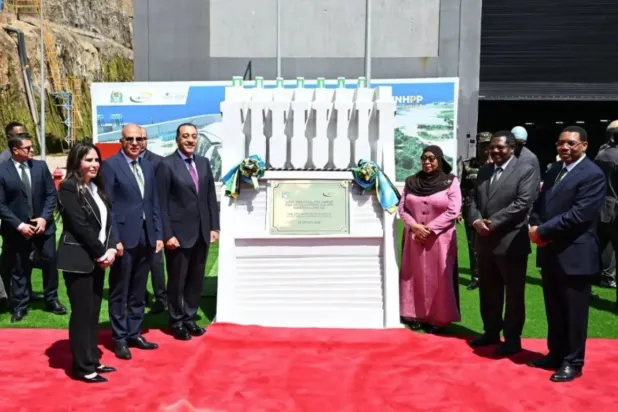
Egypt is seeking funding for 36 projects in the southern Nile Basin, expanding its role in the region through hydropower, electricity and water schemes that experts say could benefit both Cairo and its neighbors. The projects include power interconnections, transmission lines, water supplies and multipurpose schemes. Experts told Asharq Al-Awsat that Egypt’s growing involvement was guided by a principle of mutual benefit. The southern Nile Basin countries are Burundi, Congo, Kenya, Rwanda, South Sudan, Tanzania and Uganda. They are among the Nile’s upstream countries and, together with the eastern Nile countries of Ethiopia, Sudan, Egypt and Eritrea, make up the Nile River Basin region. Egyptian Minister of Water Resources and Irrigation Hani Sewilam said on Friday that Cairo had agreed to support efforts to mobilize funding for the 36 projects after studying them, exchanging information, assessing their impacts and reaching agreement through consultations. Sewilam pointed to Tanzania’s Julius Nyerere Dam as a practical example of cooperation among Nile Basin countries. The Egyptian-Tanzanian partnership had brought gains to both sides, he said. The dam provides electricity for Tanzania, Sewilam said, and its power could also support regional integration, cross-border connections and electricity trade with neighboring countries. He also cited the Grand Fula Dam project in South Sudan, saying Egypt supported Juba’s development goals, including that project. Tanzania inaugurated the Julius Nyerere hydropower dam and plant in late August. The Egyptian consortium of Arab Contractors and Elsewedy Electric built it over five years, with 1,700 Egyptian engineers and technicians among a workforce of about 12,000. Hussein al-Buheiri, an African affairs expert at the National Center for Middle East Studies, said Egypt had the resources and capabilities to play a central role in developing Nile Basin and Horn of Africa countries, particularly through hydropower dams and irrigation and agricultural projects. He said Egyptian companies’ work on the Julius Nyerere Dam and Egypt’s help in building power plants in countries such as Djibouti showed how the country could act as a strategic development partner. African countries gained development, while Egypt gained investment and thousands of jobs, he said. That approach also advanced Egyptian foreign policy and helped protect its Nile water security by drawing basin countries closer to Cairo and countering Ethiopian moves, al-Buheiri said. Salah Halima, deputy chairman of the Egyptian Council for African Affairs and a former assistant foreign minister, said Egypt’s support for development projects reflected a broader commitment to shared interests and sustainable development across the basin. Egypt had long supported water and electricity projects in Nile Basin countries, approving and helping carry out dozens of them, he said. That record showed Cairo’s support for those countries’ right to develop without harming others. Halima described current water projects as an expression of partnership and mutual investment between Egypt and its African neighbors. Their expansion, he said, was part of longstanding collective action and close cooperation. The message, he said, was clear: understanding and cooperation, rather than confrontation or dispute, should guide the management of international rivers.