Dubai: A woman’s live broadcast on a social media platform turned into a nightmare after she was subjected to abuse and threats from an anonymous account whose owner not only attacked her publicly, but also sent private messages and fabricated images using artificial intelligence techniques, showing her in indecent situations, in an attempt to abuse and blackmail her.
The woman had no choice but to turn to Dubai Police via the eCrime platform, so the AI Crimes Department team began searching for and investigating the account holder, in a case that revealed – according to the Director of the Cybercrime Department at the General Department of Criminal Investigation in Dubai Police, Lieutenant Colonel Abdullah Al Shehhi – how modern technologies can turn into a tool to abuse people and violate their privacy, and how field investigations can lead to revealing the identity of an anonymous account user.
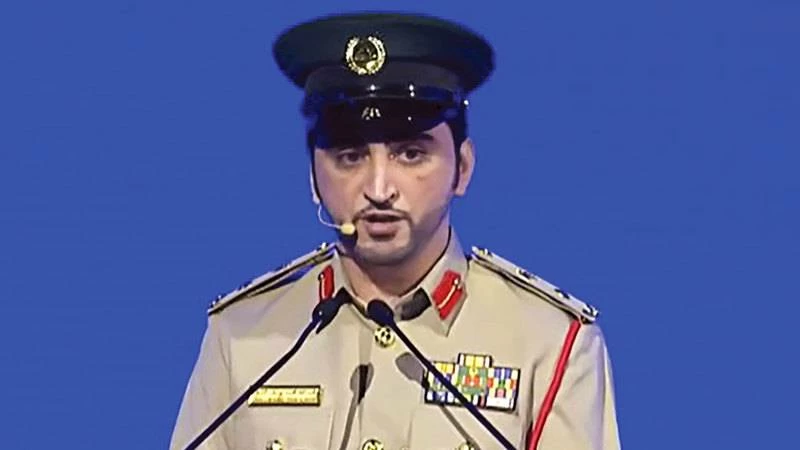
Al Shehhi stated during a session held yesterday at the World Police Summit in Dubai that the first lead in the case led investigators to a phone number registered in the name of a person outside the country.
However, the investigations did not stop at the owner of the number, but extended to identifying the actual user of the account, by tracking a location for receiving food orders in a public park. They monitored the suspect and verified his identity, before carrying out an ambush that resulted in his arrest and interrogation.
Al Shehhi said the case illustrates that behind every digital account, file, or transaction lies an incident that needs explanation and evidence that needs investigation. He pointed out that Dubai Police established a specialised section for artificial intelligence crimes within the Department of Electronic and Cyber Crimes in 2025, so that this type of crime would be a clear specialisation within the police work system.
He emphasised that the rapid development of AI technologies poses new challenges for law enforcement agencies, particularly with their potential use in identity and voice impersonation, the production of fake content, and the automation of targeting and deception processes. This expands the scope of cybercrimes and increases their ability to reach victims.
He explained that there is a difference between cybercrimes and AI-enabled crimes. The former includes attacks on systems and data or the use of digital means for fraud and extortion, while the latter exploits AI capabilities for identity theft, voice cloning, and the production of fake content, in addition to automating targeting and communication with victims.
He pointed out that a criminal might seize control of a person's account and request money in their name, or clone their voice to carry out a scam without needing to hack into their account, or they might combine both methods. This requires specialised expertise in tracking breaches, examining digital content, and verifying its sources.
Al Shehhi warned that the emergence of AI agents opens a more complex phase in the world of cybercrime, with the development of systems capable of planning and executing sequential tasks using available tools, without the need for human intervention at every step.
He explained that fraud centres, which previously required dozens of people to communicate with and respond to victims and follow up on scam operations, can be transformed into virtual centres that rely on artificial intelligence agents capable of managing conversations in multiple languages around the clock, allowing for targeting larger numbers of victims with fewer operators.
He pointed out that Interpol has warned of the ability of artificial intelligence agents to plan and execute fraud campaigns independently, which requires law enforcement agencies to develop their tools and capabilities to keep pace with this transformation.
Al Shehhi pointed out that the risks of cybercrimes are no longer limited to stealing data or seizing money, but have extended to targeting systems and devices and disrupting services that individuals and institutions depend on, citing a cyber attack that targeted the cooling control systems of about 700 commercial sites in France, which led to high temperatures and spoiled food, as well as the attack that the global medical technology company Striker was subjected to in March of the same year, which caused disruption to its internal systems, and affected order processing, manufacturing and shipping operations.