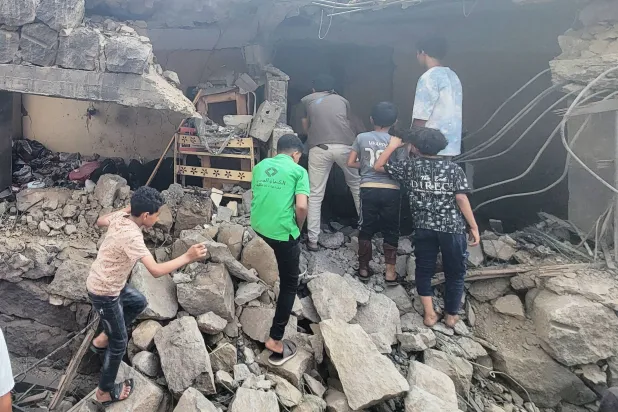
The humanitarian consequences of the Houthi escalation in Yemen have intensified as the group steps up attacks on residential areas in rural Lahj Governorate and around the city of Taiz, according to government sources. Growing numbers of families are fleeing the fighting, while relief organizations struggle to meet mounting needs in a country already facing one of the world's worst humanitarian crises. Sources told Asharq Al-Awsat that the Houthis had intensified near-daily missile and drone attacks on villages in Lahj's Al-Mudarabah district after failing to make advances on the battlefield. The attacks have forced hundreds of families to flee, adding to waves of displacement from the western coast and the outskirts of Lahj. The sources said they believed the attacks were intended to pressure local tribesmen into withdrawing their support for government forces. Around Taiz, the sources reported that the Houthis had targeted villages on Mount Sabr with drones and mortar shells in an attempt to weaken resistance from government troops and local volunteers, who have repelled repeated attempts by the group to breach the front lines in recent days. The developments come as Taiz has been under siege for 20 days, according to the sources. The fighting has made it increasingly difficult for civilians to access essential services and supplies, placing additional strain on local authorities and humanitarian organizations. Humanitarian Warnings Amid the humanitarian consequences of the Houthi attacks, the International Federation of Red Cross and Red Crescent Societies (IFRC) warned that the latest escalation had deepened Yemen's prolonged humanitarian crisis. The IFRC said 22.3 million people across Yemen require humanitarian assistance, including approximately 5.2 million who had already been internally displaced before the latest escalation. In a recent report, the federation said fighting and insecurity had disrupted access to healthcare, education, markets and essential supplies. Displaced families are arriving in host communities with few belongings and urgently need shelter, household essentials, food, clean water and healthcare. The report noted that host communities are also facing severe pressure on services and resources, while repeated displacement is eroding livelihoods, increasing protection risks and raising the likelihood that more families will be forced to leave their homes. The IFRC stressed the importance of maintaining humanitarian access and ensuring a flexible response that can adapt to changing needs on the ground, particularly in areas where insecurity restricts the movement of people and supplies. According to the report, displaced households face overlapping barriers to obtaining shelter, food, clean water, sanitation, education and healthcare. Insecurity and road closures have disrupted markets, supply routes and aid deliveries, while lost income, depleted assets and rising prices have further reduced families' ability to purchase basic necessities. The federation warned that isolated communities face even greater restrictions, as maintaining commercial supplies and essential services becomes increasingly difficult. Food insecurity is further exacerbating the vulnerability of households already struggling with inadequate access to food. Highlighting the scale of the crisis, the report said approximately 2.2 million children under the age of five suffer from acute malnutrition across Yemen. It warned that continued sieges and interruptions to humanitarian assistance could further worsen conditions, particularly for young children and pregnant and breastfeeding women. The report added that repeated displacement is exhausting families' ability to cope with successive crises. A rapid assessment conducted at three displacement sites found that approximately 45% of the households surveyed had previously experienced displacement. The IFRC emphasized that this figure reflected only the households assessed at those three sites and should not be generalized to Yemen's entire displaced population. Additional Risks The IFRC also warned that the loss of property and unstable livelihoods are undermining families' resilience and increasing the risk that they will resort to harmful coping strategies, including child labor. The federation noted that the humanitarian toll extends beyond shortages of food and shelter to additional challenges facing female-headed households, children separated from their families, older people, persons with disabilities and patients requiring regular medical treatment. Women and girls face heightened protection risks in areas lacking adequate shelter and sanitation facilities. Meanwhile, people with limited mobility or financial resources may be unable to leave isolated areas or reach essential services. The warnings highlight the widening gap between humanitarian needs and the capacity to meet them as fighting continues, families are repeatedly displaced, and roads and supply routes remain disrupted. Together, these pressures are leaving vulnerable households increasingly exposed to hardship and placing additional burdens on communities receiving displaced families.