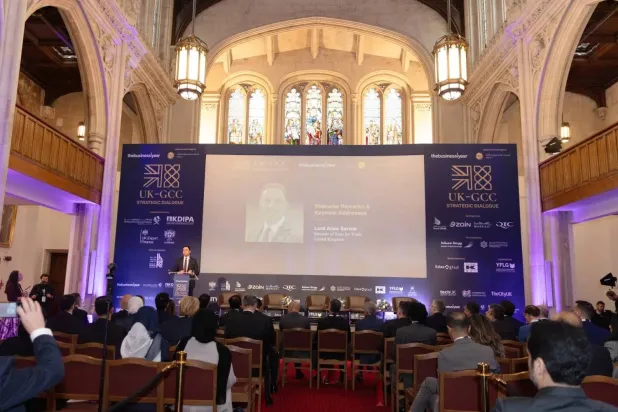
Gulf and British officials on Tuesday called for swift action to translate a free trade agreement into tangible investments and economic gains after concluding negotiations, saying closer ties could help both sides navigate mounting challenges to global trade and supply chains. At the UK-GCC Strategic Dialogue Forum in London, GCC Secretary-General Jasem Mohamed Albudaiwi said the agreement's success would be measured by the joint projects, productive investments and economic opportunities it generates. He urged business leaders and investors to move beyond the agreement itself and focus on implementation, investment and shared prosperity. British Minister of State for Trade Anas Sarwar said Britain was working with its Gulf partners to bring the agreement to signing and implementation, but stressed that businesses need not wait for those formalities to expand cooperation. He urged companies and investors to accelerate existing trade and investment partnerships rather than wait for the signing, legislative procedures and implementation to be completed. Growing economic partnership Trade between the GCC and Britain reached about $70 billion in 2025, making the six Gulf states collectively Britain's 10th-largest trading partner, Albudaiwi said. The combined value of investment assets and liabilities between the two sides stood at around $643 billion in 2024. Albudaiwi said the figures underscored the strength of Gulf-British economic relations and the scope for further expansion. With a combined gross domestic product of about $2.4 trillion, the GCC ranks among the world's 10 largest economies, while its foreign trade exceeds $1.8 trillion, he added. The conclusion of free trade negotiations marked a strategic step toward strengthening those ties by easing trade, encouraging investment and opening new opportunities for private businesses. Under the agreement, tariffs are expected to be eliminated on more than 99% of GCC exports to Britain, potentially boosting non-oil exports, particularly aluminum, fertilizers and manufactured goods. Albudaiwi said the deal would also strengthen the Gulf's position as a global logistics hub and help small and medium-sized enterprises expand their operations and access the British market. But its significance extends beyond trade gains, he said. The agreement could lay the foundation for a long-term economic and investment partnership spanning advanced manufacturing, the digital economy, artificial intelligence, clean energy, sustainability, financial and investment services, education, food security and logistics. Albudaiwi said cooperation in those sectors could shift Gulf-British relations beyond traditional trade toward deeper economic integration, driven by joint investments, technology and knowledge transfers, and stronger production capabilities. GCC Secretary-General Jasem Mohamed Albudaiwi addresses the forum. (UK-GCC Strategic Dialogue Forum) Britain sees Gulf states as strategic economic allies Sarwar said Britain regarded the GCC states as more than trading markets, describing them as strategic economic allies and friends. He said choosing the Gulf for his first international visit outside Europe since taking office as trade minister reflected the importance Britain placed on the partnership, particularly amid uncertainty and mounting challenges. Sarwar stressed the value of solidarity and friendship during difficult times, saying individuals, communities and countries needed to know they could rely on their partners. He called for a mutually beneficial relationship built on stronger two-way investment and trade, with British companies expanding into Gulf markets and Gulf businesses increasing their presence in Britain. Opportunities also extended beyond each other's markets to joint investments in third countries, an area Sarwar said offered considerable potential. He identified aviation and related industries, financial and legal services, defense and security, artificial intelligence, energy, food industries, education and scientific research as sectors with scope for expanded cooperation. In aviation, Sarwar highlighted Britain's expertise in aircraft manufacturing, engines and security systems, alongside efforts to attract more direct flights from the Gulf to Britain. He also urged closer cooperation between Gulf and British educational and research institutions, combining Britain's academic and research expertise with Gulf capabilities in energy and investment. Sarwar said the British prime minister had tasked him with making the United Kingdom the world's most connected economy. Achieving that goal, he said, would require boosting exports and investment while ensuring the benefits of economic growth reached regions across Britain. He added that Gulf investment was not confined to London or northern England but extended across different parts of the United Kingdom. GCC chief negotiator and general coordinator for negotiations Raja Al-Marzouqi delivers his address at the forum. (UK-GCC Strategic Dialogue Forum) More than 900 meetings over four years GCC chief negotiator and general coordinator for negotiations Raja Al-Marzouqi said the two sides held more than 900 meetings over four years before reaching the wide-ranging agreement, adding that the negotiations were not easy. He said the agreement sent a strong message to the international community about the resilience of trade and globalization at a time when the global economy faced challenges affecting the multilateral trading system. Covering trade in goods and services, investment, rules of origin and digital trade, the agreement is expected to generate economic gains for both sides, according to economic assessments cited by Al-Marzouqi. Britain's annual economic gains could reach approximately $4.7 billion, while the Gulf states are expected to benefit particularly from services, investment and improved productivity, he remarked. Al-Marzouqi linked the agreement to the economic transformation underway across the GCC, where governments are seeking to move away from dependence on oil and public spending toward private sector-led growth. That shift offered British businesses substantial opportunities to participate in projects and investments supporting Gulf economic diversification, he noted. Gulf and British officials on Tuesday called for swift action to translate a free trade agreement into tangible investments at the UK-GCC Strategic Dialogue Forum in London. (UK-GCC Strategic Dialogue Forum) From negotiations to results Kuwait's Minister of State for Economic Affairs and Investment and Acting Minister of Commerce and Industry Abdulaziz Al-Marzooq said the next phase of Gulf-British relations should focus on deeper cooperation in trade, investment, technology, infrastructure, financial services and advanced industries. He said the GCC offered Britain more than a market, given the Gulf states' established trade links with Asia and Africa. Al-Marzooq urged both sides to move beyond dialogue and focus on implementation, turning available opportunities into projects, partnerships and measurable economic value. He said the conclusion of free trade negotiations would give businesses greater certainty and the market access needed to turn investment intentions into action. While participants agreed on the agreement's strategic importance, their remarks underscored that concluding negotiations was not the end of the process but the beginning of a new phase. The focus now is on translating the agreement into tangible investments and projects while completing the formal procedures required for signing and implementation.