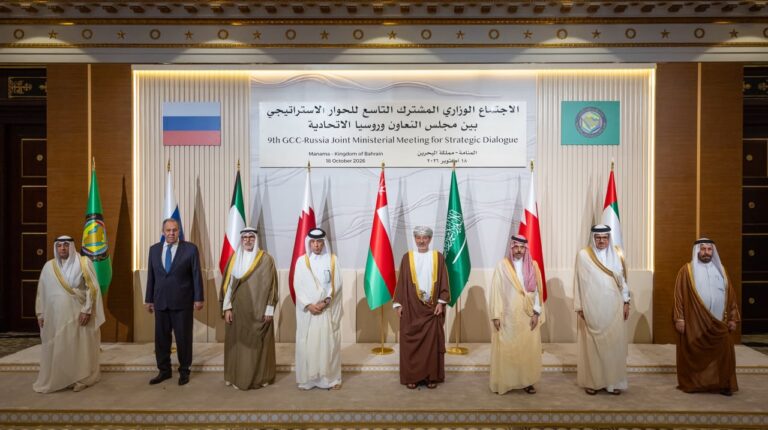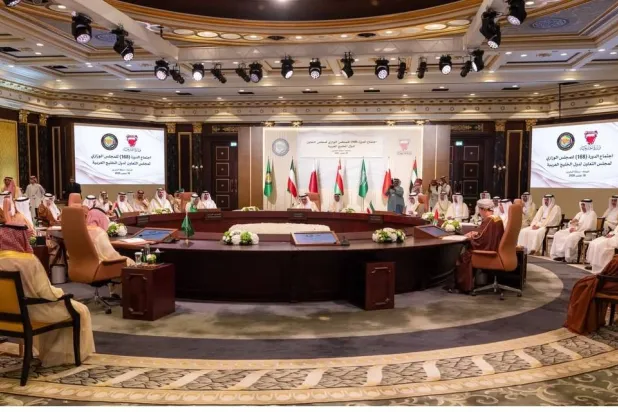
Gulf foreign ministers discussed in Bahrain on Sunday regional developments, specifically Houthi attacks on Saudi territory. The officials meeting at the 168th GCC Ministerial Council condemned the assaults and supported the Kingdom's right to defend itself. In addition to developments in Yemen, they discussed the escalation in the region and threats to freedom of navigation in the Arabian Gulf and Red Sea. The Gulf meeting was followed by the ninth joint ministerial meeting for the Gulf-Russian Strategic Dialogue, aimed at strengthening relations between both sides and expanding the horizons of partnership in various fields. Secretary-General of the Gulf Cooperation Council (GCC) Jasem Albudaiwi said the talks between the Gulf ministers and Russian Foreign Minister Sergei Lavrov will address ways to develop Gulf-Russian cooperation and exchange views on issues of common interest. Solidarity with Saudi Arabia Addressing the Ministerial Council meeting, Bahrain’s FM Dr. Abdullatif bin Rashid Al Zayani underlined Gulf solidarity with Saudi Arabia and their support for its right to self-defense. “We stand as one with the Kingdom of Saudi Arabia and support its inherent right to self-defense in accordance with Article 51 of the United Nations Charter,” he said. The security of "Saudi Arabia is an integral part of the security of the member states of the GCC" and "the security of the GCC states is a fundamental pillar of regional and international security,” he declared. He condemned the terrorist Houthi attacks on Saudi Arabia and “their deliberate targeting of civilians and civilian objects and airports” that has left deaths and injuries. He noted the attack on King Khalid International Airport that left 14 civilians dead and over 300 people wounded. The attacks are a flagrant violation of international law and Chicago convention on international civilian aviation, he said, while reiterating Bahrain’s firm stance in support of Saudi Arabia in confronting these assaults. For his part, Albudaiwi stressed that the heinous assaults committed by the terrorist militia “confront us with deliberate criminal conduct that disregards the sanctity of human life, the safety of civilian facilities, and the consequences of escalation on regional security and stability.” He reiterated the GCC's “categorical condemnation of these blatant assaults, rejecting the continued targeting of airports, civilian facilities, and energy infrastructure, as well as terrorizing residents and endangering travelers and workers.” He affirmed that this militia’s “persistence in repeating its crimes necessitates impactful international action to halt its attacks, hold those responsible accountable, and prevent its threats to security and stability.” "The repeated Iranian attacks to which GCC member states have been subjected cannot be overlooked, as they represent a flagrant violation of their sovereignty and territorial integrity, and a direct threat to their security and stability,” he added. “This is in addition to the dangerous and ongoing Iranian practices targeting the security and safety of maritime navigation in the Strait of Hormuz, and its attempts to exploit this vital international waterway as a tool for pressure and intimidation, exposing international trade and global energy supplies to grave risks,” Albudaiwi stated. While reiterating the categorical condemnation of these unacceptable attacks and practices, he asserted the necessity of Iran’s adherence to the principles of international law and the United Nations (UN) Charter, the full implementation of UN Security Council Resolution 2817, and ensuring freedom of navigation and safe passage through the Strait of Hormuz without restrictions or threats.