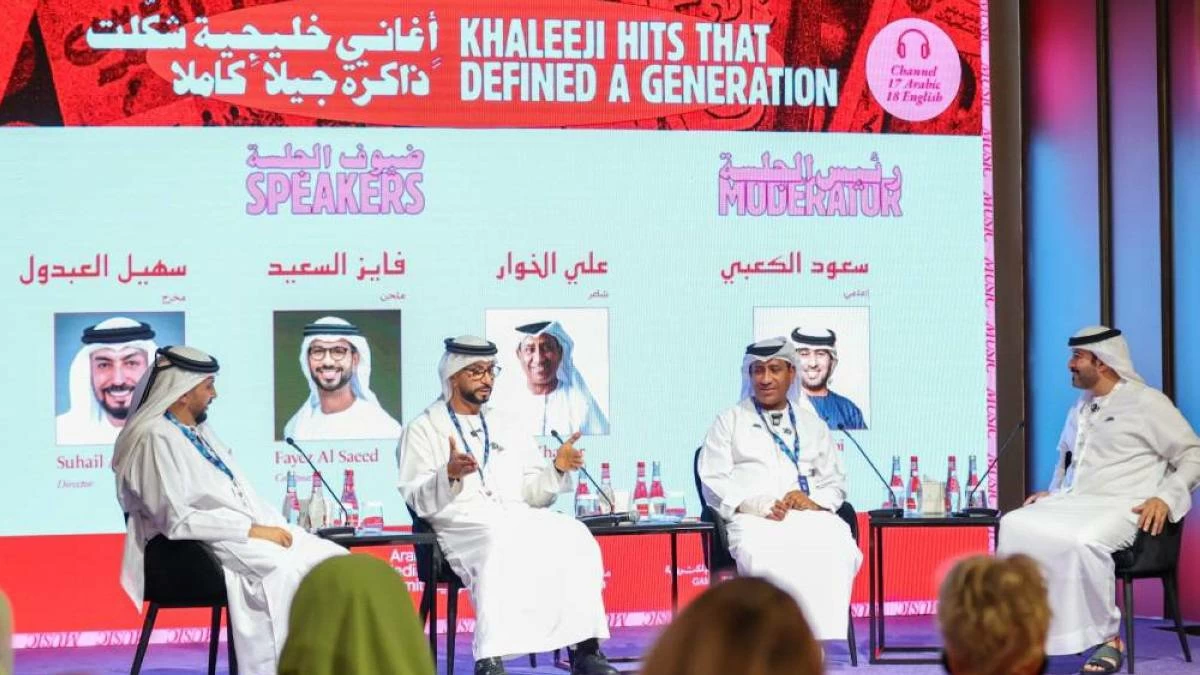
Today's songs may reach millions of listeners within hours and quickly climb streaming charts and social media trends. But the true test of a work of art begins long after its release. Years later, just a few notes can bring back a place, a person, or an entire chapter of life. Songs that define a generation's memory do not endure because they achieved high numbers when they were released. They live on because they became part of people's stories and memories.From this contrast between fleeting success and lasting impact emerged the session, "Gulf Songs That Shaped a Generation's Memory," held as part of the Film Forum at the Arab Media Summit 2026. The session featured artist and composer Fayez Al-Saeed, poet Ali Al-Khawar, director Suhail Al-Abdul, and was moderated by media personality Saud Al-Kaabi. The discussion revisited a rich artistic era and explored the enduring questions behind the creation of memorable songs.The session was not simply a nostalgic look back at songs of the past. Rather, it examined the elements that give a work lasting value. The discussion brought together the perspectives of lyricist Ali Al-Khawar, composer Fayez Al-Saeed and director Suhail Al-Abdul. Together, they highlighted that a successful song is not the product of a single element. Instead, it is an integrated artistic work that begins with the lyrics and extends all the way to the visual presentation.The discussion emphasised that the strength of a song's lyrics lies not in complex wording, but in their ability to connect with people and express emotions honestly. This is how Gulf songs have managed to preserve their local dialect and cultural character while resonating with a broader Arab audience. Human emotions have remained capable of transcending differences in dialect. Melody then gives the lyrics their own spirit. In some cases, only a few seconds of a musical introduction are enough to transport listeners back to a specific period in their lives. As a result, many melodies have become an identity of their own, with memories attached to them even before the lyrics begin.As for the visual element, participants noted that during the heyday of music videos, the image became a natural extension of the song. Some songs became inseparable from a particular scene, story or location in the minds of audiences. The session stressed that a director's role goes beyond providing a visual backdrop. Instead, the director translates the song's emotions into a story that remains in viewers' memories just as strongly as the music itself.The session revealed that a number of highly successful works were not universally embraced at the outset. Many faced hesitation and disagreement within their creative teams before one of their creators ultimately believed in their potential. The artist's performance also emerged as a decisive factor that can determine a song's fate. The same lyrics and melody can have a completely different impact depending on the performer. Success is not always about vocal ability alone. It also depends on the artist's capacity to convey emotion and make listeners believe every word.The spirit of teamwork was highlighted as one of the defining features of that era. Studios brought together poets, composers, singers and arrangers in a shared creative space that functioned as an open artistic workshop. Lyrics evolved through discussion, melodies developed through experimentation, and ideas were often born from spontaneous encounters rather than planned meetings.The discussion also revisited the contrast between that period and today's era of the home studio. Modern technology has given artists greater speed and flexibility, allowing them to exchange work across long distances. However, participants noted that it has also reduced the face-to-face interactions that once generated many of the details and creative ideas behind enduring works.Participants also reflected on the experience of "Gulf Stars" and the artistic movement surrounding it. They said the period witnessed strong collaboration between poets, composers and performers, helping to strengthen the presence of Emirati and Gulf music while introducing new talents and creative voices.In assessing the current landscape, participants stressed that the decline in the volume of Emirati music production compared with earlier periods does not indicate a lack of talent. Rather, it reflects changes in the environment that once brought creatives together and fostered ongoing competition and collaboration. This, they argued, underlines the importance of reviving the spirit of the artistic workshop while making use of modern tools and technologies.The session also explored the impact of artificial intelligence on the future of music, visual production and content creation. While participants agreed that new technologies can save time and expand creative possibilities, they said an important question remains: whether these tools can truly recreate the emotion and human connection that have allowed classic songs to endure for decades.