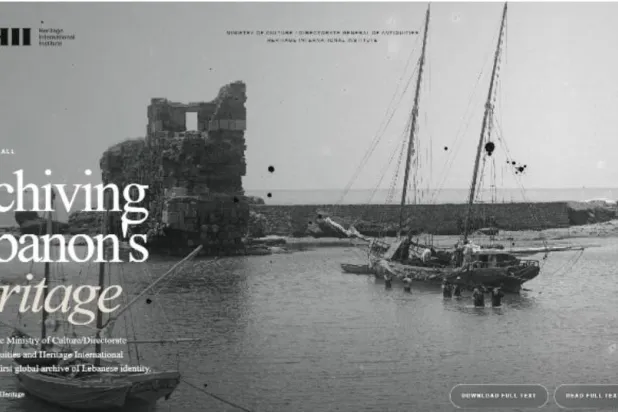
Family photographs, home videos, letters, interviews and old songs are finding a new home in a digital archive created by Lebanon’s Culture Ministry to preserve personal memories as part of the country’s collective history. Presented at the National Library, the “Archiving Lebanon’s Heritage” platform aims to build a global digital archive of Lebanon’s tangible and intangible heritage, including its natural and personal heritage, for future generations. Developed by the ministry in partnership with the Heritage International Institute (HII) and other international organizations, the platform invites contributions from Lebanese at home and abroad, as well as anyone with accounts or records of the country’s past. The initiative was unveiled in the presence of Culture Minister Ghassan Salame, Italian Ambassador Fabrizio Marcelli, HII President Sergio Iovino and Lebanon’s Director General of Antiquities Sarkis Khoury. Salame with Italian Ambassador Fabrizio Marcelliat the launch ceremony. (Ministry of Culture) Treasures hidden in Lebanese homes Speaking to Asharq Al-Awsat, Salame explained that the latest war had damaged archaeological sites, historic markets and Lebanon’s tangible and intangible cultural heritage. “I cannot put a precise figure on these losses. They certainly exceed millions of dollars, and restoring what was damaged could take an entire generation,” he noted. The minister stressed that the war had affected all Lebanese in one way or another, describing its impact as “the theft of our intimate history, a history that is priceless.” He stressed the importance of preserving existing heritage through modern technologies that can extend the lifespan of photographs, documents and other historical records. Salame pointed out that private collections may contain materials more significant than those held by some public institutions. While preparing the exhibition “Between the Lines of the Constitution” to mark the centenary of Lebanon’s Constitution, organizers discovered valuable documents preserved by families because a relative had held a particular position or worked in a field connected to them. “These are treasures hidden in homes and within families,” Salame observed, stressing that the scale of these private collections should not be underestimated. The platform accepts digital copies rather than originals. Contributors wishing to donate original documents can deposit them with the National Library for safekeeping. A written agreement protects contributors’ intellectual property rights, which remain exclusively theirs. They may also withdraw their materials from the platform at any time. Lebanese Culture Minister Ghassan Salame delivers remarks at the event. (Ministry of Culture) Contributors control access Donors can decide how widely their submissions are shared, from keeping them in a completely private, protected archive to authorizing their publication. Iovino described the initiative as providing the foundations for a “digital fortress” open to millions of Lebanese expatriates, as well as friends of Lebanon and people around the world. Contributors, he stressed, retain full ownership of their memories and control over their accessibility. Khoury urged Lebanese not to be discouraged by the heritage lost to war. “Our story does not end with these losses or with the damage to our tangible and intangible heritage,” he told Asharq Al-Awsat. “We are the ones who create our heritage, as we have throughout history. Our memories help save what remains.” Italy pledges continued support Marcelli reaffirmed Italy’s commitment to preserving Lebanon’s cultural heritage, citing its involvement in restoring the Beirut National Museum and other museums damaged by the port explosion. He also highlighted recent restoration work at the historic Mar Mikhael railway station, carried out in cooperation with UNESCO and the UN refugee agency. Although these projects differ, they share a common goal: preserving historical evidence and making it accessible to the public. The new initiative, however, shifts the focus from monuments and institutions to the lives of individuals, families and communities. Marcelli underscored the value of microhistory, which examines everyday experiences rather than focusing exclusively on major political events, wars, institutions and prominent figures. The basic idea is that studying a seemingly marginal event, an ordinary person or a small community can reveal important insights into how an entire society functions, he said.