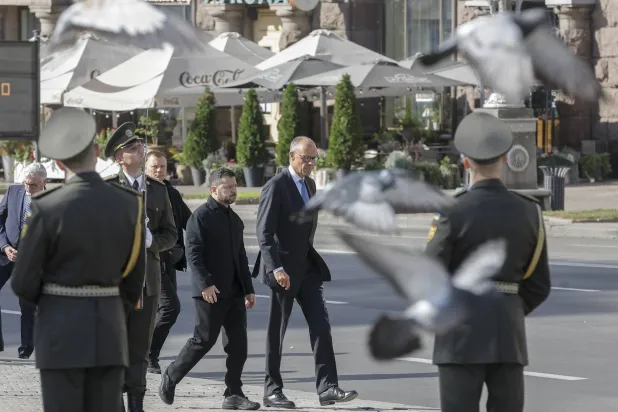
Ukraine and Germany have signed a $1.5 billion arms deal to help counter a surge in Russian drone attacks, as a solidarity visit by German Chancellor Friedrich Merz on Sunday coincided with fresh strikes and air-raid sirens in Kyiv. The aid for weapons includes combat drones and supporting Ukraine's battered energy sector, which Russia is targeting to cut off heating and power during the freezing winter months, Ukrainian President Volodymyr Zelensky wrote on his X account. The new package was announced after Merz arrived in Kyiv on Sunday, where he reaffirmed European support for Ukraine. Air raid sirens blared across the Ukrainian capital throughout the morning, as Kyiv's mayor announced one of the city's bridges had been hit by a Russian drone. Speaking alongside Ukrainian President at the badly damaged building of Ukraine's Academy of Sciences, where at least two people died in a drone strike last week, Merz said, “We are ready to discuss bringing this war to an end, but these barbaric attacks on the civilian population of Ukraine must stop. I can only repeat once again: Mr Putin, put an end to this senseless war.” Russia Attacks Bridge in Kyiv One of the Russian strikes on Sunday hit the Northern Bridge across the Dnipro River, damaging its roadway, Kyiv Mayor Vitali Klitschko said on Telegram. The explosion injured two people and damaged a hot water supply system in the area, he said. Klitschko has said the capital – largely spared from the devastation wrought near the front line in more than four years of conflict – should now be on a war footing. Round-the-clock attacks have hit residential areas, petrol stations, schools, rail and communications infrastructure, while the near-constant air raid sirens disrupt daily life and put people on edge. Zelensky said US peace envoy Steve Witkoff has messaged him to urge a return to trilateral talks as soon as possible. He said Ukraine was willing to meet this month and hoped Russia would join, but he said Western allies needed to apply more pressure to Moscow to bring the war to an end. Upon arrival, Merz said Germany remained Ukraine's strongest backer. “We do this not only to protect Ukraine's territorial integrity; we do it deeply in our own interest, for it is a matter of Europe's security,” he said, noting that Russia was carrying out cyberattacks and disinformation campaigns that struck at Europe's democratic order. “If Russia is not stopped, it will turn its war machine against us sooner or later,” Merz added. Joint Drone Production The latest deal provides for the joint production of anti-jet drones, Merz told a joint news conference with Zelensky. “Significant technical breakthroughs have already been achieved in this area in recent weeks,” he added. “Production is now being ramped up. This strengthens Ukrainian air defense quickly and significantly. We are supplying standoff weapons, combat drones and satellite technology so that Ukraine can also target Russian launch sites,” the German chancellor said. Last week, Merz called for NATO and European unity against Russia, as well as in his own country, where the far-right, Moscow-friendly AfD opposition is on the rise. Russia’s Ministry of Defense said Sunday it would intensify its strikes against military-industrial facilities and related infrastructure in Kyiv and other regions of Ukraine, in response to Zelensky’s comments in an interview with Reuters published Saturday that Ukraine would escalate its attacks on Russian oil refineries. Also, Russia warned foreigners and diplomats to leave Kyiv, saying “massive” new airstrikes would hit the city. Leaders from countries allied to Ukraine have continued to make visits despite a similar threat made in May. “The EU Delegation is staying,” European Union ambassador Katarina Mathernova wrote on X on Sunday. “Threatening us will not stop Europe's support for Ukraine,” she added. “It only reminds us why that support matters!” Merz told reporters he was unfazed by the threat but did not know if it had been made to coincide with his visit. In Kyiv, home to some three million people, residents are mulling what to do if that happens again, and there have been calls for the vulnerable and disabled to consider leaving. Merz said Berlin's winter support program will help provide generators, transformer stations and for grid repairs.