Tens of thousands of young people and workers filled Europe’s streets on Friday in an organized international youth-led day of action across more than 25 nations.
Student groups in the UK, France, Spain, Italy and beyond walked out over the sky-rocketing cost of living, rising tuition fees, underfunded education systems and what they cast as leaders’ complicity in Israel’s war in Gaza. In Italy, trade unions also joined the protests and called on their members to observe a nationwide strike.
Other grievances that have prompted Gen-Z-led protests this fall include high unemployment, the climate crisis and fears governments are failing to future-proof against unregulated artificial intelligence.
Where are the protests taking place?
Young demonstrators mobilized in central squares and capitals spanning the continent. In Italy, the country’s largest trade union CGIL said protesters demonstrated in over 100 squares, including Milan’s Piazza del Duomo.
A strike by transport workers is also expected to disrupt train lines in Italy on Friday and Saturday.
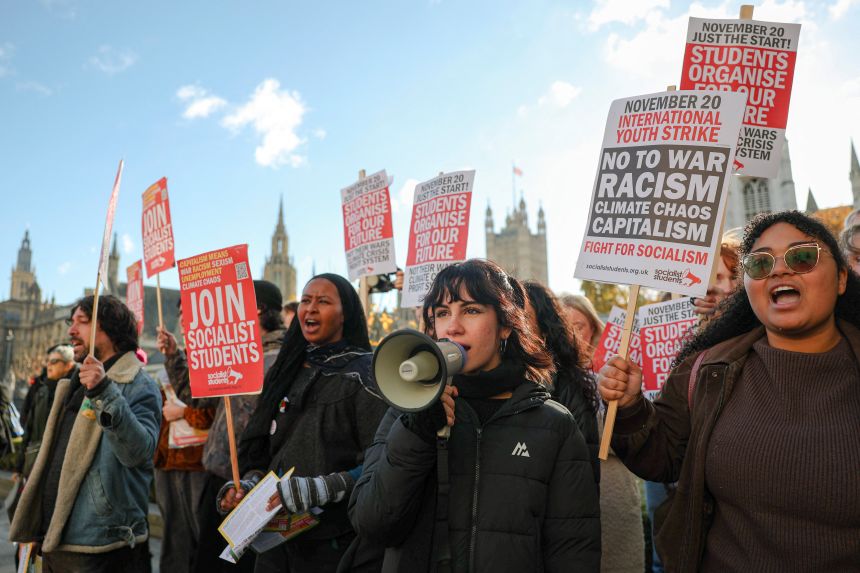
Elsewhere, multiple student groups marched toward London’s Parliament Square at the heart of the British capital.
Demonstrators gather in Parliament Square as they participate in an International Youth Strike protest in London, on Friday.
Isabel Infantes/Reuters
Students also participated in rallies in Germany’s western city of Cologne and in cities across Italy. In Rome, Genoa, Bologna and Milan, protesters called for an end to rearmament and more investment in public services. In Britain alone, students from more than 350 schools, colleges and universities were expected to walk out, according to Socialist Students, one of the groups taking part.
The head of CGIL, Maurizio Landini, claimed more than 1 million people participated in the protests there, though this figure could not be confirmed.
“Today is also a very important day because young people are taking to the streets not just in Italy but across Europe,” said Landini, according to Reuters. “The demand for change is growing,” he added.
Ahead of the planned demonstration in Parliament Square, London’s Metropolitan Police said it had been “liaising with organizers.”
“We remain committed to people’s lawful right to protest and free speech, but if behavior crosses the line into criminality we will take decisive action to uphold the law,” a police spokesperson said in a statement.
What are the main concerns?
Over the past year, Gen Z anti-government protests have touched parts of Europe, the Global South and the Americas. Their demands have often evolved as the movements have gathered momentum, and differ slightly from country to country.
A generation whose adolescence has been marked by the Covid-19 pandemic, climate change and wars in Ukraine, Gaza, Sudan and Iran now fears world leaders are risking their futures by curbing funding for public services in favor of increased military spending. On Friday, protesters in Germany, Italy and Britain voiced concerns over conscription, rising military spending and underfunded public services.
Students march in downtown Rome on Friday.
Alessandra Tarantino/AP
“Young people will not sit quietly while our schools, colleges and universities are cut and billions are found for war,” the national chair of Socialist Students, Adam Powell-Davies, said in a statement. “Fight for our future, not their wars.”
In Italy’s capital, Rome, protesters chanted and held up an array of slogans including “Money for schools, not war,” and “We want to live life without the high cost of living.”
Another lead campaigner, Giorgio Airaudo of Italy’s CGIL union, described the international day of action as a “beautiful day when students, workers and retirees came together to say no to war and rearmament.”
Britain’s Stop the War Coalition, an anti-war advocacy group, echoed calls for higher wages and greater health care spending, condemning what they saw as lawmakers’ “mass rearmament” drive and “complicity with Israel’s genocide.”
The post Gen Z are protesting across 25 European countries – why? appeared first on Egypt Independent.