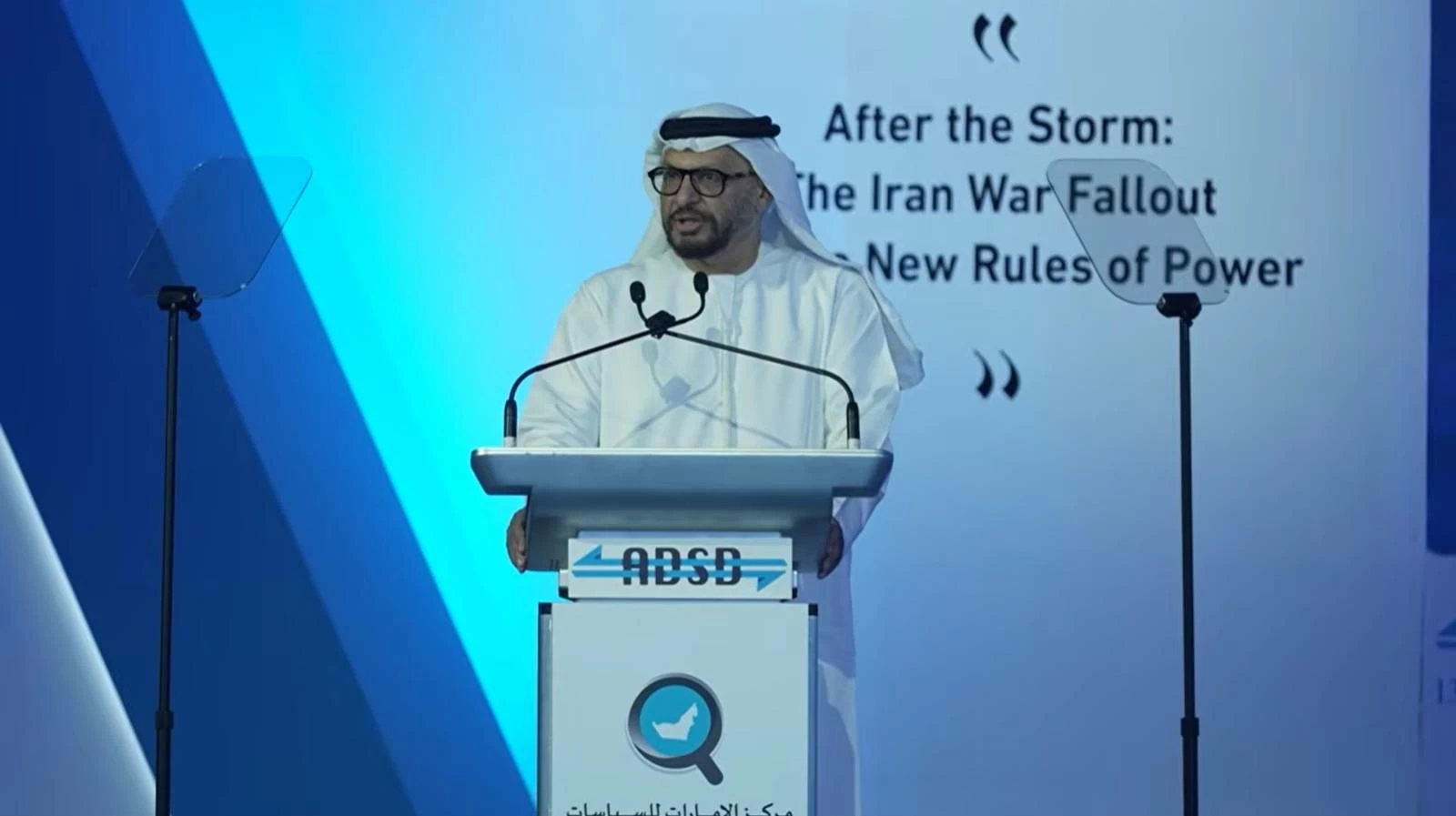
Abu Dhabi: His Excellency Dr Anwar bin Mohammed Gargash, Diplomatic Advisor to His Highness the President of the UAE, confirmed that trust with Iran has been damaged and cannot be restored through statements alone, but rather through behaviour.
In a speech during the 13th Abu Dhabi Strategic Debate, organised by the Emirates Policy Centre in Abu Dhabi, he stressed that freedom of navigation should not become a tool for economic manipulation, and that these waterways should be respected and their management should not depend on what some parties do and not others.
He pointed out that "we emerged stronger from the war crisis, and we will continue to defend our security, our partnerships, and our pursuit of security and stability," noting the proactive strategic vision of the UAE and the defence establishment that enabled the country to build an integrated defence system that impressed both friend and foe.
He stated that the war represented a test of our defensive capabilities and resilience, and that the performance of our military forces was honourable, demonstrating great professionalism and expertise in defending our land and people.
Dr. Gargash pointed out that the deeper lesson we learned is that our national security lies in our ability to defend ourselves, and the UAE showed that it was not the weakest link in the region’s security equation, noting that one of the most important direct lessons of the recent war is that we do not face a choice between diplomacy and deterrence, but rather both together.
He said that Iran, through its attacks, has caused a crisis of confidence and undermined any stable and consistent relations with its neighbours, adding that this war and the continuation of this crisis represent the biggest test the UAE has faced since its founding in 1971, and are among the biggest challenges the Gulf region has faced, with repercussions that go beyond military considerations.
He considered this war to be a test not only of our defensive capabilities, but also of our ability to persevere and recover quickly, stressing that the UAE faced what happened with strength and had learned valuable lessons.
He noted that the war, of course, had a cost, such as economic disruption, security pressures, and wide-ranging consequences that demanded attention and concern.
We should not underestimate what happened, nor allow it to affect the overall image. The UAE has shown that it has institutional strength and a sustainable strategy.
He added that President His Highness Sheikh Mohamed bin Zayed Al Nahyan led the stage with wisdom, clarity and firmness, and was able to guide the country during exceptional circumstances in a way that strengthened the UAE’s position and consolidated international confidence in it, noting the outstanding performance of the armed forces and air defence systems, which embodied the fruit of decades of investment in national competencies, advanced technology and strategic partnerships.
He stated that one of the most important lessons that emerged from the crisis is that protecting national sovereignty is a responsibility that falls first and foremost on the state and its own ability to defend its interests and security, with the importance of strengthening it with reliable partnerships.
He noted that "the UAE should continue to call for a diplomatic solution, and will be able to contribute to this regional balance in the region," adding that "it is too early to assess the impact of the midterm elections in Washington regarding its relationship to managing this conflict, but we hope that it will be supportive of diplomatic solutions that can guarantee lasting peace and stability in the region."