The decades-long Cold War ended with the collapse of the Soviet Union in late 1991, bringing an end to bipolarity and establishing the United States as the world's leading power. Following its victory over the communist bloc and the latter's collapse at home, another Cold War confrontation began to emerge with a system whose doctrine is rooted in the ideas of Mao Zedong, the founder of the People's Republic of China.
This was an issue that former US National Security Advisor Zbigniew Brzezinski had warned about in his 1997 book, The Grand Chessboard. In it, he pointed out that the threat posed by China's rise extended beyond its economic power to the possibility of it becoming a dominant force across the Eurasian continent, potentially leading an anti-US alliance.
Less than five years after the book's publication, the Shanghai Cooperation Organization was established in 2001 to strengthen security, political, and economic cooperation across Eurasia, particularly Central Asia, while limiting direct external intervention in the region.
A few years later, in 2006, consultations began that paved the way for the establishment of the BRICS group, aimed at promoting cooperation among emerging economies and reducing dependence on Western frameworks.
In 2013, Chinese President Xi Jinping launched his country's ambitious Belt and Road Initiative, aimed at connecting China with the rest of the world by reviving the historic Silk Road and building an extensive network of ports worldwide.
Economic plans have gone hand in hand with political discourse in Beijing, Moscow, and their allied countries, calling for the establishment of a new world order based on multipolarity and an end to US unilateralism.
Ahead of the trilateral summit with US President Donald Trump and Russian President Vladimir Putin, Xi reiterated, in a speech delivered during the APEC summit, his call for the creation of a "multipolar world characterized by equality and order" and for "inclusive economic globalization."
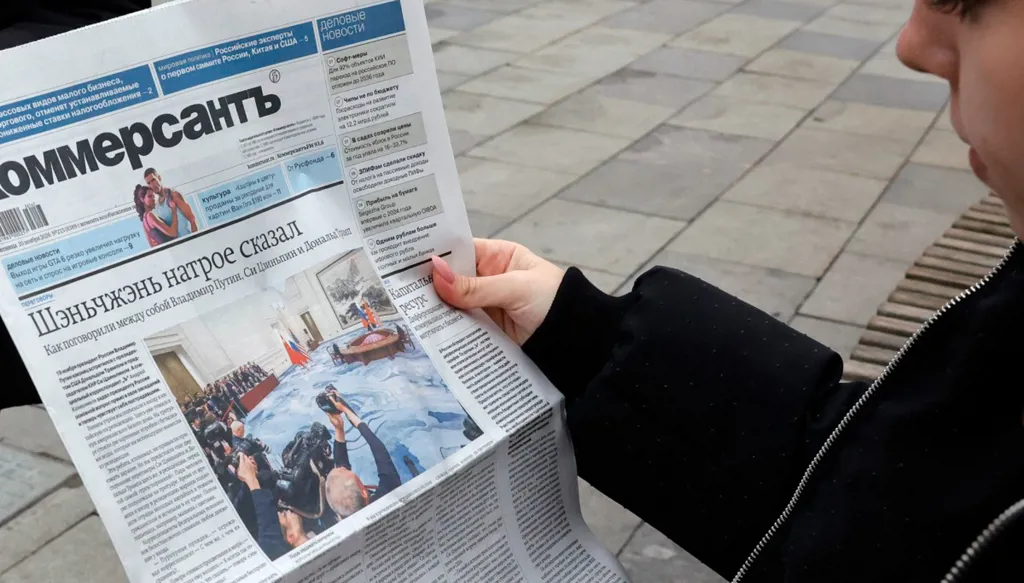
At the trilateral summit in Shenzhen, he said: "The seeds planted during the meeting of the three countries will root, grow, blossom, and bear fruit."
The image of the three leaders seated around a round table on Chinese soil was enough to suggest that the world had entered a new historical phase, regardless of the practical resolutions reached during the summit.
Geopolitical analyst Professor Hai Sing Tso, president of the "Guiguzi" Institute for Strategic Learning in Hong Kong, believes that the world order has already entered a phase of multipolarity since the collapse of the Soviet Union and the end of the Cold War. This, he argues, marked the end of the "ideological struggle between communism and democracy," with international relations no longer driven entirely by ideology, "but rather putting national interests first."
Speaking to "Annahar," he adds that "pragmatism has replaced principles, and this is the essence of multipolarity." He considers that US President Donald Trump is "accelerating this shift by resorting to what is known as the new Monroe Doctrine."
He also notes that this doctrine represents "a grand strategy and a geopolitical vision, and we must watch how it is practically applied on the ground, as Trump's policies sometimes do not fully align with this doctrine." He cites the war on Iran as an example, noting that the American president "is sometimes influenced by Israeli pressures, as well as challenges he faces from the Democratic Party that may also affect his orientations and policies."
Although competing interests and differing ideological visions separated Moscow and Beijing during the Soviet era, their shared interest in breaking US unilateralism has brought them closer as allies.
Russian Ambassador Andrey Baklanov, deputy president of the Russian Diplomats Association and a professor at the National Research University Higher School of Economics, sees the trilateral summit as a reflection of a new geopolitical reality, represented by "the emergence of a troika format composed of major global powers."
Speaking to "Annahar," he explains that the summit primarily aims to determine the extent of "harmony and agreement" among the leaders of the three countries when discussing complex issues, while sending a clear message to the entire world that "Moscow, Beijing, and Washington consider themselves indisputable leading powers and will have the decisive word in determining the planet's destiny."
He emphasizes, in this context, that it is not possible to speak of "institutionalizing this format, as happened after World War II." He adds that it is quite clear that, "in a multipolar and multicentric world," there are three centers of power: Russia, the United States, and China. This, he says, serves as "a warning lesson for Europe and Japan," which have found themselves outside this "exclusive club of elite countries in the world."
The views expressed by Russia's and China's allies on the Shenzhen summit and its implications are not so different from those of some researchers in the United States. Veteran Washington columnist Peter Roff states: "We live in a multipolar world, and this reality began with the fall of the Berlin Wall in 1989, and some believe that this multiplicity existed even before that."
Speaking to "Annahar," he expresses his belief that the end of the Cold War "unleashed many ethnic tensions, nationalistic trends, and the desire to redraw geographical and cultural boundaries." These, he believes, "remained suppressed during the period when most of the world was forced to choose one side in the conflict, between socialist repression on one hand, and economic and political freedom on the other hand."
He goes further, arguing that for fifty years, "the world system remained in a state of inertia," while the confrontation ended with an American victory. "Now, we all face a new world, with new priorities, to which the existing great powers, as well as rising powers like India, must adapt as changes continue in the global scene."
The US aims to contain China through military alliances and technological and economic constraints while simultaneously pressuring Russia through economic sanctions and diplomatic isolation. These policies aim to maintain American superiority and prevent the formation of a Russian-Chinese axis capable of reshaping the international order, a direction Washington expresses in its national security strategies.
But after the Shenzhen summit, these policies have a different reading. For American writer Roff, "cooperation and containment are not contradictory or mutually exclusive," and it's unsurprising that no "clear and significant statements" came out from the summit, as "it was fundamentally held for media and demonstration purposes, to show the gathering of the world's three great power leaders together," as he put it. The summit aimed to "convey a specific message, and it's up to the rest of us to understand what that message is."
The message was understood similarly in Beijing, as "competition and cooperation run parallel," according to Professor Sing Tso, who describes the Sino-American relations as "ruled by a contradictory equation, they love and hate each other, but at the same time they need each other in various areas, despite differing on other issues."
As a result, "competition and cooperation will continue to go hand in hand, and the US will maintain its policy to contain China." He justifies this by saying that a strong state, especially the US, "needs an enemy to maintain its power," as without one, there is no need for a powerful army and leadership adopting a challenge discourse.
He points to the most prominent point of contention between the two countries: "The United States will not abandon the Taiwan card as a strategic tool used in maneuvering and managing its conflict with China."
Regarding the policy of isolating Russia, after reviewing the history of attempts to isolate the Soviet Union, Russian ambassador Baklanov says: "Those who try to isolate Russia today probably had poor grades in school, they do not know geography, nor do they understand the distribution of resources on Earth." He continues by pointing out that Russia is the largest country in the world in terms of area and can secure all its needs by itself, and that "the fate of many countries depends on its exports," especially oil, gas, and food.
As for attempts to isolate Russia technologically, the Russian diplomat considers them "simply foolish in this area too. Our country possesses the most advanced technologies in the most technologically developed sectors, primarily the space sector and defense industries."
He concludes by returning to the recently held Russia-Africa forum, indicating that "the global majority stands with Russia. And the former colonial powers in Europe need to leave their new colonial mindset behind."