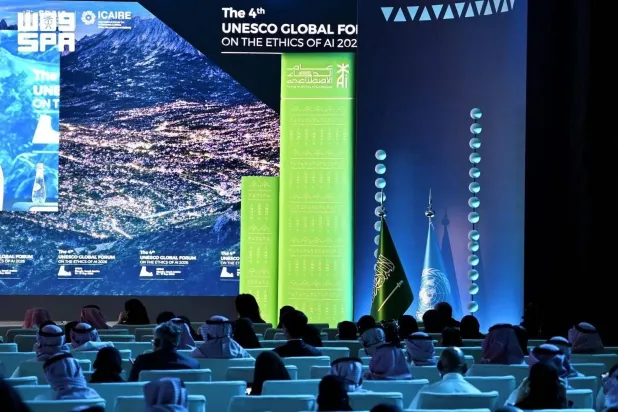
As artificial intelligence (AI) capabilities expand, so do the questions that technology alone cannot answer: Where does human responsibility begin and end? Who bears the consequences of decisions made by algorithms? And how can we balance the pace of innovation with the need to protect people and society? These questions place AI ethics at the heart of the global debate from Riyadh, not as a constraint on innovation, but as a framework that helps guide technological development toward more responsible and secure uses, the Saudi Press Agency said on Thursday. The fourth edition of the UNESCO Global Forum on the Ethics of Artificial Intelligence (GFEAI 2026) is being held in Riyadh (from September 14 to 17, 2026) at a time when the world is witnessing rapid advances in the capabilities and applications of intelligent systems, providing a platform to discuss the principles that can underpin the development and use of these technologies. The forum brings together policymakers and experts to review progress made since the adoption of the UNESCO Recommendation on the Ethics of Artificial Intelligence in 2021, as well as what is needed to translate principles into actionable policies and practices. This discussion is becoming more important as AI enters increasingly sensitive and influential fields. Its use is no longer limited to support tasks; it now shapes analysis, prediction, content creation, and decision-making, raising new questions about fairness, transparency, accountability, and privacy. The challenge is not to halt development or limit innovation, but to strike a balance that lets society benefit from AI’s significant potential while establishing clear principles to ensure its use aligns with responsibility and the public interest. This challenge highlights the growing need for global dialogue on the values and principles that should accompany AI development, particularly as technological applications transcend national borders and the effects of decisions and algorithms can extend across multiple societies simultaneously. Riyadh therefore assumes particular importance, as it hosts an international dialogue that places ethics at the heart of AI's future, giving experts, decision-makers, and academia an opportunity to discuss challenges and opportunities and develop clearer visions for the next phase. The future requires not only more advanced AI, but also rules and principles that ensure such progress is trustworthy and responsible. As countries and companies race to develop AI capabilities, another question is coming to the forefront: Can the world establish rules for the future as fast as technology evolves? From Riyadh, a global dialogue is beginning to seek the answer.