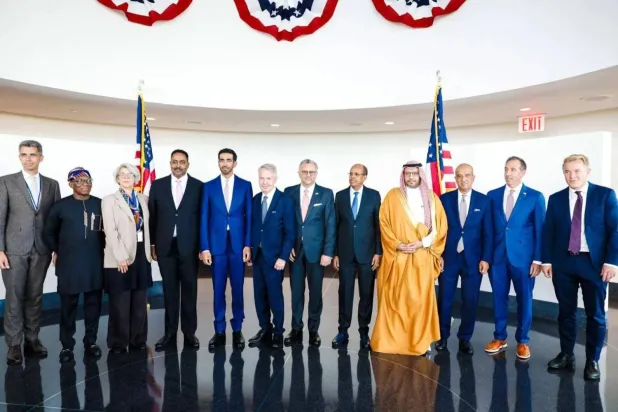
Sudanese doctor "S" needed a truce to get out of a health center where she and her colleagues were trapped in the first days of the war. She took a long route from Nile Street, crossing the Fiteihab and Halfaya bridges, until she reached her family in Kober. She said she found bullet holes in the walls of her bedroom. Her siblings were waiting for her so they could leave together. The family fled and remains displaced today. A brief halt in fighting in May 2023 allowed S to escape, but it did not last long enough for her family to remain in their home. Since that brief truce, initiatives and agreements have followed, while the hardest question has remained: How can mediators bring the two sides to agree to a cessation of fighting that is implemented and sustained? The question returned to the fore on Sept. 23, when the Quad and Quintet met together for the first time in New York, under the co-chairmanship of the African Union and the United States. Participants called for a humanitarian truce and an end to hostilities. They agreed to coordinate efforts to protect civilians and prepare to monitor and verify the implementation of any agreement. But the meeting's statement announced no agreement with the army or the Rapid Support Forces (RSF), and set no date for talks between them. A worker repairs a damaged building in Khartoum on September 20, 2026 (Photo by Ebrahim HAMID / AFP) The sticking point lies in the terms of the truce itself. According to Reuters, the army-led government accepted most of a US proposal for a 90-day truce but rejected a provision that would limit the RSF's withdrawal to specified areas. It demanded that the RSF withdraw from all cities it had seized. Sudan's Foreign Ministry said this week that it rejected any negotiating process it believed would legitimize a reality imposed by the RSF through force. The RSF, meanwhile, welcomed the truce proposal, but the fighting continued. Even when the two sides signed an agreement, it did not guarantee its implementation. In Jeddah, Saudi Arabia, the army and the RSF signed a declaration committing them to protecting civilians on May 11, 2023. On May 20, they signed an agreement on a short ceasefire and humanitarian arrangements. But the ceasefire did not hold. In June, the army suspended its participation in the talks, accusing the RSF of violating the agreement. Other efforts faced different obstacles. In December 2023, the Intergovernmental Authority on Development (IGAD), a regional organization involved in peace efforts in the Horn of Africa, announced that army chief Abdel Fattah al-Burhan and RSF leader Mohamed Hamdan Dagalo, known as Hemedti, had agreed to meet face to face under its auspices. IGAD renewed the invitation in January, but the meeting never took place. In Manama, Bahrain, a document titled "Principles and Foundations for a Comprehensive Solution to the Sudanese Crisis" was initialed on Jan. 20, 2024, in the names of Shams al-Din Kabbashi for the army and Abdel Rahim Dagalo for the RSF, according to the published text. But the initialing was not followed by a final agreement or a sustained negotiating process. Dagalo accused Kabbashi of backing away from the document, while Kabbashi did not comment on the reasons for the process coming to a halt. In August 2024, the absence of one of the warring sides prevented direct ceasefire talks in Switzerland, shifting the focus to facilitating the delivery of aid and protecting civilians. Rosalind Marsden, a researcher at Chatham House, wrote in an analysis published by the institute on Sept. 18, 2024, that the main reason the August 2024 ceasefire talks in Switzerland failed was that both the army and the RSF continued to seek a military victory. Their continued hopes of making military gains were a major reason for the negotiations' failure to make progress, despite limited progress in delivering aid to Darfur. In September 2025, the Quad proposed a roadmap beginning with a three-month humanitarian truce, during which aid would reach areas across Sudan, followed by a permanent ceasefire and a political transition. But the Quad's roadmap remained a proposal by the mediators and did not become an agreement between the warring parties. The dispute over withdrawal in the latest US proposal shows that the two sides have yet to agree on the terms under which a new truce could be tested. Researcher Ahmed Soliman says the multiplicity of mediation groups and weak coordination among them make it necessary to link ceasefire efforts to a Sudanese political process led by civilian forces. Hubert Kinkoh, a researcher at Chatham House, argued in an analysis published by the institute on Feb. 13, 2026, that the multiplicity of mediation tracks on Sudan, along with the absence of clear leadership and effective coordination among them, had allowed the army and the RSF to resist making serious concessions. The New York meeting may help address the fragmentation of mediation efforts. Its real value, however, will become clear if it can bring the warring parties to a clear agreement and establish a mechanism to monitor compliance and address violations. A brief truce allowed S to reach her family, but the family was then forced to leave their home. The truce that displaced people and refugees are waiting for today would allow aid to reach them and mark the beginning of a lasting end to the fighting, making a safe return to their homes and communities possible.