Dubai: Students from various schools presented innovative projects at the National Science, Technology and Innovation Festival, employing technology to address challenges affecting individuals’ lives and community safety, from facilitating Braille learning for the blind and visually impaired and rationalising irrigation water, to monitoring fires, flood warnings, electronic phishing, and protecting museum exhibits.
The solutions varied between portable educational devices, sensors, automated control systems, artificial intelligence applications, and 3D printing, transforming school knowledge into prototypes that could be tested and developed. The value of the projects emerged from their starting point in real-life problems, and the design of solutions that respond to needs.
Reusable water is directed towards irrigation, a change in water level triggers an alarm, suspicious messages call for alerts, while low-cost devices provide wider opportunities for learning Braille.
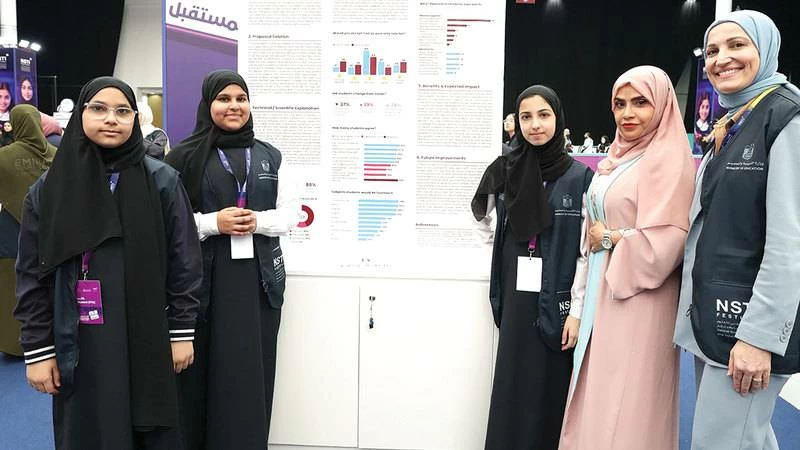
In detail, a team of female students from Al Manar Model School created a research project entitled ‘The Teacher Robot: From Imagination to Reality’, which studied the extent to which students in the UAE accept the idea of a humanoid robot that works with artificial intelligence as a teacher, and the reasons that influence their opinions.
Students Halima Al Naqbi, Amal Abdul Rahman and Farah Fahd said that the project was based on a survey that included 201 male and female students from grades 5 to 12, and monitored the change in their opinions after thinking about aspects of trust and feelings, leading to a vision that combines the ‘human teacher’ and the ‘assistant robot’ in schools.
For her part, the project supervisor, Nadine Al-Hali, said that the study addressed the students’ acceptance of this model, and sought to understand their views on the role of educational robots in the school environment.
In the field of educational accessibility, students Majid Rashid Al Mansouri, Hussein Ahmed Al Hammadi, and Khalifa Nasser Al Muhairi, from Al Nukhba School, invented a low-cost, portable educational device called ‘Tactile Touch’ to help blind and visually impaired students master Braille reading. The interactive tool prioritizes portability and accessibility.
The students said that the project stemmed from the importance of providing tools that help blind and visually impaired individuals acquire reading skills. They emphasised that understanding the learner's needs and ensuring their accessibility were central to the development of the idea. The project places equal educational opportunities at the heart of its design by considering the target audience, their usage conditions, and the device's function.
The team supervisor, teacher Lubna Mufid Abbas, confirmed that the experience develops research, design, and teamwork skills, and reinforces students’ awareness of the role of innovation in facilitating learning and responding to different needs.
A team of students from Al Manar Model School (Cycle 2) – Hamda Saeed, Nour Yasser, and Mira Younis – developed the ‘Smart Container’ project. Picture credit: SuppliedIn the digital environment, students Salama Yaqoub Al-Balushi and Arun Ahmed Muthanna, from the Zayed Educational Complex in Al-Dhaith, presented their project, ‘Cyber Shield Companion’, designed to help users recognise suspicious messages and phishing attempts.
The project utilises artificial intelligence, integrated with an ESP32 chip, to issue visual and vibration alerts when suspicious messages are detected. The concept transforms digital suspicion into a tangible alert, prompting users to pause and verify information before interacting with the message, opening links, or sharing data. The project integrates programming, electronics, and cybersecurity awareness, incorporating user behaviour as a key element of prevention.
In response to water waste, students at Al-Rahib School (Cycle 2, Boys) – Ahmed Abdullah Mohammed Khalifa Al-Fadhli, Ali Salem Awad Abbas Salem, and Hamad Salem Mohammed Saeed Al-Suwaidi – under the supervision of teacher Raed Ahmed Mohammed Al-Faqeer, developed the ‘Smart Sensor for Sustainable Irrigation’ project.
This project links soil moisture measurement to automatic irrigation regulation, providing plants with water according to their needs. The students utilised sensors and automated control to address an observable environmental need both at school and at home. The project relies on utilising water from handwashing and air conditioners, filtering it, and using it to water potted plants, while simultaneously monitoring soil moisture to control the irrigation process. This combines water reuse with efficient management of the amount of water supplied to plants.
In the field of safety, students at the Emirates Science Club: Sanad Marwan Al Marri, Mohammed Saeed Al Khayali, and Rashid Mohammed Al Mansouri, under the supervision of teacher Ashraf Ahmed Mohammed Salim, created a prototype of a hybrid fire tower that works with foam and water, and aims to detect the fire and determine its direction, then direct the firefighting process automatically, by designing a miniature model, assembling it, and operating it using programmed mechanical and electronic components.
The project combines engineering design, electronic circuits, and programming, employing 3D printing to build the prototype components. Its concept is based on integrating monitoring, direction determination, and fire suppression control within a single system.
The concern for safety extends to the ‘AI Flood Guardian’ project developed by students Aisha Salem Al Zaabi and Alia Abdullah Salem Al Zaabi from Applied Technology Schools, under the supervision of Lakshmi Devi VS. The project relies on sensors and smart monitoring to track the rise in water levels and provide early warnings of potential risks of flash floods, aiming to support rapid attention and response and reduce damage.
The two students said that the idea stems from the importance of monitoring changes in water levels early, and converting sensor readings into alerts that draw attention to the potential danger, stressing that time is a key element in dealing with these situations.
A team of students from Al Manar Model School (Cycle 2) – Hamda Saeed, Nour Yasser, and Mira Younis – developed the ‘Smart Container’ project, a system that employs advanced sensors to protect museum exhibits and facilitate visitor interaction. The students explained that the system detects loud noises, camera flashes, and visitors approaching the exhibits. It also uses smart technologies to identify the exhibits and provide immediate, interactive information to visitors, enriching the museum experience and contributing to the preservation of cultural heritage.