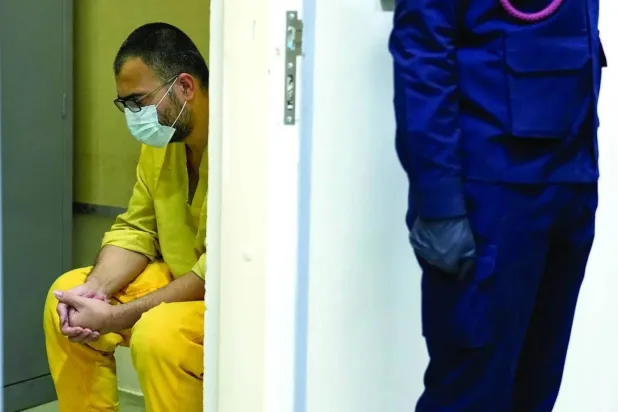
An Iraqi official said the cases of ISIS detainees transferred from Syria to Iraq earlier this year were being handled exclusively by the Counter-Terrorism Service and the Supreme Judicial Council because of the sensitivity of the issue. The official told Asharq Al-Awsat that the cases remained “an Iraqi national security matter,” adding that they went beyond “formal defense requirements.” “Their files are still being reviewed by senior authorities, and it may take some time before they are referred to trial,” the official added. The comments came after a team of French lawyers accused Iraqi authorities of refusing them permits to follow the cases of French clients accused of belonging to ISIS after their transfer from northeastern Syria to Iraq. The lawyers warned that their clients could face death sentences after trials they described as “lacking the minimum standards of justice.” In a statement Thursday, the defense team said several French nationals they represented had been “unlawfully transferred from northeastern Syria to Iraq” and were due to appear before courts in Baghdad in the coming days. The lawyers reported meeting some of the detainees in Iraq and witnessing what they described as inhumane and degrading treatment and violence. They also informed French authorities of torture suffered by the detainees in Iraq and the arbitrary nature of the proceedings. The lawyers said they had been denied access to their clients’ case files and could not speak to them without Iraqi authorities present. They also alleged that court-appointed lawyers assigned to defend the detainees — some of whom had been able to meet them for only 10 minutes — insulted them in front of their guards. ‘They Were Children’ The lawyers noted that some of the detainees were young men who had been children when their parents forcibly took them to Syria and were now adults. They applied over the summer for new permits to travel to Iraq, but Iraqi authorities “rejected our requests at the last minute,” they added. The lawyers recently renewed their request to meet their clients, “but we learned that their trials would be held without us.” According to the defense team, French authorities merely confirmed the information, explaining that Iraq did not recognize the French lawyers’ right to represent the detainees in the country or intervene in local judicial proceedings concerning them. “France knows very precisely the fate awaiting these French nationals,” the lawyers warned, noting that 11 French citizens transferred to Iraq in 2018 “under the same circumstances” were sentenced to death by Baghdad’s Central Criminal Court. They argued that those trials “did not meet the minimum standards of a fair trial guaranteed by Article 6 of the European Convention on Human Rights.” The defense team urged French authorities to “urgently return them to France” to prevent them from facing the death penalty and becoming victims of a “flagrant denial of justice,” noting that the request had been submitted “many months ago.” Al-Hol and Prisons Deputy Minister of Migration and Displacement Karim al-Nouri, meanwhile, told Asharq Al-Awsat that “a distinction must be made between two matters.” The first concerns al-Hol camp in northeastern Syria’s Hasakah region, which he said held “more than 60,000 people from countries around the world, including more than 25,000 Iraqis, most of them children and women.” Al-Nouri distinguished them from detainees in prisons held by the SDF. “The camps were under the SDF (Syrian Democratic Forces) and then came under the control of official Syrian forces,” he explained. Iraqis who returned from prisons were also different from those repatriated from Hasakah and al-Hol after security screening, he added. “A distinction must be made between those who returned to Iraq, most of whom returned to their homes and have had no security violations recorded against them, and those who are currently in prisons,” al-Nouri said, adding that those in prison had different cases that fell outside the remit of the Migration and Displacement Ministry, with responsibility resting with the judiciary. Iraqi Judicial Jurisdiction Legal expert Ali al-Tamimi told Asharq Al-Awsat that Iraq’s refusal to allow French lawyers to represent their clients rested on “two aspects: the Iraqi Law of Lawyers and the law governing criminal jurisdiction,” both of which he said gave Iraq the right to refuse. Under Iraq’s Law of Lawyers No. 173 of 1965, lawyers registered to practice must hold Iraqi citizenship, al-Tamimi explained, noting an exception for Palestinians residing in Iraq as refugees. A foreign lawyer who is not a member of a bar association in an Arab country may only appear alongside an Iraqi lawyer, he added. This requires approval from both the head of the Iraqi Bar Association and the president of the Supreme Judicial Council for a specific case, after confirming that the foreign lawyer continues to practice law. On jurisdiction, al-Tamimi said Iraq considered the detainees to have “committed crimes on its territory.” He cited an Iraqi judicial source as saying they had “all held senior positions in ISIS,” with some involved in planning attacks in the Iraq-Syria region. Al-Tamimi noted that Article 6 of Iraq’s Penal Code applies Iraqi law to crimes committed in the country, while Anti-Terrorism Law No. 13 of 2005 gives Iraqi courts jurisdiction over terrorism cases. He continued that proceedings are governed “exclusively by Iraqi Code of Criminal Procedure No. 23 of 1971, which guarantees the right to a defense, but through an Iraqi-licensed lawyer.” “If the defendant has no lawyer, the court appoints one.” Asked whether international law required Iraq to allow foreign lawyers to represent the defendants, al-Tamimi said the Vienna Convention on Consular Relations gave France the right to consular visits and access, “not the right to impose its lawyers to plead cases.” “National security considerations and the integrity of the proceedings prevent this,” he underlined.