Numerous cities across France awoke on Sunday morning to scenes of destruction, vandalism, and looting following demonstrations on Saturday, October 17, 2026. The protests turned into a “Black Saturday” as violence overshadowed the social and educational demands that hundreds of thousands of French people had taken to the streets to defend. With the country preparing for presidential elections in about six months, a sensitive political question has emerged: who benefits from the chaos that swept through the streets, and can the next president lead France out of its accumulating crises?
In Paris, Marseille, Bordeaux, and other cities, stores were looted and official buildings attacked, from municipalities to police stations and provincial headquarters, while security forces faced violent groups operating on the sidelines of the official marches.
According to the latest figures announced by the authorities, security forces arrested about 1,800 people nationwide, including 855 in the Paris region, while more than 500 police officers, gendarmes, and firefighters were injured. The demonstrations drew 550,000 participants, according to the Ministry of the Interior, compared with 800,000 according to the organizers.
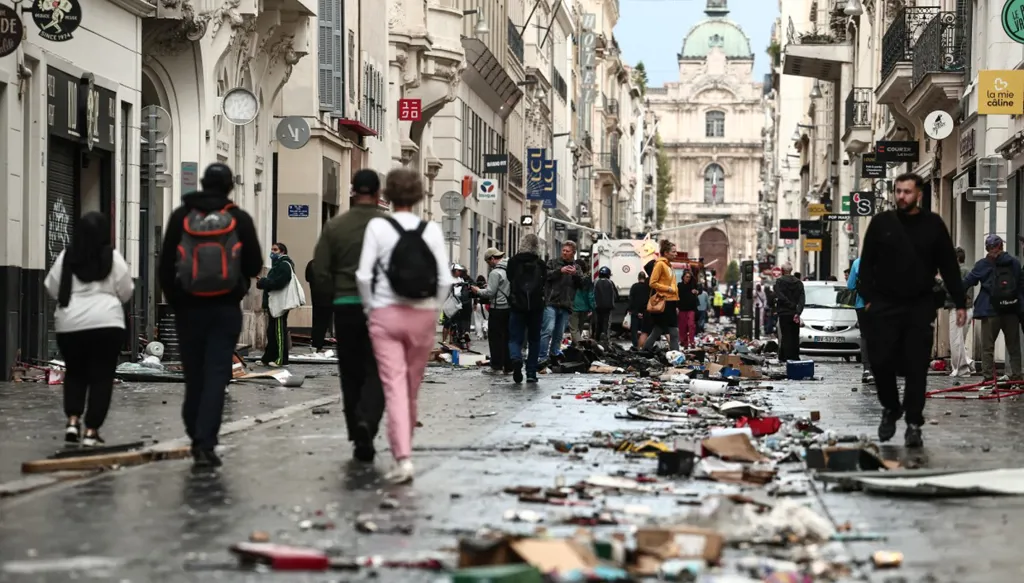
Pedestrians near burning furniture and destruction marks in central Bordeaux, southwest France, on October 18, 2026, following protests against high living costs. (AFP)
Images circulating on social media and news networks were shocking, particularly in Marseille, where masked individuals dressed in black or wearing yellow vests stormed the entrance of the town hall. Amid the crowds, a young man shouted, “Let’s seize Bastille!”, invoking the French Revolution.
In other scenes, riot police were forced to retreat as crowds pelted them with stones, metal barriers, and signs torn from the streets. Tear gas failed to stop the advance of some groups, which attacked police vehicles and forced them to withdraw.
The vandalism spread to other cities, most notably Limoges, where a fire caused severe damage to the historic town hall. Institutions and shops were also attacked in Lyon and Bordeaux.
Notably, confrontations began in some areas before the official marches had started, highlighting the difficulties security forces faced in controlling groups operating outside the organized demonstrations.
In the capital, disturbances affected the areas around the Champs-Élysées, Place de la Concorde, and the Madeleine district, while police reinforced their presence around the presidential palace on Rue du Faubourg Saint-Honoré.
French officials, led by Prime Minister Sébastien Lecornu and Interior Minister Laurent Nuñez, unanimously accused far-left groups of participating in the riots and vandalism. Nuñez said that many marches had taken place peacefully, but extremist groups had exploited the mobilization to attack institutions and shops. He stressed the need to distinguish between students protesting the deterioration of public education and others who had used the demonstrations to spread chaos.
A protester sets ablaze materials near the Canal Saint-Martin in Paris, on October 17, 2026, during protests against high living costs. (AFP)
Jean-Luc Mélenchon, leader of the “France Unbowed” party, has once again found himself at the center of the political debate over his responsibility for inflaming tensions on French streets. For years, he has adopted harsh protest rhetoric against the authorities, repeatedly calling for popular mobilization and rejecting government policies, while positioning himself as a defender of affected social groups and the demands of young people.
His critics, however, argue that this escalation deepens political divisions and creates a climate of confrontation that benefits the most radical groups.
There is no evidence that Mélenchon directed or organized the violence. Instead, the debate centers on his political responsibility for the consequences of the mobilizations he calls for, particularly when protests turn into attacks on public institutions and security forces.
Paradoxically, the continuation of these confrontations could benefit his far-right opponents, who place the restoration of security and order at the center of their electoral rhetoric.
This turmoil comes about six months before the French presidential elections scheduled for spring 2027. It raises the possibility that the escalation accompanying radical left-wing mobilization could produce a counterproductive outcome, pushing concerned voters toward the narrative of the National Rally party, led by Marine Le Pen.
Demonstrations initially launched to demand improvements in education and action against rising living costs could become a factor strengthening political forces that prioritize security, order, and strict immigration policies in their agendas. Nevertheless, this possibility depends on future developments and cannot be considered a decisive electoral outcome.
Jean-Luc Mélenchon among leaders of the 'France Unbowed' party during a demonstration against high living costs in Paris, on October 17, 2026. (AFP)
Opinion polls point to the strength of the National Rally in the electoral landscape, while candidates from Emmanuel Macron’s camp, most notably former prime ministers Édouard Philippe and Gabriel Attal, face challenges in distancing themselves from his administration’s record and convincing the French public that they can offer a new political vision.
Meanwhile, social democrat Raphaël Glucksmann is gaining ground after winning the social democratic left’s primaries on October 11, with 66.17% of the vote against 14.46% for Socialist Party Secretary Olivier Faure.
The victory reflects a trend within part of the left toward moving away from Mélenchon’s political line in search of a moderate socialist alternative that supports Europe. However, low participation in the primaries raises questions about Glucksmann’s ability to expand his electoral base.