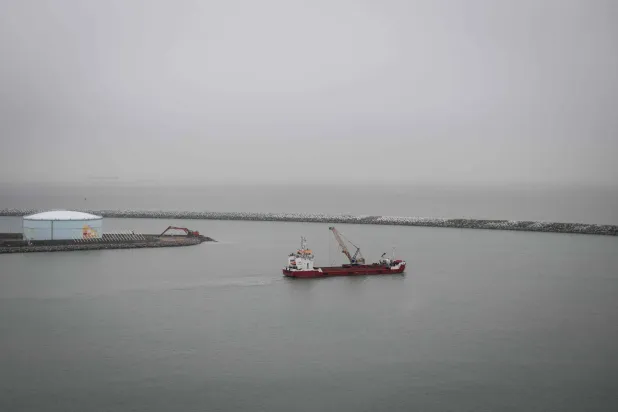
Huguette Germain's seafood restaurant is close to the Normandy D-Day beaches and a short walk to a monument to lost sailors, but Germain and the region's fisherman are increasingly worried about a new battle: disappearing sole. Sole meunière, the emblematic flat fish cooked in lashings of butter, is a staple delicacy of any French fish restaurant worth its salt. But stocks in the eastern Channel separating France and Britain have mysteriously collapsed, sending shock waves through dining rooms and trawler fleets. "It's become very difficult to find, and there's a good chance we'll have to take it off the menu next year," said Germain, who runs La Trinquette in the fishing village of Grandcamp-Maisy. Sole meunière has been a staple at her establishment since the 1980s. "But there is no longer enough to be found in Normandy, so we're bringing it in from Brittany" -- at increasingly prohibitive prices. "Even mackerel is becoming hard to come by," Germain added. "Moving forward, we'll inevitably have to cut back on these types of fish." With the 2027 quotas on sole fishing slashed in a bid to save stocks, many French fishermen in the region fear they will be put out of business. The International Council for the Exploration of the Sea (ICES) -- a senior scientific authority -- has recommended a catch limit of 163 tons in the eastern Channel, stretching from the Belgian border to the Gulf of Saint-Malo. This is 87 percent down on 2025. "It's heartbreaking," said Dimitri Rogoff, president of the Normandy Fisheries Committee. "Sole is what has put food on my table for 30 years. I never thought I'd see this in my lifetime." He called the crisis "a complete failure in resource management." - Over-fished - "It is going to be a catastrophe," predicted Quentin Yonnet, 45, who has a trawler in Port-en-Bessin. "In the spring, the boats will be left tied up at the dock, and some will end up for sale. It's as simple as that." Yonnet said some 150 boats in the Seine Bay on the Normandy coast depend on the sole that is shared with trawlers from Britain and Belgium. Channel sole has long been over-fished. In the early 2000s, the trawlers caught up to 5,000 tons a year in the eastern Channel. Since 2015 "we have seen a continuous reduction in fishing, yet the stock is not recovering," said Raphaël Girardin, a fisheries scientist at France's main sea institute IFREMER. The sole that survive are also getting smaller and the reasons are mainly unknown. "We haven't identified a specific culprit," said Girardin, though he did pinpoint some "environmental factors." In winter, sole spawn hundreds of thousands of eggs offshore. After hatching, the larvae drift for two months. As young sole, they spend the first two years in coastal mudflats that serve as nurseries. Even minor environmental changes can have a radical impact. Over the past two centuries, Seine Bay has lost a third of the intertidal mudflats that were a vital habitat for juvenile sole. Much has been dredged away so bigger vessels can enter the key river Seine. Olivier Le Pape, a researcher in fisheries ecology at L'Institut Agro, said that if the bay was in the same conditions as the 19th century there would already be 20 percent more fish. But Le Pape, who has studied a similar phenomenon in the Bay of Biscay down the coast, said the decline appears to begin as early as the larvae stage though he cannot say why. Plankton may be changing or there may be problems with the timing of the larvae hatching and the plankton blooms. Le Pape said that could be more fallout from global warming.