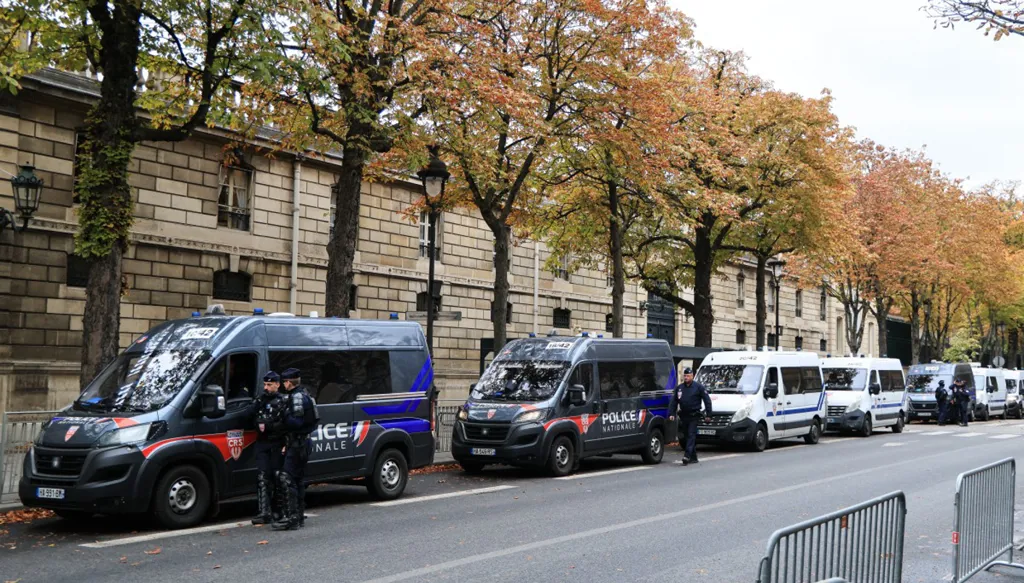
France is bracing for a new wave of protests on Saturday amid fears of renewed rioting and looting following the unrest that swept Paris and other French cities last week. Authorities have announced the deployment of 70,000 police officers and gendarmes to strengthen security and maintain public order.
French Interior Minister Laurent Nuñez warned on Friday that calls for violence and looting were circulating online, vowing to take a firm stance against rioters and anyone engaging in acts of violence.
“We will show no leniency toward rioters, looters or anyone who commits acts of violence,” Nuñez told reporters, stressing that the authorities would remain on high alert to prevent a repeat of the destruction.
The minister explained that security forces would be reinforced with elite units, mounted police and heavy vehicles, alongside helicopters, water cannons, drones and anti-drone systems.
Luxury retailers across France have covered their usually gleaming glass storefronts with protective panels and brought in security guards ahead of fresh protests scheduled for Saturday. Some plan to remain closed after rioters looted stores across the country early last week.
France, the world's most visited tourist destination, attracts large numbers of international shoppers looking for Chanel bags and Hermès scarves, providing an important source of revenue for brands facing slowing demand.
However, some stores have judged that opening their doors would pose too great a risk following last week's events, when rioters smashed into and looted hundreds of shops in Paris, Marseille and Bordeaux.
Employees said a Rolex watch store and a De Beers store near the capital's famous Place Vendôme would remain closed on Saturday. Meanwhile, managers at stores including Richemont-owned IWC said they would decide whether to close early depending on the intensity of the protests.
The heightened security measures come a week after riots hit Paris and several other French cities, amid growing public anger over deteriorating living conditions and the rising cost of living.
The protests initially began with student demands for better education, more teachers and improved educational facilities before expanding to reflect broader social discontent.
Last Saturday's demonstrations escalated into violence, with authorities accusing extremist groups and groups of young people of exploiting protesters' anger to sow chaos. Reports indicated that cars and buildings were set on fire, while thousands of shops were subjected to looting and vandalism.
Nuñez stressed that the violence was “completely unacceptable,” adding that the government would do everything in its power to prevent a recurrence.
In Paris, shop owners have begun reinforcing their storefronts with wooden boards in anticipation of further vandalism or looting. The city authorities have also urged residents and business owners to remove objects that could be set on fire, thrown as projectiles or used to build barricades.
French authorities have authorized a single protest march in Paris on Saturday, organized by the General Confederation of Labour (CGT), along a designated, restricted route through the capital.
Meanwhile, authorities rejected requests from the National Union of Students of France (UNEF), the country's largest student union, and the anti-establishment Yellow Vests movement to organize separate demonstrations. The student union nevertheless vowed to proceed with its protest despite the ban, while Yellow Vests supporters are expected to join the authorized union march.
Authorities have also decided to maintain curfews in certain areas, including restrictions on movement between 11 p.m. and 6 a.m. in two squares in central Paris, according to local police.
In Marseille, France's second-largest city, authorities reversed their decision to ban all protests and allowed a union demonstration to go ahead. In Lyon, the country's third-largest city by population, authorities plan to keep protesters away from the city center.
Alongside the security measures, the government of French President Emmanuel Macron is seeking to distinguish peaceful demonstrations from acts of violence, as political and social tensions over student demands and living conditions continue.
Macron has rejected attempts to blame Islamist extremists and immigrants for the violence. However, he has accused far-left groups of trying to exploit the crisis to trigger political unrest, going so far as to accuse them of seeking to stage a coup.
On Friday, Macron held his first meeting with representatives of secondary school students, but the meeting failed to ease the protests.
Nathanaël Combarieu, head of the “Renewal of Secondary Schools” group and a student representative, said participants were “not satisfied” with the outcome of the meeting, although he noted that the president had listened attentively to their demands.
Combarieu explained that students were still awaiting concrete proposals at their scheduled meeting with the prime minister on Monday. He urged his peers to maintain their mobilization and keep up the pressure on the government.
The demonstrations began with demands for improvements in education and study conditions but broadened to reflect discontent over the rising cost of living and wider social conditions.
As some protests have devolved into violence and looting, the French government faces a dual challenge: safeguarding the right to peaceful protest while preventing vandalism and protecting public and private property.
Saturday's demonstrations will provide another test of the authorities' ability to contain public anger and prevent a repeat of the violence witnessed in the capital and other cities, as students continue to demand clear government commitments and concrete measures to address their grievances.