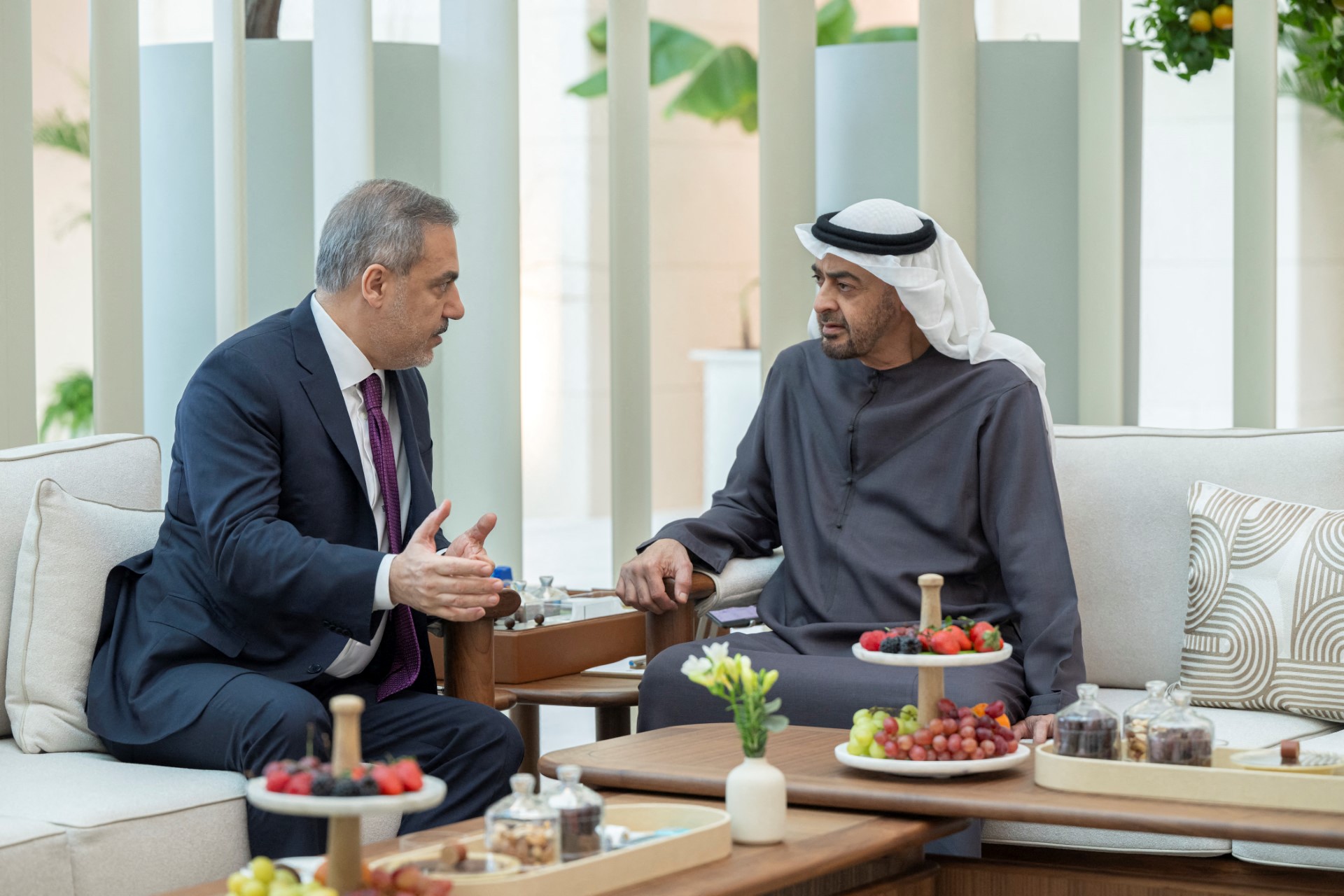
ALBAWABA- Turkish Foreign Minister Hakan Fidan met UAE President Sheikh Mohamed bin Zayed Al Nahyan in Abu Dhabi on Monday, a day after Israeli Prime Minister Benjamin Netanyahu held a meeting with the Emirati President, Sheikh Mohamed bin Zayed.
Fidan’s talks with Sheikh Mohamed focused on strengthening the Türkiye-UAE strategic partnership and regional developments, including efforts to promote security and stability in the Middle East. The two sides also discussed bilateral cooperation and issues of shared interest, according to Emirati state media.
The Turkish foreign minister’s visit came less than 24 hours after Netanyahu made a brief, unannounced trip to Abu Dhabi and met Sheikh Mohamed. The UAE has officially confirmed that Israeli Prime Minister Benjamin Netanyahu met President Sheikh Mohamed bin Zayed Al Nahyan in Abu Dhabi on Sunday. The Emirates News Agency (WAM) reported on Monday that Sheikh Mohamed received Netanyahu during his visit and that the two discussed bilateral relations and ways to strengthen cooperation.
The Netanyahu visit took place amid heightened tensions involving Iran and the wider regional security environment. Reports have indicated that Iran-related security issues were an important element of the discussions, although the details have not been officially disclosed.
HH Sheikh Mohamed bin Zayed Al Nahyan received Hakan Fidan, Minister of Foreign Affairs of the Republic of Türkiye. They discussed areas of cooperation between the two countries and ways to further strengthen bilateral ties in a manner that serves their mutual interests. pic.twitter.com/lc4ZGhVOHR
In a parallel diplomatic move, UAE Vice President and Deputy Prime Minister Sheikh Mansour bin Zayed Al Nahyan is scheduled to travel to Saudi Arabia on Tuesday at the invitation of Saudi Defence Minister Prince Khalid bin Salman. The visit has been described officially as a “fraternal” visit. The timing is significant as Riyadh and Abu Dhabi have faced differences over regional conflicts and competing strategic approaches, particularly in Yemen and Sudan, as well as their broader policies in the Horn of Africa.
The Saudi-UAE have increasingly pursued distinct regional partnerships and priorities. Their differences have been particularly visible in Yemen, where they have supported different local actors, and in Sudan, where their approaches to the conflict have diverged.
The diplomatic activity comes after Saudi Arabia, Türkiye and Pakistan signed the Makkah Joint Defence Agreement on August 7. The pact states that an armed attack against any one of the three countries will be regarded as an attack against all three and calls for expanded defence cooperation and collective deterrence.
The agreement has since moved toward implementation. The three countries have established mechanisms for defence cooperation, while their foreign and defence ministers and military chiefs have held meetings to develop the pact’s military framework.
On September 25, the three countries also announced plans for urgent talks among their military chiefs over ways to support Saudi Arabia amid the escalation with Yemen’s Houthis. Türkiye has separately said it is prepared to help meet Saudi military requirements under the agreement, while emphasizing that the pact is not directed against a particular country.
At the same time, Saudi Foreign Minister Prince Faisal bin Farhan arrived in Washington on Monday for talks with U.S. Secretary of State Marco Rubio. The meeting comes as Saudi Arabia faces escalating attacks by Yemen’s Houthis and seeks to manage the wider regional security crisis.
According to Saudi state media, Faisal and Rubio are discussing bilateral relations and major regional and international developments. Yemen is expected to be a central issue given the intensifying conflict and its impact on Saudi security and Red Sea shipping.
The talks also follow reports that Saudi Crown Prince Mohammed bin Salman sought greater U.S. military assistance against the Houthis. Washington has so far declined to launch direct strikes, while agreeing to provide intelligence and targeting support, according to sources cited by Reuters. The diplomatic moves in Abu Dhabi, Riyadh and Washington illustrate the increasingly complex network of regional partnerships developing around the Yemen conflict and the wider confrontation involving Iran.
Dr. Mansour Al-Maswari is Postdoctoral Fellow at Columbia University-Global Center, Amman. A Yemeni academician with a Ph.D. in English "Comparative Literature" and two MA degrees, one in political science and the other in English, Dr. Al-Maswari possesses more than 17 years of extensive experience in university-level teaching, research, research reviewing, bilingual translation, and copy-writing...
Subscribe to our newsletter for exclusive updates and enhanced content