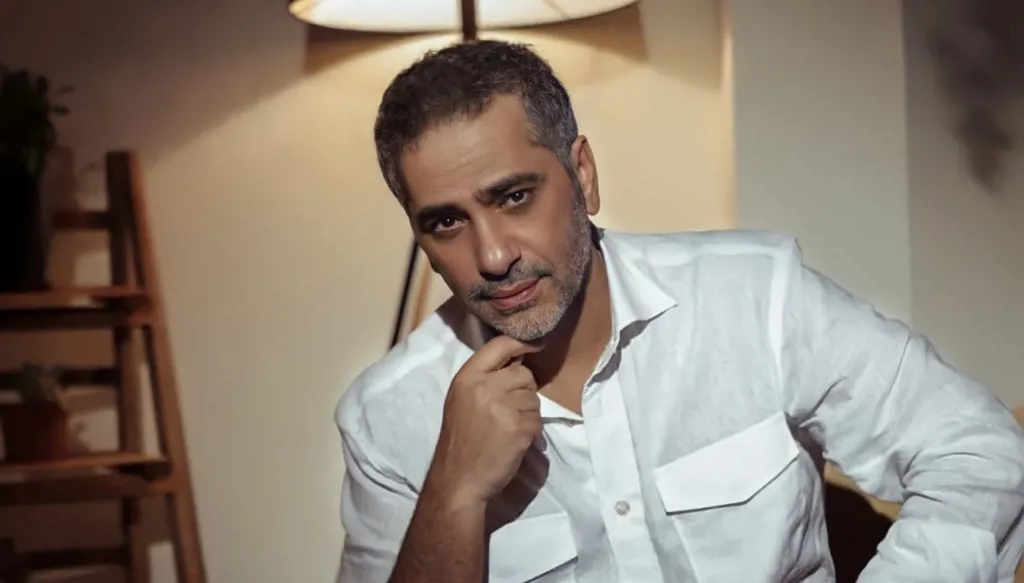
After years in which his voice remained present in songs while he himself disappeared from the stage, Lebanese singer Fadel Chaker is preparing to reunite with his audience in the Saudi capital, Riyadh. His return carries more than one artistic significance and brings to the fore a question worth examining: How has an artist who stepped away from the spotlight, voluntarily retired, and then found himself caught in a maze of political and security crises and legal proceedings managed to keep his voice so strongly present in the daily lives of millions, as though he had never been away for a single day?
A post shared by Benchmark (@benchmarkksa)
Ahead of the highly anticipated concert, a video of Fadel Chaker rehearsing for the event circulated online, featuring his song Ya Ghayeb Leih Ma Tes’al (“Oh, You Who Are Away, Why Don’t You Ask?”). The scene reflects the symbolism of his long-awaited return. The song, closely associated with his name and his fans’ memories, is once again taking center stage as the singer prepares to move from reaching audiences through recordings and screens to performing directly in front of them.
The first secret behind Fadel Chaker’s enduring appeal lies in his exceptional vocal signature, which the Arab music scene has been unable to replace. Over the past 15 years, hundreds of voices have emerged and numerous musical styles have evolved, yet the space for “sincere romance” and warm melancholy has remained unfilled. Chaker was not merely a performer; he embodied an entire emotional experience, with a style closer to personal confession. This “monopoly on emotion” made him difficult for Arab listeners to replace, prompting millions to return to his musical archive whenever nostalgia for an era of pure romantic songs took hold.
At the height of his political crises, Fadel Chaker faced fierce attacks and deep divisions in public opinion. There is no doubt that he was sometimes treated unfairly, just as he was sometimes wronged. Yet a unique phenomenon emerged: a large portion of his audience managed to separate the “artist” from the “person and his stance.”
Songs such as Ya Ghayeb, Ma’oul (“Is It Possible?”), and Law Ala Albi (“If It Were Up to My Heart”) were more than musical compositions. They were the soundtracks to love stories, youthful memories, and moments of nostalgia for an entire generation. Arab listeners refused to abandon their emotional memories associated with these songs, keeping them on the airwaves and at the top of digital streaming charts, beyond the political controversy surrounding their singer.
This is further underscored by the song’s recent return to the Billboard Arabia Hot 100 chart, more than two decades after its release, according to Billboard Arabia. The development highlights the continued circulation of Chaker’s work, even in the absence of concerts that once gave his songs a different kind of life through live performances and audience interaction.
Fadel Chaker did not leave his fans to rely solely on his back catalogue. From within his seclusion, he astutely recognized the importance of not disappearing completely. He began releasing singles from the camp through digital platforms, with limited production resources compared with those available to him in the past. These releases, however, were enough to gauge the audience’s response and maintain a tenuous but unbroken connection with his fans. The songs garnered millions of views shortly after their release, demonstrating that those yearning for his voice were unconcerned with where or under what circumstances the recordings were made. What they sought was the distinctive tone they had missed.
Today, Fadel Chaker’s return to the stage through Saudi Arabia’s entertainment events marks the culmination of this journey. The stage in Riyadh will not welcome a new audience discovering a returning artist. Instead, it will welcome fans who know his songs by heart and have sung along to them throughout his 14-year absence. This comeback does not rely on promoting a newly established star; rather, it draws on a vast reservoir of nostalgia.
That does not mean the audience awaiting his concerts today is the same one that knew him at the beginning of his career. Alongside listeners whose memories are deeply tied to his older songs are others who discovered him through his more recent releases.
Thank you for subscribing to our newsletter