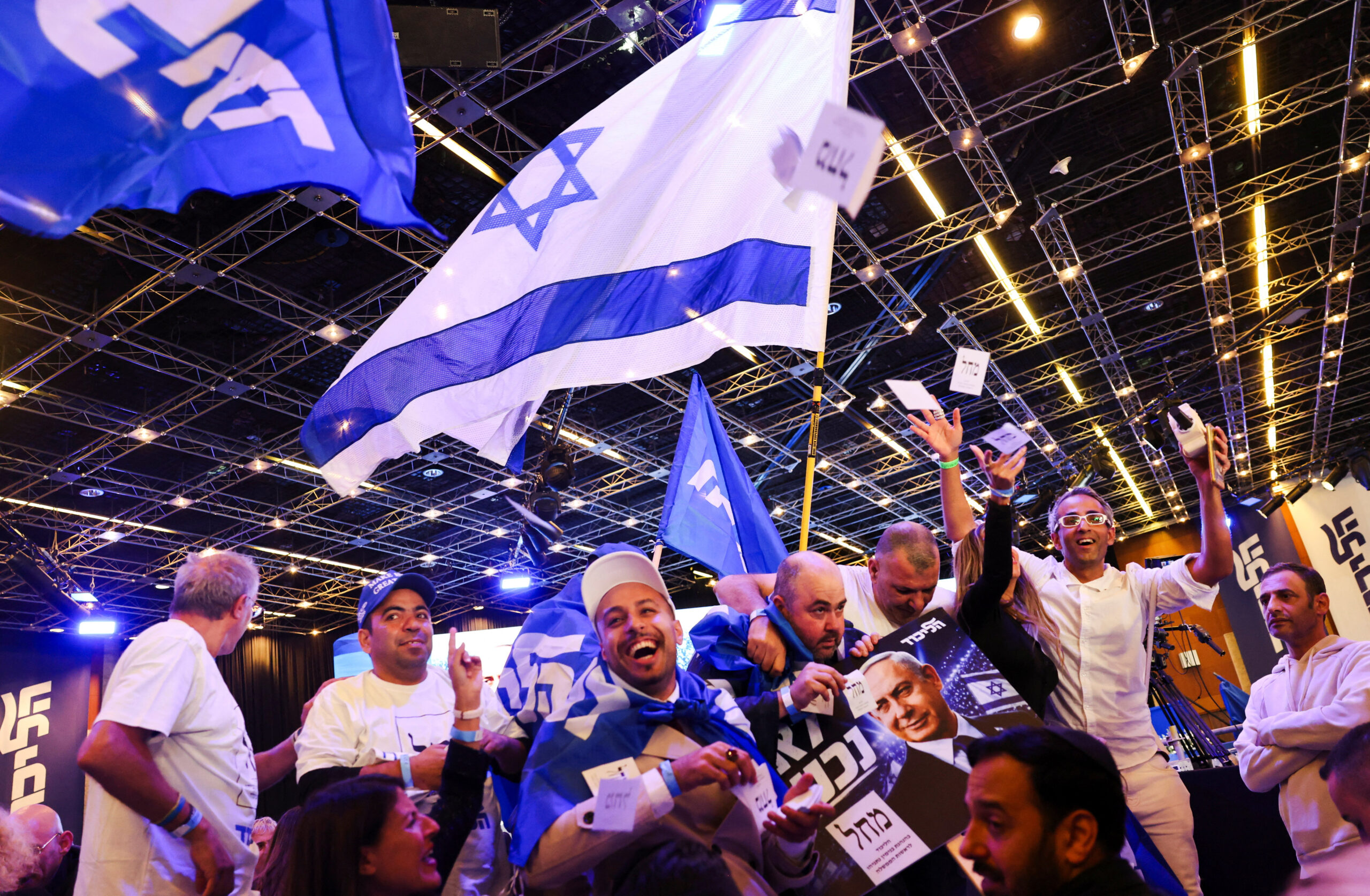
JERUSALEM: Israeli voters delivered a rebuke to Prime Minister Benjamin Netanyahu ‘s far-right and religious governing coalition, but exit polls Wednesday suggested the election had no clear winner and indicated that the long-serving Israeli leader was far from defeated after three years of war ignited on his watch.
The exit polls suggested voters gave opponents of the current government a solid majority in the next parliament. But it’s not clear if those disparate parties — which include Arab-led factions who appear to have made a historic showing — are willing to form a coalition. If they are, it would likely take weeks of haggling.
At an appearance early Wednesday, Netanyahu was upbeat and already trying to position himself to remain prime minister, listing off military achievements of the past three years. He called on his opponents to line up behind him and dismissed the idea of a partnership with Arab parties — whose constituents make up 20 percent of Israel’s population — as treasonous.
“We must establish a strong, right-wing, nationalist government,” said Netanyahu, who was facing off in the vote against his former military chief, centrist Gadi Eisenkot. “We must not endanger Israel and establish a government that relies on anti-Zionist Arab parties.”
While exit polls indicated Netanyahu would face a difficult path to return to office, in his defiant speech he made clear he had no intention of stepping aside. Even if he is unable to form a government, Netanyahu’s inflammatory rhetoric against the Arab parties could complicate any attempt by his opponents to partner with them and sets the stage for a potential new vote where the Israeli leader could make gains.
Eisenkot has left the door open to partnering with Arab parties under certain conditions, but some of his other likely partners have ruled it out.
The close results also suggest that Netanyahu’s opponents were unable to capitalize on the public anger and grief sparked by Hamas’ Oct. 7, 2023 attacks to decisively unseat Netanyahu.
A setback for Netanyahu but not an outright defeat
Israel’s leader, a savvy political operator who has delivered last-minute upsets in previous elections, appeared to have been rebuked by voters disappointed in his alliance with the far-right and angry over draft exemptions for ultra-Orthodox Jews.
The exit polls by major Israeli TV stations suggested Netanyahu’s governing coalition shrunk, jeopardizing his ability to form a government. Although exit polls suggested Netanyahu’s Likud party dropped from 32 seats to around 27, it would remain the largest party and best placed to be asked to form a government.
Like all surveys, exit polls are subject to potential error. Final results are expected in the coming days, including from hundreds of thousands of absentee ballots yet to be counted, and may vary from the exit polls.
The exit polls suggested that Netanyahu’s bloc and Eisenkot’s each won about 51 seats, and Arab parties won about 18. That would set the stage for weeks of political jockeying before a prime minister is declared — or another round of elections is called.
The easiest path to a parliamentary majority would involve Eisenkot partnering with Arab-led parties, but that could prove politically difficult and potentially alienate other opposition factions.
In a sign of the uncertainty ahead, the mood at both Eisenkot and Netanyahu’s headquarters was celebratory. In a speech early Wednesday that focused on national unity, Eisenkot pledged to form a government and promised “a new era — an era of hope” for Israelis.
“Today, Israel went out to a referendum over the leadership that will lead Israel in the coming years,” Eisenkot said to cheers from supporters. “The people decided in favor of change.”
Arab-led parties represent Israel’s Palestinian citizens
Israel’s Arab citizens, the descendants of Palestinians who remained in the state after its creation in 1948, have citizenship and hold senior jobs in many sectors, but face discrimination and are often viewed as a fifth column because of their solidarity with the Palestinian cause.
That suspicion only intensified after Oct. 7.
Netanyahu warned earlier Tuesday that Arab parties could make or break the election, saying they were receiving “truly massive support” and heading to the polls in “unprecedented numbers.”
The mood was joyful at the headquarters of the United Arab List, the lone Arab party to ever join a governing coalition, briefly, in 2021.
“We are here, we are not on the sidelines,” party leader Mansour Abbas told supporters. “Our duty and responsibility in the United Arab List is to turn this voting bloc into a major political force.”
The race was widely seen as a referendum on Netanyahu’s nearly unbroken 17-year rule, which had left Israelis bitterly divided on a host of issues even before the deadliest attack in the country’s history. The resulting wars in Gaza, Lebanon and Iran, along with settler violence in the occupied West Bank, have stoked worldwide outrage, straining ties with Israel’s closest allies and fueling a rise in antisemitism.
Among Israelis, the election was broadly viewed as a struggle over the character of the state, pitting Netanyahu and his ultranationalist and religious allies against those seeking to preserve its liberal and secular foundations. The opposition may soon have to grapple with the social divisions — between right and left, and between Jews and Arabs — that have widened during Netanyahu’s long and polarizing rule.
The process of coalition building will begin
Israel’s president will be tasked with asking the party leader with the best prospect of forming a government, usually one with the most seats, to cobble together a coalition. If Netanyahu’s right-wing Likud emerges as the largest party, he could claim that right.