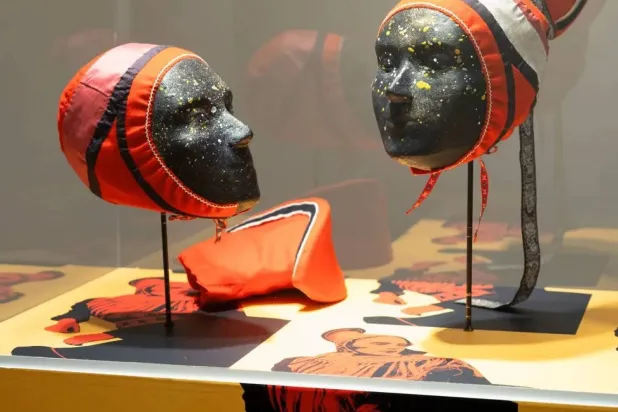
More than a century after they were first documented, the stories of the Sami people return to the spotlight in an art exhibition in Kiruna, northern Sweden. The exhibition revisits the work of artist Johan Turi, who wanted his 1910 book Muitalus samiid birra (An Account of the Sami) to set the record straight about the lives of Europe’s only recognized Indigenous people, according to The Guardian. Turi is widely regarded as the first Sami author to write about Sami life in his own language, but until now his pioneering works had not been on display for almost 100 years. To mark the handover to the Swedish government this week of a long-awaited report by the Truth Commission for the Sami People on abuses committed by the state against the Sami, his writings, drawings, paintings and Duodji (traditional Sami handicraft) now form the center of an exhibition at the Kin Museum of Contemporary Art in Kiruna, the area in which he used to live. The title of the exhibition, On the Ugly and the Beautiful, draws from a quote by Turi, who died in 1936, about his belief that everything, positive and negative, has a place to be shown. The museum’s director, Maria Lind, said an Account of the Sami, which was published in Sami and Danish before being translated into Swedish seven years later, is “about Sami life, small and big – external and inner life.” Turi was born in Guovdageainnu (Kautokeino), the Norwegian part of Sapmi, in 1854 but as the imposition of formal national borders began to have a bigger impact on the lives of the Sami, his family, who were reindeer herders, moved to Kiruna. “He had dreamed about writing a book about the Sami with the purpose of making the population in Sweden understand how difficult it was for the Sami because those were difficult years,” Lind said, citing the arrival of settlers, industry, including mining, and the railway. “He wanted the king to read his book because he felt if the king knew then things would change. Most likely the king did not read his book, but it became a success,” she added. The problems facing Sami people today are not dissimilar to those Turi would recognize. Industry – especially the search for rare earth minerals and wind energy – is an ever-increasing threat to reindeer herding and nature. Anti-Sami rhetoric is on the rise, including from political leaders, despite the seeming progress symbolized by the truth commission and its report, which will be presented on Wednesday. Similar commissions have also been held in Norway and Finland. But unlike in Turi’s time, there is now the escalating impact of the climate crisis, particularly visible in the Arctic and northern regions. As the report, which is intended to form the basis for reparation and reconciliation discussions, is handed over at Mid Sweden University in Staare, the Kin Museum will put on a special tour of the works, after which there will be a reading of testimonies at the culture house next door.