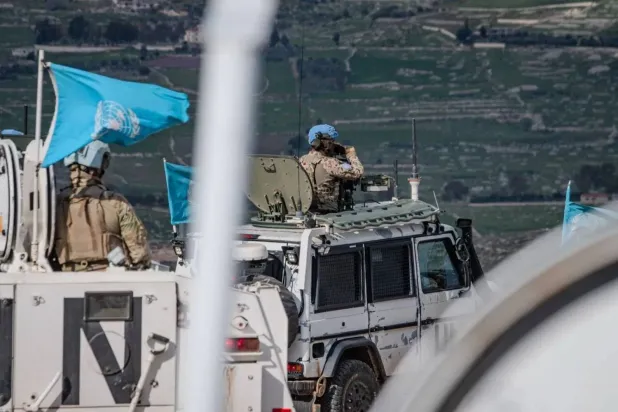
The European Union is continuing to fulfill its commitments to support Lebanon’s military and security institutions after the end of UNIFIL’s mandate by establishing a new mission to provide training and advice to the Lebanese army and Internal Security Forces. The mission will not replace the UN Interim Force in Lebanon (UNIFIL), but will help “strengthen state sovereignty and extend its authority” across Lebanese territory. Speaking in Beirut on Thursday, Kaja Kallas, the EU’s high representative for foreign affairs and security policy and vice president of the European Commission, announced plans for a new EU mission to provide training and advice to the Lebanese army. She said she expects EU foreign ministers on Monday to formally establish the mission, which will make a key contribution to Lebanon’s security. The mission will provide advice and assistance to the Lebanese army and Internal Security Forces to strengthen their authority across Lebanon, secure its borders and bolster internal security. All of this will be in line with UN Security Council Resolution 1701, Kallas said, adding that the mission will not replace UNIFIL and will not focus exclusively on southern Lebanon. UNIFIL’s mandate is nearing its end. European countries are among its leading supporters and troop contributors, notably France, Italy, Spain, Germany and Ireland. As the mandate’s expiration approaches, a proposal to establish a European replacement force with the same responsibilities has faced US and Israeli opposition, stalling the initiative. Lebanese Prime Minister Nawaf Salam (R) meets with Kaja Kallas (L), the European Union's high representative for foreign affairs and security policy, at the Government Palace in Beirut, Lebanon, 08 October 2026. (EPA) Multiple roles Through the new mission, the EU is continuing its commitment to support Lebanon’s armed forces and enable the Lebanese state to fulfill its pledges, particularly maintaining internal stability and implementing its decisions to establish a state monopoly on weapons and extend control across its territory exclusively through its legitimate forces. A Lebanese ministerial source told Asharq Al-Awsat that the mission “is not linked to UNIFIL or any other mission.” “Its role is not military, and it will not take over UNIFIL’s responsibilities. Its role will be logistical and will include training Lebanese military forces, alongside social, health and education activities, meaning it will have more than one role,” the source said. It added that the European mission’s task would be to “strengthen state sovereignty, extend its authority and enable Lebanese security agencies to deploy and carry out their duties.” That role can be inferred from Kallas’s statement that the mission would align with Security Council Resolution 1701, which provides its political framework. The EU has allocated 505 million euros to Lebanon for 2026 and 2027, the second part of a 1-billion-euro package announced in 2024, to support economic recovery, reforms, security and essential services. European assistance to the army through the European Peace Facility has totaled 182 million euros since 2022. The EU has expressed its readiness to provide Lebanon with the assistance it needs, particularly for the army, Internal Security Forces, and social and humanitarian institutions. It also supports the Lebanese state’s decisions to establish full control over its territory and move ahead with disarming Hezbollah. Alongside this role, the EU is pushing to extend UNIFIL’s mandate to avoid a security vacuum after the international mission leaves. UNIFIL has played an important role for almost 50 years. A continued UN presence in Southern Lebanon is under discussion, and the EU remain ready to work with Lebanon, the UN, and the Security Council members on what comes next, Kallas said in Beirut.