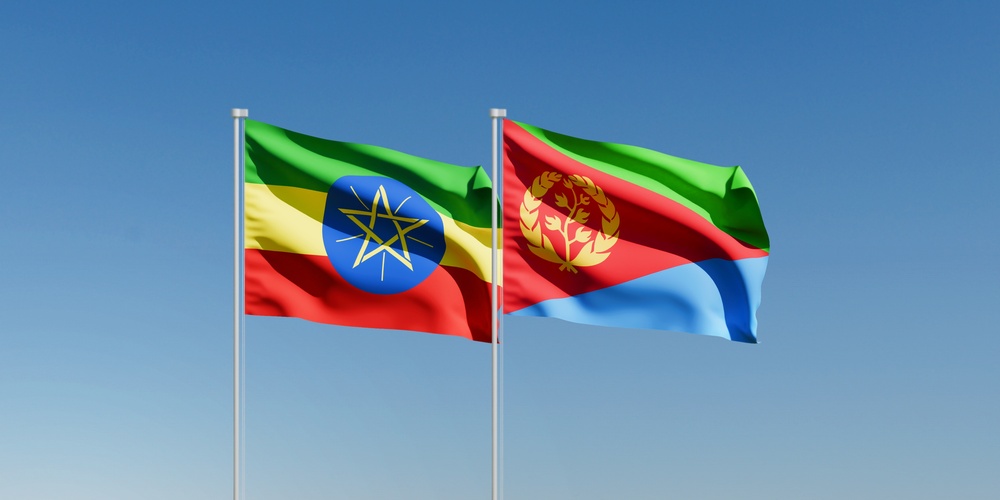
ALBAWABA- Eritrea announced on Thursday that it was severing diplomatic ties with Ethiopia, hours after Addis Ababa closed its embassy in Asmara and expelled 10 Eritrean diplomats amid rapidly escalating tensions and renewed fighting in northern Ethiopia.
Ethiopia’s Foreign Ministry said it was closing its embassy in Asmara and declaring 10 Eritrean diplomats persona non grata, ordering them to leave the country within 48 hours. It accused Eritrea of “direct and indirect acts of hostility and belligerence” and said the diplomats had engaged in activities posing a direct threat to Ethiopia’s national security and violating the Vienna Convention on Diplomatic Relations.
Addis Ababa called on Eritrea to halt actions it said were contrary to the principles governing relations between sovereign states, while stressing that Ethiopia continued to value its historical, cultural and people-to-people ties with Eritrea and remained committed to peaceful coexistence and regional stability.
Eritrea rejected Ethiopia’s accusations, describing the measures as hostile and accusing Addis Ababa of pursuing a three-year campaign to obtain sovereign access to the Red Sea, including what Asmara said were threats to Eritrean ports and coastal areas.
Eritrea also accused Ethiopia of hosting, training and arming Eritrean opposition groups in an effort to destabilise the country and promote regime change. Eritrea said it had exercised restraint to avoid escalation but decided to reciprocate by cutting diplomatic relations.
The rupture follows the rapid deterioration of relations that had improved after the 2018 peace agreement between Ethiopian Prime Minister Abiy Ahmed and Eritrean President Isaias Afwerki. The agreement ended two decades of hostility following the 1998-2000 border war and restored diplomatic relations, including the reopening of embassies. Abiy was awarded the Nobel Peace Prize in 2019 for his efforts to resolve the conflict with Eritrea.
The two countries subsequently fought on the same side during Ethiopia’s 2020-2022 Tigray war, when Eritrean forces supported Ethiopian federal troops against the Tigray People’s Liberation Front (TPLF). Relations deteriorated again after the November 2022 Pretoria peace agreement ended the conflict without Eritrea being a formal party to the deal.
Ethiopia's foreign ministry says it would close its embassy in Eritrea's capital, Asmara, and declared 10 Eritrean diplomats in Ethiopia persona non grata pic.twitter.com/DZOBlWN2Of
Tensions have also centered on Ethiopia’s efforts to secure reliable access to the Red Sea. Landlocked since Eritrea became independent in 1993, Ethiopia has repeatedly said it needs a dependable maritime outlet. Eritrea has viewed Ethiopian statements concerning access to its ports, particularly Assab, as a threat to its sovereignty.
The diplomatic rupture comes as fighting has resumed in northern Ethiopia, threatening the fragile peace established by the Pretoria agreement. Tigrayan forces and allied armed groups launched a major offensive in late September, capturing several strategic positions and airports before Ethiopian federal forces and their allies mounted counterattacks. Federal forces have since reported recapturing the strategic town of Alamata south of Mekelle.
Ethiopia has accused Eritrea, along with Sudan and Egypt, of supporting an opposition alliance that includes the TPLF and other armed groups. Eritrea has denied supporting the alliance. The renewed fighting has already displaced tens of thousands of people and raised concerns that Ethiopia’s internal conflict could develop a broader regional dimension.
The escalation reached Addis Ababa overnight, where several explosions were reported after the Ethiopian government banned drone flights over the capital. An opposition-linked source claimed that drones had targeted military sites, but the nature and perpetrators of the explosions had not been independently confirmed.
Dr. Mansour Al-Maswari is Postdoctoral Fellow at Columbia University-Global Center, Amman. A Yemeni academician with a Ph.D. in English "Comparative Literature" and two MA degrees, one in political science and the other in English, Dr. Al-Maswari possesses more than 17 years of extensive experience in university-level teaching, research, research reviewing, bilingual translation, and copy-writing...
Subscribe to our newsletter for exclusive updates and enhanced content