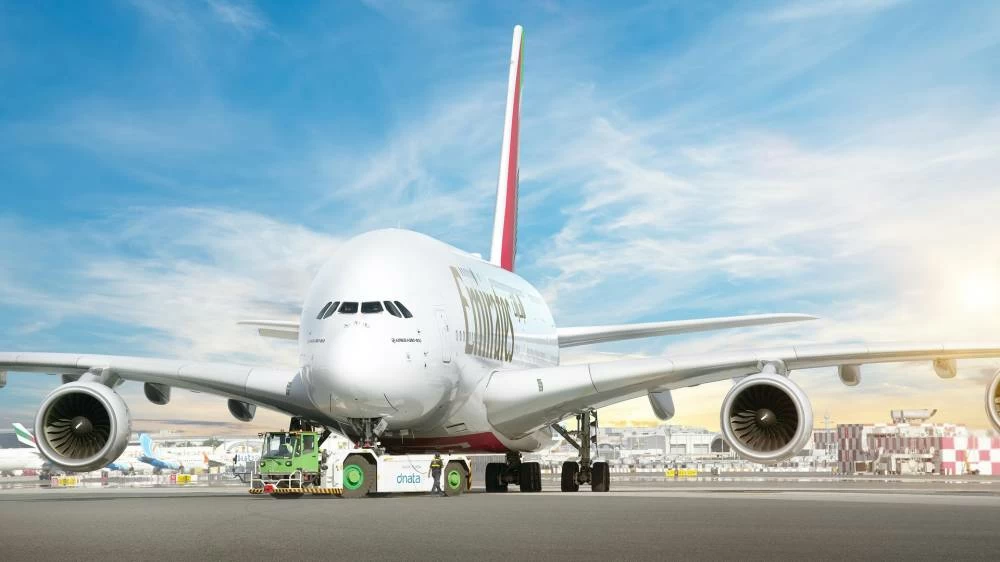
DUBAI: The Emirates Group today announced its half-year financial results, posting a profit before tax of AED4.1 billion ($1.1 billion) for the first six months of 2026-27, despite disruption and higher fuel prices caused by the ongoing conflict in the Gulf region.
After accounting for income tax, the Group's profit after tax stood at AED3.6 billion ($1.0 billion), down 66% from last year.
The Group achieved EBITDA of AED12.5 billion ($3.4 billion), 41% lower than the AED21.1 billion ($5.7 billion) reported in the same period last year, when it set a new record for profit and revenue.
Group revenue for the first six months of 2026-27 was AED66.2 billion ($18.0 billion), down 12% from AED75.4 billion ($20.6 billion) a year earlier.
The Group closed the first half of 2026-27 with a cash position of AED54.1 billion ($14.7 billion) as of September 30, 2026, compared with AED59.6 billion ($16.2 billion) on March 31, 2026. The Group used its strong cash reserves to support business requirements, including pre-delivery payments for aircraft and servicing debt obligations. It also paid the remaining AED2 billion ($545 million) dividend to its owner, the Investment Corporation of Dubai (ICD), from the AED3.5 billion ($953 million) declared for the 2025-26 financial year.
His Highness Sheikh Ahmed bin Saeed Al Maktoum, Chairman and Chief Executive of Emirates Airline and Group, said: "It has been a demanding six months, and once again our business model and our people stood up to the test. Against unprecedented regional challenges and high fuel prices, the Group delivered a profit before tax of AED4.1 billion ($1.1 billion). Customer demand held firm and our cargo operations made a strong contribution, keeping revenue and cash levels healthy even as global jet fuel prices doubled compared with the same period last year, impacting our costs and profitability.
"I'd like to thank the UAE government for its decisive response and coordination of all stakeholders to enable the safe resumption of air transport following military activity across the Gulf region. The government's measures have also led to the easing of travel advisories to and through the UAE. This has allowed us to restore operations with confidence and continue serving our customers and communities.
His Highness Sheikh Ahmed bin Saeed Al Maktoum, Chairman and Chief Executive, Emirates airline and Group, credited the UAE government for enabling the safe and smooth recovery of air transport activities; highlights the Group’s continual investments in fleet, product, and future capabilities; and says the Group is well-placed to stay agile against the headwinds of high fuel prices and regional volatility."Throughout this period, we have not paused our investments. Emirates and dnata continue to commit significant resources to expanding our fleet, enhancing products and services, and developing capabilities that will shape the future of our business. This is how we stay ahead and remain resilient to external challenges."
HH Sheikh Ahmed added: "We enter the second half of our 2026-27 financial year with measured optimism. While keeping a close watch on costs and geopolitical developments, we remain focused on delivering what Emirates and dnata are known for: safety, quality and customer satisfaction. We've weathered challenges before, and with our strong cash position and solid foundations, the Group is well placed to navigate the headwinds of volatility and high fuel prices."
Compared with March 31, 2026, the Emirates Group's workforce declined by 2% to 128,237 employees as of September 30, 2026. However, both Emirates and dnata continue recruitment to support business requirements.
Emirates airline
The first six months of 2026-27 brought significant challenges to Emirates' operations. Intermittent airspace restrictions and closures across the region tested the airline's operational agility, while government travel advisories reshaped travel patterns and consumer behaviour.
During the period, Emirates focused on restoring its network and connectivity through Dubai. As of September 30, the airline was operating 91% of its pre-disruption network, serving 150 airports in 78 countries and territories across its passenger and cargo network.
The airline also launched initiatives to boost customer confidence, including comprehensive travel cover unrestricted by government travel advisories, free date changes and flexible refund policies.
Between April 1 and September 30, Emirates expanded its Premium Economy offering and introduced its latest cabin products to more markets. The airline received nine new A350 aircraft and completed the refurbishment of 12 aircraft, including nine A380s and three Boeing 777s. Its retrofit programme, one of the world's largest, represents a planned investment of more than $7 billion. Emirates also equipped 36 more aircraft with Starlink connectivity, taking the total Starlink-enabled fleet to 57 aircraft by September 30.
In May, Emirates broke ground on its $5.1 billion engineering and Maintenance, Repair and Overhaul (MRO) facility at Al Maktoum International Airport, with completion expected in the mid-2030s.
The airline also introduced two new cabin products: the U-dream headrest in Economy Class and electronically controlled privacy dividers in Premium Economy.
On the ground, Emirates opened new-concept lounges in Munich, Frankfurt and Manchester, and expanded its retail footprint to more than 30 travel stores.
Emirates also extended its Travel Rehearsals programme to 15 additional locations across the UK, Australia, Portugal, the Philippines, Madagascar and the Maldives. The initiative, now operating at 47 stations, supports young travellers with autism and their families through real-life airport and flight simulations.
The airline continued its community initiatives worldwide, including projects with the USTA Foundation, NBA Cares, the London Wildlife Trust, and the Emirates Nourishment Programme in South Africa.
During the first half of 2026-27, Emirates extended sponsorship agreements with Arsenal Football Club until 2033 and Real Madrid until 2031.
Overall capacity fell 10% to 28.2 billion Available Tonne Kilometres (ATKM) because of a reduced flying schedule. Available Seat Kilometres (ASKM) fell 17%, while Revenue Passenger Kilometres (RPKM) dropped 25%. Average passenger seat factor was 72%, compared with 79.5% a year earlier. Emirates carried 21.8 million passengers during the period, down 22%.
Emirates SkyCargo transported 1.2 million tonnes in the first six months, down 1% year-on-year. However, cargo revenue rose 52% as regional conflict reduced air freight capacity and disruptions to maritime transport increased demand for air cargo.
Emirates SkyCargo added capacity through the delivery of five Boeing 777 freighters and deployment of its first passenger-to-freighter converted aircraft. It also added Almaty and Zhengzhou to its freighter network and increased services across several key markets.
Emirates reported a profit before tax of AED3.7 billion ($1.0 billion), compared with a record AED11.4 billion ($3.1 billion) in the same period last year. Profit after tax was AED3.3 billion ($903 million), down 66%.
Revenue, including other operating income, totalled AED56.9 billion ($15.5 billion), down 13% from AED65.6 billion ($17.9 billion) last year. The performance reflected sustained travel demand, particularly for premium cabins, and strong cargo revenues.
Operating costs, including fuel, fell 2% in line with operations. Despite a 12% reduction in fuel uplift, fuel costs before hedging increased 60% year-on-year. Gains of AED7.1 billion from fuel hedging reduced the net increase in fuel costs to 13%. Fuel remained the airline's largest operating cost at 34%.
EBITDA stood at AED11.5 billion ($3.1 billion), down 41% from AED19.7 billion ($5.4 billion).
Emirates Flight Catering revenue from external customers declined 51% to AED273 million ($74 million), while the number of meals served fell 41% to 4.5 million due to reduced air traffic at Dubai's airport.
Emirates Leisure Retail/MMI revenue declined 13% to AED1.2 billion because of lower tourism traffic in the UAE.
dnata
dnata's airport operations, catering and retail, and travel divisions adapted quickly to challenges arising from the regional conflict. Its international operations helped offset reduced airline and travel activity in the UAE and wider Gulf region.
During the first half of 2026-27, dnata secured several multi-year agreements, including a cargo partnership with Silk Way Group in Singapore and inflight catering contracts with Cathay Pacific at several airports in the UK and US. It also secured a seven-year ground handling licence at Amsterdam Schiphol Airport.
dnata continued investing in operational growth, opening a new integrated command centre for cargo operations in Dubai and committing AED8 million to expand The Fort-Lisaili tourism destination. It also invested in technology and equipment across its operations.
The company announced an investment of AU$32 million to build a cargo facility at Western Sydney International Airport and continued work on a new catering facility there. It also commissioned a new AED100 million logistics facility in Dubai South and advanced several cargo-related projects, including a planned AED37 million investment in Alat, Azerbaijan.
Within its travel division, dnata integrated Imagine Cruising and Travelbag to strengthen scale and support international growth.
dnata's revenue, including other operating income, reached AED11.0 billion ($3.0 billion), down 7% from AED11.7 billion ($3.2 billion) in the same period last year.
Profit before tax was AED410 million ($112 million), down 51%, while profit after tax was AED309 million ($84 million), down 56%.
EBITDA totalled AED939 million ($256 million), down 31% from AED1.4 billion ($372 million) a year earlier.
Airport operations remained dnata's largest revenue contributor at AED5.4 billion ($1.5 billion), down 3%. Aircraft turns handled fell 8% to 414,012, while cargo volumes declined 6% to 1.49 million tonnes.
Flight catering and retail operations generated AED4.2 billion ($1.1 billion) in revenue, up 1%, supported by growth in inflight retail partnerships. Total meals uplifted fell 10% to 54 million, largely because of the loss of major UK contracts.
dnata's travel division contributed AED1.4 billion ($373 million) in revenue, down 31% from AED2.0 billion ($538 million), mainly due to the divestment of Travel Republic and Netflights in the UK. The division reported a total transactional value of AED3.8 billion ($1.0 billion), down 22% from AED5.0 billion ($1.4 billion) in the same period last year.