Egypt is seeking to expand its exports to African markets by diversifying destinations, strengthening commercial partnerships and improving access for Egyptian products, Industry Minister Khaled Hashem said.
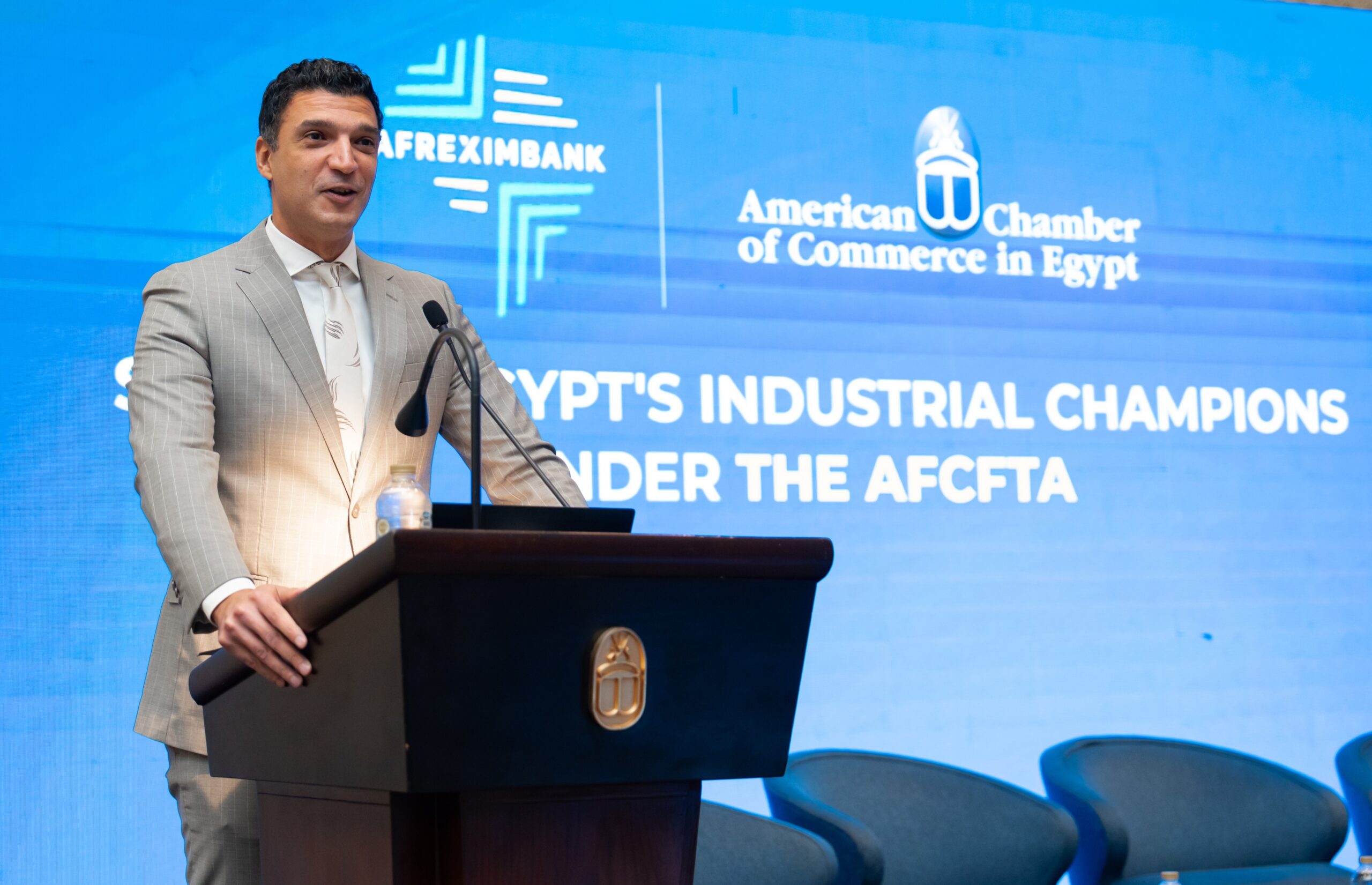
Speaking at “Scaling Egypt’s Industrial Champions” forum organised by the American Chamber of Commerce in Egypt (AmCham Egypt) in cooperation with the African Export-Import Bank (Afreximbank), Hashem said Africa offers significant potential for Egyptian exporters, particularly in industrial, agricultural, engineering and building-materials products.
The event, attended by AmCham Egypt Chairman Omar Mehanna, Afreximbank executives and representatives of the business community, brought together government officials, exporters and development finance specialists to discuss ways to expand Egypt’s commercial presence across African markets.
Hashem noted that intra-African trade reached approximately $214bn in 2025, marking an annual increase of 5.5%, while total African merchandise trade stood at around $1.5trn.
Egypt accounted for approximately 4.4% of intra-African trade, equivalent to around $9.3bn, according to figures cited by the minister.
He said the figures demonstrate both the scale of Africa’s existing trade and the room for Egypt to increase its presence in the continent’s markets.
“There is something abnormal about these figures,” Hashem said, referring to Egypt’s share of intra-African trade in relation to its industrial capabilities and production capacity.
He stressed that increasing Egyptian exports to global markets remains a central government objective and a key performance indicator for the industrial sector. Africa, however, offers particularly significant opportunities for rapid export growth, potentially allowing Egyptian exports to multiply over a relatively short period, he added.
Egyptian exports to Africa reach $7.6bn
Trade figures presented at the event highlighted the scale of Egypt’s existing commercial presence in Africa and the opportunities to expand it further.
Egyptian exports to African Union countries reached approximately $7.6bn in 2025, compared with $7.8bn in 2024. Imports from these countries amounted to around $2bn, down from approximately $2.1bn a year earlier.
Total trade between Egypt and African Union countries consequently stood at approximately $9.6bn in 2025, compared with $9.9bn in 2024, according to the detailed figures cited during the discussions.
Egypt’s main exports to African markets include electrical machinery and equipment, plastics, iron and steel, processed food products, fresh vegetables and fruit, as well as salt, stone and cement.
In 2025, exports of electrical machinery and equipment amounted to approximately $633.6m, followed by plastics and plastic products at $544.4m, iron and steel at $528.3m, processed food products at $517.8m, vegetables and fruit at $491.4m, and salt, stone and cement at $446.4m.
Libya was the largest African destination for Egyptian exports, receiving approximately $1.5bn worth of goods in 2025. Algeria followed with $1.2bn, Morocco with $1.1bn, Sudan with $957.1m and Tunisia with $431.3m.
Although North African markets remain major destinations, Hashem stressed the need to strengthen Egypt’s commercial presence in East, West and Central Africa, reducing dependence on a limited number of markets and diversifying export destinations.
Industry Minister Khaled Hashem
Egypt targets new African markets
Hashem said Egypt is pursuing practical investment and trade opportunities across the continent, revealing that another major project in Tanzania would be announced soon.
He also announced plans to visit Côte d’Ivoire in November to discuss and reach agreements on additional major projects, reinforcing Egypt’s economic partnerships with both countries.
“We are serious and taking practical steps at a rapid pace,” he said, calling for the support and participation of all key stakeholders to accelerate implementation and achieve the desired results.
Hashem said Egypt’s efforts to expand its African presence should be supported by closer cooperation between government institutions, financial organisations and private companies.
He also highlighted the importance of ensuring that Egyptian products are able to compete effectively in African markets by meeting required quality and technical standards and by improving the efficiency of trade procedures and transportation networks.
Exporters call for broader African presence
Mohamed Kassem, chairman of the Egyptian Exporters Association, said Africa represents a strategic market for Egyptian businesses, offering considerable opportunities to expand industrial and food exports and improve the competitiveness of locally manufactured products.
He said Egypt’s export performance in Africa does not adequately reflect the strength of its economic relations with the continent, noting that a substantial proportion of Egyptian exports remains concentrated in North African Arab countries and Sudan.
Trade with many other African markets remains relatively limited, he added, highlighting the need for Egyptian companies to expand their presence across the continent.
Kassem pointed to opportunities to increase exports of agricultural products, pharmaceuticals, chemicals and fertilisers, alongside the industrial goods already reaching African markets.
He called for stronger trade facilitation measures, more efficient shipping and logistics networks, improved market intelligence for exporters and greater participation in trade fairs and business missions.
He also stressed the importance of financing and guarantees to help businesses convert export opportunities into actual commercial contracts.
Turning export opportunities into deals
The AmCham Egypt–Afreximbank seminar featured an executive discussion on the practical implementation of the African Continental Free Trade Area (AfCFTA), market access and the expansion of bankable demand.
Participants examined how the agreement could facilitate cross-border commerce, improve access to African markets and mobilise the financing needed to execute export transactions.
The discussions underscored the need for closer coordination between government institutions, financial organisations, business associations and private companies to help exporters identify opportunities and turn them into commercial agreements.
For Egypt, the challenge is not simply to increase the value of exports, but also to establish a stronger and more diversified presence across African markets.
With North African countries currently accounting for a significant share of Egypt’s exports to the continent, expanding into East, West and Central Africa could provide new outlets for Egyptian manufacturers and agricultural producers while broadening the country’s export base.
As Africa’s internal trade continues to grow, Egypt is seeking to use its industrial and production capacity to capture a larger share of the continent’s demand and translate existing economic ties into higher export volumes and new commercial partnerships.