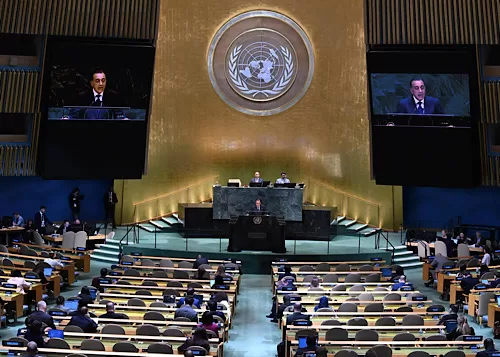
Egypt’s water security is an existential issue that cannot be compromised, Prime Minister Mostafa Madbouly said in an address to the UN General Assembly on Friday. “The Nile is not merely an economic resource, but a lifeline linked throughout history to the existence and development of Egyptian society,” Madbouly said while delivering Egypt’s statement during the high-level general debate of the Assembly’s 81st session. Madbouly, who headed Egypt’s delegation on behalf of President Abdel Fattah El-Sisi, said Egypt believed transboundary water resources should be a field for co-operation rather than conflict. “Water security and development are not competing goals,” he said, provided there was political will, good faith and respect for international law. Egypt did not oppose any people’s right to development, Madbouly said, but defended the principle that one party’s development must not come at the expense of others. Shared resources must not be managed through unilateral measures or a policy of imposing faits accomplis, he said, calling instead for co-operation, good-neighbourly relations and binding agreements under international law that safeguard the legitimate rights and interests of all parties. “Egypt retains its legitimate right, guaranteed by the UN Charter and international law, to protect its water security and preserve the existential resources of its people,” he said. Madbouly called for a stronger multilateral system based on international law, equal representation and fair access to development opportunities. “Confidence in the usefulness of collective action and the multilateral system has declined,” he said, warning against power politics, polarisation and double standards. He said the international system faced a widening gap between principles and their implementation, as well as between those who make decisions and those affected by them. Gaza and regional security Madbouly devoted much of his speech to the war in Gaza, saying peace could not be built by uprooting Palestinians from their land. “Any belief that stability can be achieved in the region while ignoring the suffering of the Palestinian people and continuing to manage the occupation rather than end it is pure illusion,” he said. Egypt categorically rejects any attempt to displace Palestinians from Gaza or the occupied West Bank, including east Jerusalem, he added. Madbouly called for the consolidation of a Gaza ceasefire, a complete Israeli withdrawal, safe and sustained humanitarian access, and the swift launch of early recovery and reconstruction efforts. He said these steps were not only humanitarian measures but also necessary to create a serious political process addressing the roots of the conflict. Egypt continues to support the establishment of an independent, sovereign and geographically contiguous Palestinian state on the borders of June 4, 1967, with east Jerusalem as its capital, under a two-state solution and relevant international resolutions, he said. The prime minister also warned that regional security was indivisible. “No state’s security can be built on the insecurity of its neighbours, threats to navigation, trade and energy routes, or violations of state sovereignty and attacks carried out in breach of international law,” he said. Madbouly urged support for national institutions, territorial integrity and political settlements across the Middle East, while rejecting the fragmentation of states, the backing of militias and foreign interference. “Protecting states and their sovereignty cannot be separated from protecting the resources on which peoples’ lives depend,” he said. He also expressed Egypt’s support for Sudan, which he said faced a crisis extending beyond military confrontations to threaten civilians and the country’s state institutions. “Sudan finds in Egypt a strong supporter of its people, its right to unity, and institutions capable of protecting its resources,” Madbouly said. Calls for UN Security Council reform Madbouly said the fairness of international rules could not be complete while institutions responsible for making decisions remained unrepresentative of the world they governed. More than eight decades after the creation of the United Nations, the structure of international institutions, particularly the Security Council, continued to reflect historical balances that no longer matched current realities, he said. Egypt remained committed to genuine and comprehensive Security Council reform, in line with the Ezulwini Consensus and the Sirte Declaration, with particular attention to what he called the historical injustice suffered by Africa. Madbouly said the imbalance in political representation was mirrored in the global economy. Developing countries were being asked to accelerate development, create jobs, finance the green transition and adapt to crises while facing rising debt burdens, higher financing costs and shrinking fiscal space, he said. Reforming the international financing system had therefore become a necessity, not a luxury, he added, calling for more representative financial institutions, expanded concessional financing and greater lending capacity for multilateral development banks. Debt treatment should also be accelerated in a fair and effective manner, he said. Countries should not be forced to choose between debt servicing and funding education, healthcare, food and infrastructure, Madbouly said. “Development is not a grant, but a right and a shared interest,” he said. “Investing in it is investing in global stability and in countries’ ability to prevent crises before they become cross-border humanitarian and security crises.” Artificial intelligence and climate Madbouly warned that artificial intelligence (AI) could create a new and significant gap in global power based on access to computing capacity, data, models, skills and financing. He called for international frameworks governing AI and emerging technologies, arguing that technology should be treated as a global public good rather than a closed privilege of a limited number of countries or companies. Egypt supported the UN’s role and global dialogue in developing principles combining innovation with responsibility, protecting privacy and ensuring transparency, accountability, non-discrimination, human oversight and respect for international law, he said. He also called for technology and knowledge transfer, digital infrastructure financing and skills development so developing countries could become producers and developers of technology rather than merely markets for it. AI should reflect the world’s linguistic and cultural diversity, he said, calling for fair representation of Arab and African languages and communities in datasets and models. Egypt has launched the second edition of its National Artificial Intelligence Strategy for 2025-2030, Madbouly said. He stressed that the safe and responsible use of technology must go hand in hand with building national capabilities. Madbouly added the same principle applied to the green transition, which could not be fair unless ambition was matched by fair means of implementation. Climate action must go hand in hand with development, poverty reduction and job creation, while adaptation and water and food security should receive greater priority, particularly in Africa and countries most exposed to the effects of climate change. Drawing on Egypt’s experience hosting the COP27 climate conference in Sharm el-Sheikh, Madbouly said the main gap was no longer in diagnosing the problem but in implementation, turning pledges into financing, projects and technology reaching the countries and communities most in need. Disarmament Madbouly also warned that accelerating geopolitical and technological change must not lead to more dangerous arms races. Egypt reaffirmed its commitment to balanced disarmament and non-proliferation arrangements without double standards, as well as to the creation of a Middle East zone free of nuclear weapons and all other weapons of mass destruction, he said. “Collective security is not achieved by accumulating instruments of destruction,” Madbouly said, but through equal rules, obligations applied to all and political will to make preventing escalation a priority. Egypt was not merely calling for reform of the international system but was offering its experience and capabilities in support of solutions, he said. “Legitimacy gains meaning when it is translated into results, and institutions regain trust when they deliver justice to those they serve. Trust is not demanded; it is built through fairness. Transformation is not imposed; it is managed through participation,” Madbouly said. Egypt would continue to support efforts to restore confidence and effectiveness to the multilateral international system and to manage global change in a fair and participatory manner, he added. At the close of his speech, Madbouly thanked UN Secretary-General Antonio Guterres for leading the organisation during one of the most difficult periods in its history and for his efforts to uphold international law and preserve the UN’s credibility and moral authority. The post Egypt PM calls for stronger multilateral system, reaffirms Nile water rights appeared first on Egyptian Gazette.