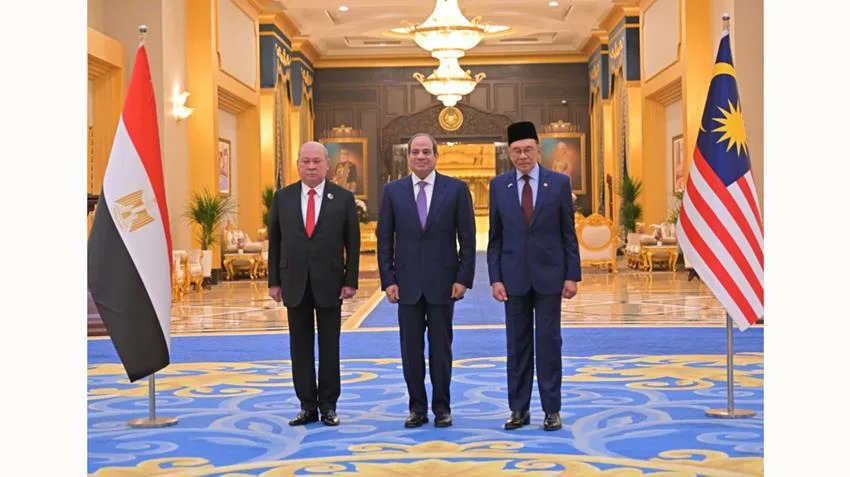
When President Abdel Fattah El-Sisi arrived in Kuala Lumpur on Friday, he began what Malaysia’s Foreign Ministry (Wisma Putra) described as his first state visit to the country since taking office in June 2014. The visit was made at the invitation of King Sultan Ibrahim. By the time President El-Sisi met Prime Minister Anwar Ibrahim at Seri Perdana, the prime minister’s official residence in Putrajaya, yesterday, it had already carried unusual symbolic weight. The king and the prime minister awarded the Egyptian president Malaysia’s highest federal honour, the Darjah Utama Seri Mahkota Negara, which he described as a reflection of mutual appreciation between the two countries. The substance behind the ceremony deserves closer reading. Before the visit, Wisma Putra said it was expected to elevate bilateral relations to a Strategic partnership. The Egyptian account of the talks records an exchange of several memoranda of understanding and a decision to refer the outcomes to the Egypt-Malaysia joint committee, which is scheduled to meet in the first quarter of 2027. It does not mention a formal change in the status of relations, and the texts of the memoranda were not available at the time of writing. This analysis therefore treats a strategic partnership as an aspiration, not an established outcome. President Abdel Fattah El-Sisi, alongside King of Malaysia Sultan Ibrahim, (L), and Prime Minister Anwar Ibrahim (R), at the Malaysian National Palace, Istana Negara. The foundations are deep. A Malay Association was established in Egypt in 1930, well before formal diplomacy, and its headquarters was a gift from President Gamal Abdel Nasser in 1959. Malaysia dates diplomatic relations to 1959, and the Malaysian embassy opened in 1960. Contact at the top has been steady, Hosni Mubarak, then vice-president, visited Malaysia in 1979, and returned as president in 1997 for the Group of 15 summit in Kuala Lumpur, where the two sides signed nine agreements on technical and trade cooperation. Prime Minister Mahathir Mohamad visited Egypt in 2003, and Najib Razak attended the Non-Aligned Movement summit at Sharm el-Sheikh in 2009. The record describes a relationship sustained by regular summitry and shared membership of multilateral bodies, rather than by a single dramatic episode. That shared membership is the strongest political asset. Egypt and Malaysia sit together in the United Nations, the Organisation of Islamic Co-operation and the Non-Aligned Movement. According to the State Information Service, they take similar positions on human rights, the environment, terrorism, refugees and democratisation, and both regard the UN as the principal body for international development, peace and security, and the defence of the Charter and international law. Convergence is not the same as identical interests, but it lowers the cost of consultation. Two capitals that share a vocabulary on multilateralism can co-ordinate more readily in New York, within the OIC and among non-aligned states. The talks showed that vocabulary in use. The two leaders agreed on the need to de-escalate tensions and to prioritise diplomatic solutions to crises, and El-Sisi said Egypt would continue its efforts to halt escalation in the Middle East and called for co-ordinated international action to uphold international law. On the Palestinian issue, he restated Egypt’s call for a just and comprehensive settlement on the basis of the two-state solution, with an independent, sovereign Palestinian state along the 4 June 1967 borders and East Jerusalem as its capital. He praised Malaysia’s support for the Palestinian cause and its humanitarian assistance, called for the full and sustained entry of aid into Gaza, and reiterated Egypt’s rejection of any attempt to displace Palestinians forcibly, alter the demographic composition of Palestinian territories or divide them. He also voiced concern over settlement expansion and attacks on Islamic and Christian holy sites in the West Bank and East Jerusalem. The leaders discussed the Horn of Africa and the Red Sea as well, and, as reported, agreed that diplomacy and political dialogue offer the best means of resolving regional crises. These are Egyptian accounts of positions Anwar was said to share. Malaysia’s own statements should be consulted for its formulation. Such exchanges illustrate a wider point about the two countries’ placement. Egypt sits at the junction of the Arab world, Africa and the Mediterranean. Malaysia is an established voice in South-East Asia and the wider Muslim world. Closer alignment could allow each to act as an interlocutor for the other’s region, with Cairo offering insight into Arab and African affairs and Kuala Lumpur doing the same for ASEAN. This is an assessment of potential, not a declared understanding between the governments. The visit also sits within a wider Asian itinerary, President El-Sisi’s tour began in Seoul, where Egypt and South Korea elevated their relationship to a strategic partnership. El-Sisi also arrived yesterday at Halim Air Force Base in the Indonesian capital, Jakarta, marking the third and final stop of his Asian tour. The pattern suggests that Cairo is deliberately diversifying its Asian partnerships. Institutions give dialogue its rhythm, and here the record is encouraging but uneven. The first meeting of the joint committee, held in 2008 under Foreign Minister Rais Yatim, produced signed minutes covering all fields of co-operation. A joint sub-committee on trade and investment followed in Cairo in October 2009, and a businessmen’s council had been formed in 2003. Referring this week’s outcomes to the committee’s 2027 session is therefore sensible, since it ties the visit to an existing mechanism rather than creating a new one. It also sets a deadline against which progress can be judged. Economics and religious co-operation support the political relationship rather than replace it. El-Sisi identified renewable energy, industry, electronics, agriculture and food processing as priority sectors, and said that sincere co-operation could deliver significant results. Earlier official material conceded that trade volumes lagged behind the quality of political ties, and historical figures should not be read as current data. The leaders’ inspection of Proton Saga cars and motorcycles after the press conference was a visual reminder of an industrial link: the reference material records an earlier Malaysian investment by Proton in Egypt for assembling car parts. On religious affairs, the two sides held extensive discussions on training preachers to promote moderate religious discourse. President cited Al-Azhar’s role over more than 1,000 years and said Egypt was ready to receive more Malaysian students, preachers and teachers. Those ties rest on earlier agreements, including a 2000 co-operation agreement between Al-Azhar University and Malaysia’s Ministry of Education. The opportunity is real but conditional. El-Sisi renewed his invitation to the Malaysian king and prime minister to visit Egypt, and Anwar stressed the importance of building on the current momentum. Three tests will show whether momentum becomes substance. The first is whether the joint committee meets on schedule and produces a defined work programme. The second is whether the memoranda signed in Putrajaya are implemented in the priority sectors named. The third is whether political consultation on regional and multilateral questions becomes routine rather than occasional. Cairo and Kuala Lumpur have a solid platform of nearly seven decades of diplomatic ties and overlapping memberships. Its value will be measured by the follow-up in the months ahead. The post Egypt, Malaysia turn goodwill into working agenda appeared first on Egyptian Gazette.