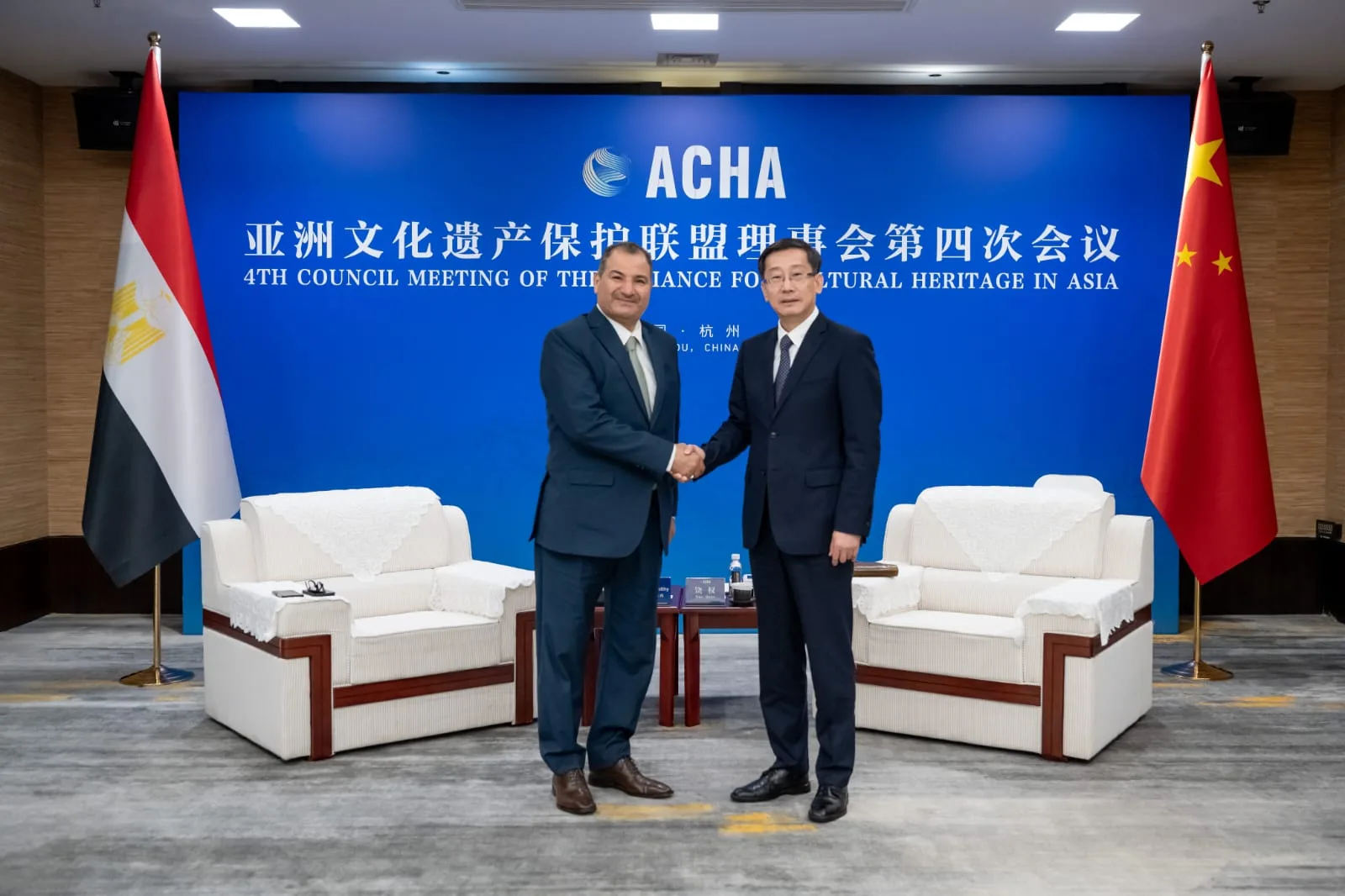
Egypt’s cultural legacy spans millennia, but the challenges facing its monuments are firmly of the present: climate change, natural disasters, conflict and the illicit trade in antiquities. The country is looking to deepen its international partnerships to confront those threats, joining the Alliance for Cultural Heritage in Asia (ACHA) as a partner country, the Tourism and Antiquities Ministry said Sunday. Hisham El-Leithy, secretary-general of Egypt’s Supreme Council of Antiquities, attended the alliance’s fourth council meeting in the eastern Chinese city of Hangzhou, being held from October 17 to 19. The intergovernmental alliance promotes co-operation on protecting cultural heritage through shared expertise, joint archaeological research, restoration projects and training for specialists. In remarks to the meeting, El-Leithy described heritage not simply as a record of the past but as a vital part of human identity and a means of promoting dialogue and understanding between peoples. Egypt hoped to contribute to the alliance through joint fieldwork, technical exchanges and cooperation on the preservation and documentation of heritage, while drawing on the experience of other members, he said. The country’s expertise includes archaeological discoveries, restoration, conservation and documentation, as well as efforts to combat the illicit trade in cultural property and recover smuggled antiquities, the statement said. El-Leithy also outlined the work of the Supreme Council of Antiquities, including preventive conservation, management of archaeological sites and museums, training young specialists and updating regulations for heritage protection. On the sidelines of the meeting, he met Rao Quan, the alliance’s chair, a Chinese vice-minister of culture and tourism and head of China’s National Cultural Heritage Administration, to discuss joint projects. The talks covered plans for a joint UNESCO World Heritage nomination involving Egypt’s Nilometer on Rawda Island and China’s Baiheliang inscriptions, the ministry said. The Nilometer, a historic structure on the Nile, was used to measure the river’s water levels. The Baiheliang inscriptions, carved into a submerged rock formation in the Yangtze River, record water levels over centuries. The two sides also discussed plans to establish an Egyptian-Chinese centre for marine archaeology and underwater heritage in Alexandria, under a cooperation memorandum signed in 2025, the statement said. The post Egypt joins Asian alliance to boost heritage protection, research appeared first on Egyptian Gazette.