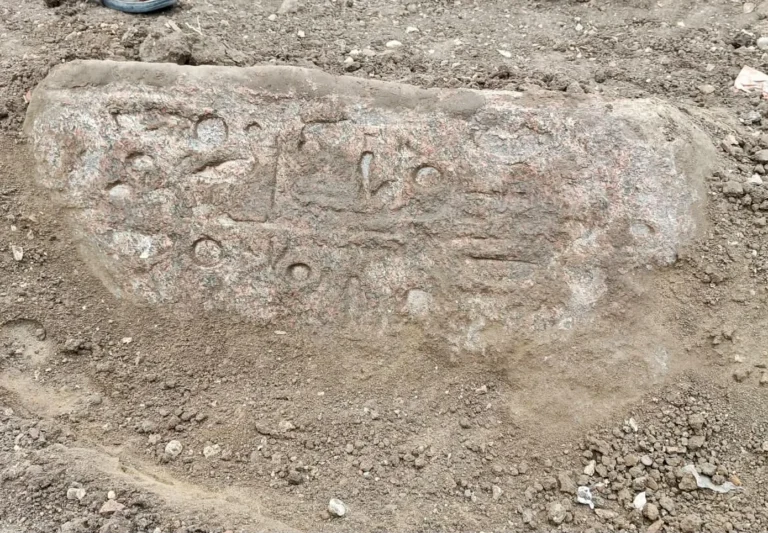
A joint Egyptian-Chinese archaeological mission has uncovered the remains of a mud-brick residential complex, a structure believed to have been used as a wine press and a range of artefacts at the site of the Sekhmet temple in Mit Rahina, the Egyptian Ministry of Tourism and Antiquities said Sunday. The discoveries shed further light on the history of the area and daily life there across successive periods, the ministry said. The mission, jointly conducted by Egypt’s Supreme Council of Antiquities and the Shanghai Museum, began by cleaning and documenting the Sekhmet temple, which formed part of the larger temple complex of Ptah, the principal temple of ancient Memphis. Excavations in the areas surrounding the temple revealed the remains of a mud-brick residential complex, as well as stone blocks and fragments of statues, some of which are believed to have belonged to the Great Temple of Ptah. East of the temple, archaeologists discovered a limestone structure thought to have been used as a wine press. It consists of an upper basin sloping southwards towards a central opening and a lower collection basin. Both sections had openings for securing amphorae used to collect the liquid. Grape seeds found inside the structure support the interpretation that it was used in wine production, the ministry said. The excavation also yielded a variety of artefacts, including stone blocks and statue fragments dating mostly to the New Kingdom, particularly the reign of King Ramses II. The objects were made from limestone, red granite and schist. Other finds included pottery fragments, faience amulets, small terracotta and limestone figures, ostraca, votive stelae and other archaeological remains. Mohamed Abdel Badie, head of the Egyptian Antiquities Sector at the Supreme Council of Antiquities, said the discoveries indicated that human settlement in the area continued from the Third Intermediate Period and Late Period through the Ptolemaic and Greco-Roman eras. The findings also showed that life continued in ancient Memphis after the temple’s decline as a major religious centre, with the area later being used as a residential neighbourhood, he said. The mission, led by Reham Zaki, scientific affairs supervisor at the Supreme Council of Antiquities, and Chen Jie, deputy director of the Shanghai Museum, will continue its work in coming seasons. The team plans to expand archaeological excavations and architectural documentation at the Sekhmet temple and surrounding area to obtain a clearer understanding of the temple and the development of human settlement in this part of ancient Memphis. The Sekhmet temple was accidentally discovered in 1959 during construction work on a house in the area. Excavations were subsequently carried out by Egyptian antiquities inspector Mohamed Abdel Tawab El-Hetta during a single season between 1961 and 1962. In 2015, visible archaeological features at the site were documented as part of a project focusing on the management of the ancient Memphis site and its surrounding community. The Egyptian-Chinese mission later resumed excavations at the temple and its environs for the first time since 1962. The post Egypt-China team uncovers ancient homes, wine press in Mit Rahina appeared first on Egyptian Gazette.