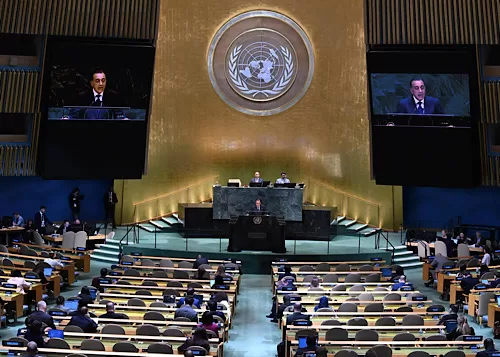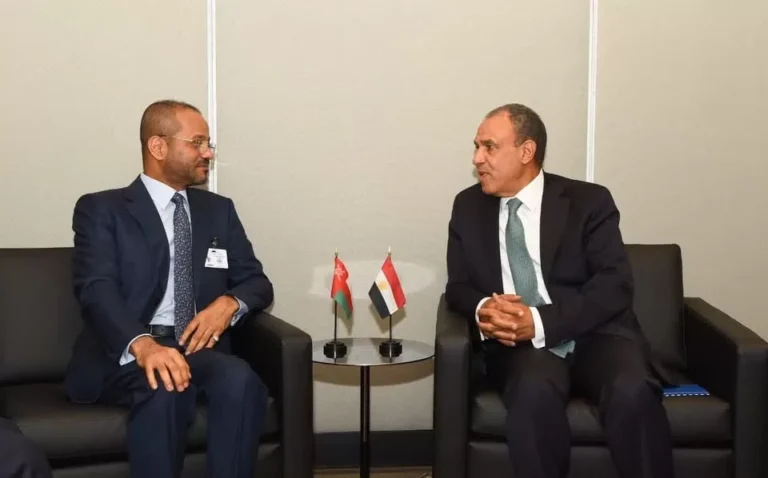
Prime Minister Moustafa Madbouly called this week for reshaping international co-operation frameworks. Speaking at the United Nations General Assembly in New York, he said this change was necessitated by the rapid change happening to the global economy. The prime minister led the Egyptian delegation attending the 81st session of the assembly on behalf of President Abdel Fattah El Sisi. His participation in the event held special importance that extended beyond the diplomatic realm, observers said. While in New York, the Egyptian premier took part in a wide range of high-level meetings, including one titled “Global Reset Dialogues”. He also participated in the Leaders’ Meeting on Partnership for Multilateral Action, Security and Peace. On right track Addressing the international gathering of world leaders and policymakers, the prime minister reviewed the reform measures Egypt took in the past years to reinvigorate its economy. Egypt has weathered one of the region’s largest recent economic shocks without a broader downturn, benefiting from improved international reserves, exchange rate flexibility, and a swift policy response, the prime minister said. His assessment is backed by a recent report by the International Monetary Fund (IMF) which said reforms under its Egypt-supported programme had strengthened economic growth, helped bring inflation down, rebuilt international reserves and improved banks’ foreign asset positions, leaving the country better equipped to withstand external shocks. Despite subsequent global shocks, local economic activity remained resilient, with real gross domestic product growth, reaching 5 per cent in the third quarter of 2025/26 and 5.2 per cent over the first nine months, the international lender said. Fairer global financial system The prime minister called for the international financial system to redirect its resources towards greater fairness and better address the needs of the Global South. Poverty, inequality, and obstacles to achieving the Sustainable Development Goals, he said, threaten international stability and economic prosperity. He called for joint efforts to focus on preventing and settling conflicts. “Over a long period, the initial response of some nations to potential conflicts had been to resort to unilateral measures, while overlooking the many benefits of diplomacy,” the prime minister said. “The multilateral international system must remain at the heart of all these efforts,” he added. He noted that the UN was uniquely positioned to provide the vital assistance needed to achieve shared goals, providing that it was sufficiently empowered to carry out its mandate. Prime Minister Madbouly reaffirmed Egypt’s commitment to multilateralism and boosting international co-operation. “Egypt stood ready to work with all partners to ensure that multilateralism did not remain an aspiration, but became an effective tool for achieving peace, prosperity and dignity for all,” he said. He stressed the importance of international partnerships for developing economies, whether in attracting investment, transferring technology, developing infrastructure, or supporting productive projects and public services. Collective action During the panel discussion, the prime minister underscored the importance of boosting the collective action of Global South nations in international forums and working towards a more just and balanced international order, one that responds more effectively to the needs of developing countries and grants them a greater role in decision-making. This vision holds particular significance from an economic perspective, as the ability of developing countries to influence the formulation of international rules and policies is directly linked to their interests in finance, development, trade, and capacity building, the prime minister said. Consequently, the call for enhanced collective action offers a pathway to address the challenges these nations face by coordinating positions and developing frameworks for joint co-operation, he added. The prime minister also affirmed Egypt’s view of the “Accra Reset” initiative, launched by Ghanaian President John Mahama, as a framework for co-operation among Global South nations, particularly African countries. Regional heavyweight Political analyst Mohamed Hamada viewed Egypt’s participation in the UN General Assembly meetings as reflecting its political and economic heavyweight in the Middle East and beyond it. “Egyptian action has political, development, and economic dimensions,” Hamada told The Egyptian Gazette. “It also works all the time to boost international partnerships,” he added. The UN General Assembly meeting came this year at a highly sensitive time, given geopolitical tensions raging on around the world. At meetings with world leaders, the prime minister was keen to highlight the raft of measures Egypt took and the incentives it introduced to attract investors and capital inflows to industrial areas around the nation. Egypt made noticeable progress in localising industries, upgrading infrastructure, and establishing more industrial zones, with the chief aim of propping up the local economy in ways that help it withstand external shocks, the prime minister told the world leaders and businessmen he met in New York. The post Egypt calls for global reset at UN assembly appeared first on Egyptian Gazette.