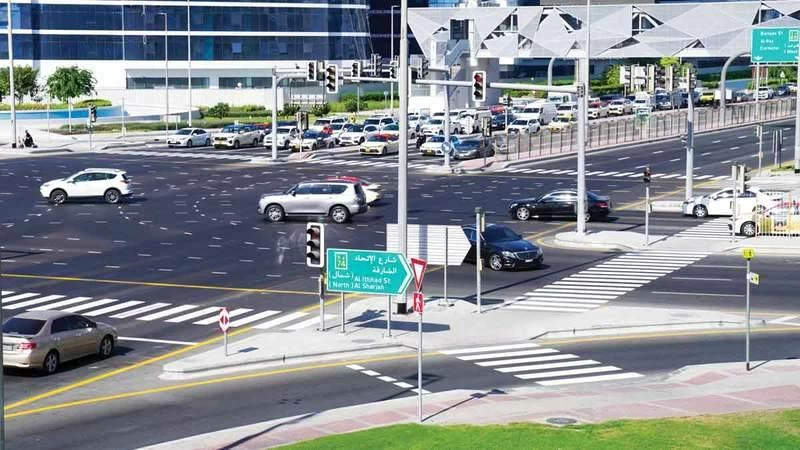
Dubai: Dubai’s Roads and Transport Authority (RTA) has revealed a major project under development to link all traffic signals in the emirate to the traffic control centre in Al Barsha, in preparation for employing artificial intelligence(AI) technologies in their dynamic management, enabling the prediction and proactive handling of traffic jams and bottlenecks, and contributing to improving traffic flow and reducing congestion at signals by at least 10%.
The RTA explained that it is expected that all traffic signals will be connected to the centre by the beginning of 2027, and that the new system will be supported by available cameras and traffic systems, and artificial intelligence technologies capable of analysing vehicle movement and predicting potential congestion locations, and then dynamically adjusting signal timings, according to the traffic situation, in order to enhance the efficiency of managing the road network in the emirate.
Signals that adapt to traffic
Ahmed Hashim Bahrozyan, Executive Director of Corporate Technical Support Services at the RTA. Picture credit: SuppliedIn detail, Ahmed Hashim Bahrozyan, Executive Director of Corporate Technical Support Services at the RTA, said that the authority is currently working on a major project to link all traffic signals in Dubai to the traffic control centre in Al Barsha, noting that the centre manages traffic in general in the emirate, with continuous coordination between the RTA and Dubai Police.
He added that work is underway to link traffic signals to the centre, and this process is scheduled to be completed at the beginning of 2027, in conjunction with the introduction of artificial intelligence technologies in signal management. He explained that artificial intelligence will rely on cameras and available systems to monitor and analyse vehicle movement, and predict congestion or bottlenecks that may occur in certain locations.
During an interview on the Live Broadcast programme on Noor Dubai Radio, he explained that the new system will allow traffic signal timings to be changed more dynamically than they are currently, so that they are controlled according to vehicle movement and traffic conditions.
He pointed out that these systems are expected to contribute to reducing traffic congestion by no less than 10%, in addition to other projects that will also contribute to improving traffic flow in the emirate.
AI across 41 areas of work
Bahrozyan stressed that traffic signal management is one of the key areas within the RTA’s updated artificial intelligence strategy, which covers 41 areas in the authority’s various sectors and departments, including services provided to the public, internal services, and support areas such as contracts, procurement, finance, and human resources.
He said that the rapid development in the field of AI requires a review of the strategy at a faster pace than the review of traditional strategies, explaining that the RTA reviews its strategy in this field within a period ranging between six months and a year at most, to ensure that it keeps pace with the rapid developments in artificial intelligence technologies.
He added that the RTA aims, within two and a half years, to radically introduce AI to support its 41 areas of work, explaining that the implementation is distributed over six phases. The authority has begun implementing the first and second phases, and the other four phases will be completed during the next two years, leading to the use of artificial intelligence technologies in planning and covering the authority’s various work.
He pointed out that the RTA identified areas of focus according to priorities that balance developing and facilitating services provided to the public on the one hand, and raising institutional efficiency and supporting internal operations on the other hand, noting that these areas include transportation planning in its various forms, including buses, maritime transport, the Metro and other means of mass transit.
He explained that one of the main axes is the development of service delivery through an AI assistant, so that services move from traditional digital channels to a more user-friendly and interactive system that allows the customer to complete vital services through an AI-powered assistant agent, such as paying fines, renewing vehicle ownership, renewing driver's licenses, and other services that customers use frequently.
Bahrozyan pointed out that the strategy also focuses on managing the authority’s assets, which are worth more than Dh150 billion, especially with the addition of new assets through vital and giant projects, such as the Blue Line Metro project and infrastructure and road projects, noting that managing this volume of assets by traditional means, and through employees and inspectors, will become more difficult as the size and value of the assets increase.
He stressed that employing artificial intelligence in asset management will enable the RTA to expand the scope of its asset coverage and monitoring to up to five times the current coverage, thereby enhancing their preservation and increasing the efficiency of their management.
Bahrozyan noted that the authority expects the strategy to achieve added value exceeding Dh300 million annually, through improving services provided to the public and raising operational efficiency, in addition to converting more than 50% of operations and services to an assistive artificial intelligence system during the next two years.