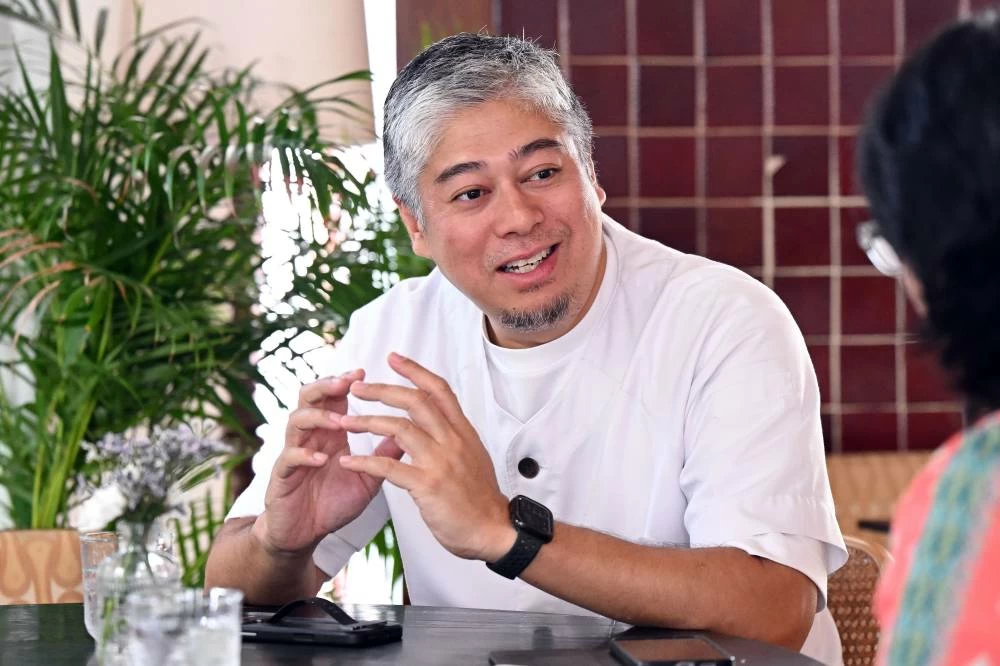
Dubai: He dropped out of school, washed dishes, cooked in the Solomon Islands under the watch of an armed bodyguard and once had no money left to send his daughter to school after pouring everything into a new restaurant.There is a group chat somewhere in Singapore populated by friends who knew Akmal Anuar before anybody called him “Chef”.They went to school together. They remember the boy he was.Some became truck drivers. Others settled into ordinary jobs and ordinary lives. And then there is their old schoolmate Anuar, turning up in magazines and on television, building restaurants thousands of kilometres away in Dubai. A literal definition of Dubai-It: A man who has turned ambition into achievement, exceptionally and fast.“They have no clue how I became…,” Singaporean Chef Anuar says to Emirates 242/7, the sentence disappearing into a laugh and the slightly chaotic shorthand with which he often tells his story.Neither, apparently, does he.He looks back at himself in 1992 and comes up with two words.“Dropout…, punk.”Today, Chef Akmal Anuar is a Michelin-starred chef and restaurateur whose professional life has become entwined with Dubai's extraordinary rise as a dining destination. His restaurants have brought awards and recognition. He has opened projects beyond the UAE, built brands, left others and started again. In 2022, he received his first Michelin star. He describes 2023 as one of his best years professionally, a period when money, ideas and opportunity converged.“When times are good, you make money,” he says. “So that was the time when I was super creative.”The distance between the ‘punk’ and the Michelin chef is considerable.But Anuar, 45, doesn't tell it as a triumph. He tells it as work.Ask him what he feels when he steps back and considers how far he has come and his first answer is prosaic.“It's working… moment my eyes open, it is work,” he says. There are school fees to pay. Salaries, responsibilities, another day to navigate.For all the improbable turns in his life, Anuar has never quite learned to regard himself as either as lucky or as a remarkable success. Instead he says it’s “Baraka” or blessings he prays for every day. “I always believe … it’s faith. Allah is the One to determine my path. If He allows, He allows. If He wills, I will do it. If He says yes, He will open doors there, if He says no and there’s a reason why He says no….”Anuar has now spent over 12 years in Dubai. It is where his family, friends, teams and businesses are. It is where, as he puts it, feels “appreciated” and recognised for being part of building the F&B industry in Dubai. It is “home”.The first kitchen was barely a kitchen by the standards of the restaurants he would later run.About three metres by four metres, he remembers.His parents were blue-collar workers in Singapore. His father had tried his hand at a fried chicken business; it failed. Then came Harummanis, the family food shop, opened in 1992 which served Malay dishes and local breakfasts.Anuar was about 10 years old. The family lived upstairs. By 11, he was downstairs working.Potatoes needed peeling. So did onions. Plates had to be fetched. Food had to go out. There wasn't much romance attached to any of it. His parents worked, day in and day out.“We were not poor or broke,” Anuar says. But this was a household in which work mattered. School, meanwhile, was not going the best way.His father reached a practical conclusion. If his son wasn't going to study, he could work in the shop.By 12 or 13, Anuar could cook. By 15, he understood considerably more about running a food business than many adults.He just didn't know that this was what he was learning.“I know how the trade works. I know how the timing works,” he says. “I know how to cut, I know how to cook.”Then he adds: “Fundamentally, I don't know what I was doing.”He wanted other things. Football. A band. Maybe he would become a rock star. Chef was not the plan. Professional cooking entered his life almost by accident.At 18, after dropping out of technical school, Anuar bounced through odd jobs. He worked as a dispatch rider. Then came kitchens.China Jam in Boatquai. Les Amis on Orchard Road.At Les Amis, one of Singapore's celebrated fine-dining restaurants, the future Michelin chef started as a dishwasher. He earned S$700 a month, roughly AED1,900. The hours could run to 16 a day.He had grown up around Malay cooking. Now he found himself looking at ingredients that belonged to a whole new culinary language.Asparagus sticks in his memory. A small detail but for Anuar, it represented another world. “I have the skills. I can cut now,” he remembers thinking. “I need to refine it.”And that is what he began to do. For years, the food of his parents moved further into the background as he immersed himself in French and European cooking - Saint Pierre, then Iggy's.In 2006, newly married, he and his wife spent two weeks travelling through Europe. He spent every penny he had to travel, eat, discover and learn - Poland, Amsterdam, Belgium….He came back equipped with new knowledge that he promptly applied in the kitchen. By 2012, he was head chef at Iggy's in Singapore, which he recalls as then being ranked No. 1 in Asia and No. 26 in the world.Headhunters arrived. Offers came from Moscow, London … and finally, Dubai invited him - in style.He and his wife flew in business class, on Emirates.A BMW was waiting. They stayed at Le Royal Méridien.For a man accustomed to budget airlines and riding a motorbike to work, it was another universe.He remembers looking out and seeing Atlantis. Blue sky. Skydivers. In January 2013, he moved to Dubai to open Zengo. Eventually, he moved on.More than 12 years later, the city he once approached as a job opportunity has become something considerably more personal.“The city, for me, allows me to be more,” he says now. “If I wanted to build something, this city now allows me to build.”He could build in Singapore, he says. But Dubai gave him a different kind of accessibility: people he knows, networks he can call, suppliers who support what he does.“Home feels like I'm travelling now. So here [Dubai] feels more like home. My life is here in Dubai.” He pauses through the thought. “Dubai… has helped me a lot.”Dubai, as he has experienced it, offers access like no other.“It doesn't hand out freebies,” he says. “Doors are open. Not locked.” But walking through an open door does not mean finding “pots of gold” on the other side.“Time and time again,” he says, “you give your best shot.”Over the years, his relationship with the city has also moved beyond restaurants and customers. He talks about Emirati friends and families in Dubai, Sharjah and Abu Dhabi who have returned to his food, asked him to cater and booked private dinners.For Anuar, those repeat relationships matter. “I feel like I'm part of it,” he says. “That feels good.”Many would probably call him ‘lucky’. He says there’s no such thing as luck, just hard work, the hard hits, the lows, pulled along by the determination to stay true to your dream.By 2016, after a period back in Singapore, Anuar was preparing to open 3Fils in Dubai.He didn't have enough money for his share of the investment. Inez, his wife, supported him to sell their home in Singapore and put the money into the restaurant. At one stage, he had less than AED10,000 left in savings. He made monthly visa runs because his residency situation was unsettled. His family was here with him. Anuar kept going.Looking back, Anuar says taking those risks was possible because of the people around him. His wife, parents, in-laws, all gave him, as he puts it, the “infrastructure” to pursue what he wanted. Not everyone, he says, has that kind of support.3Fils eventually became one of Dubai's iconic restaurants, driving many others to follow suit. He had started a trend, opened up possibilities for many others.Anuar has a slightly feral metaphor for himself. A wolf. Might be “dirty, scrawny” but is free to do as he chooses. He likes independence and has deliberately resisted some opportunities to build with people whose financial muscle would make life easier.“I just like to have it my way,” he says.He reaches for the word “freedom”, then almost pulls it back. “Freedom is too big a word,” he says. “I like it when I see things a bit harder,” he says. He talks about being “in the trenches”. “The cuts and the scars,” he says, give you rank. “Some kind of stripes.” These are not theoretical scars.After leaving 3Fils, Anuar started his consultancy White Rice Co. from home. Then he started building restaurants again.Goldfish followed. Then other projects, including 11 Woodfire, which received a Michelin star in 2022. By 2024, Anuar says he was juggling three or four construction projects. More than 100 people were involved across his operations. He estimates that he travelled around 200,000 miles that year.“I was not sleeping, to be honest,” he says. But he wanted it. When you “ask for rain”, it comes with some “mud”.His working life now includes things nobody dreams about while watching chefs plate food: landlords, licensing, permits, suppliers, salaries, construction and the large sums that disappear before a restaurant opens its doors.Dubai's dining market has also become far more competitive.Anuar describes it as “aggressive in terms of business”. You cannot wait for things to be handed out to you. Awards, too, have changed the terrain.“I think the first two years definitely changed the game for Dubai,” he says of Michelin's arrival.His analogy is football.Restaurants do not all enter the league with the same stadium, owners, resources or superstar players. An independent operator competes in the same city as businesses backed by enormous capital. Anuar places himself firmly among the smaller players. And still he builds because in Dubai, dreams are meant to be lived. He has delivered six Michelin-recognised brands in an industry where achieving one is a lifetime ambition: Goldfish (Dubai and Abu Dhabi), Otoro, Osteria Funkcoolio, 3Fils, 11 Woodfire, and, finally, Harummanis.After spending much of his career learning cuisines far removed from his childhood, he eventually came back to the food he knew first. Harummanis. His parents' name. His parents' food. The three-by-four-metre shop of 1992, reimagined through the chef he became. It received a Michelin Bib Gourmand last year, 2025. His parents were present to receive the award with him, in Dubai - an achievement Anuar holds as his proudest moment. He doesn't want the story to become one of pride or ego. He calls it evolution. “I’ve seen my parents struggle. You have your daily duties. You have a responsibility.”His three daughters, Sophia, Athea and Mahiya, have grown up differently. He has made sure of it. They did not see the struggle he saw. They open the refrigerator and there is food. They have not had to understand, as he did, what happens when a small family business depends on everyone working. Giving them that security was the point.He has also reached an age at which work matters the most. So does surviving it.“There is no formula,” he says. He is wary of the endless advice available now. Everyone, he says, has advice on their phone.Instead, he says, “Build something slowly. Fail, get hurt, cry, get beaten whatever. You will fall and you will hurt. You have bruises, but you get up again.” He doesn't say run. “Walk.”Anuar has now spent over 12 years in Dubai. It is where his family, friends, teams and businesses are. It is where, as he puts it, feels “appreciated” and recognised for being part of building the F&B industry in Dubai. It is “home”.---Anupa Kurian is a Dubai-based senior editor and writer with nearly 28 years in journalism, including as a food editor. She writes across gastronomy, culture, health, environment and the people who make a city what it is, drawn to stories that reveal themselves in the details.