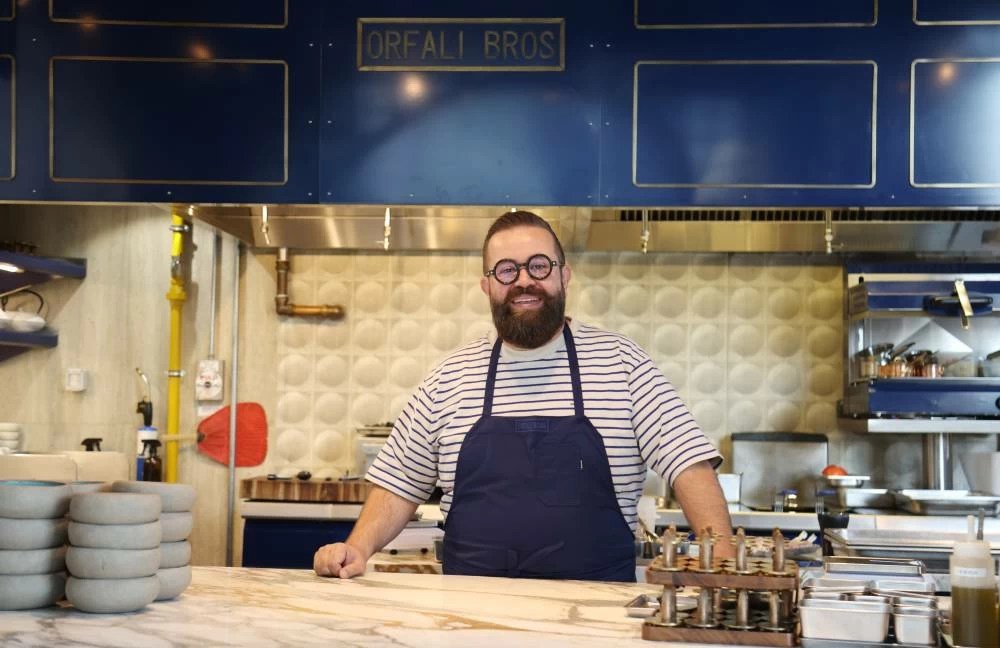
Dubai: Three days after Orfali Bros opened in Dubai, it was fully booked for a week. A week later, the waiting list had stretched to 15 days. Before long, getting a table at the restaurant in Wasl 51 had become something of a challenge.
Its founder, Chef Mohamad Orfali, still sounds slightly astonished.
“You tell me why. I don't know,” he tells Emirates 24/7.
He has his theories, of course. The food was different. His brothers had brought their own considerable talents to the business. The service was unlike what diners were accustomed to. But there was nothing inevitable about what happened after the restaurant opened on March 14, 2021.
Orfali had come close to losing everything before a single customer walked through the door. A lot of money had been spent; he was on the verge of bankruptcy. “My father told me, ‘Did what you did? Just open the door.’”
Five years later, Orfali Bros received its second Michelin star in 2026. It was named the best restaurant in the Middle East and North Africa for three consecutive years, from 2023 to 2025, and placed fourth in the regional ranking this year. It also reached No. 37 on the 2025 World's 50 Best Restaurants list.
Orfali is 46. He has spent almost half his life in Dubai, although he originally came here with an entirely different destination in mind: France.
“I came to Dubai to gain an international experience that can help me if I go somewhere else around the world, and also to learn good English and to get the skill of communication,” he says.
He went to France in 2009. He studied there and tried to work there.
“I couldn't find myself in Paris. I couldn't find the link between the food and my memories. I felt like why am I leaving Dubai? I was lucky to back again in Dubai, to be honest.” This was 2011.
The accidental chef
Orfali's career began in Aleppo in 1994, when he was 14.
“It was by ‘mistake’ I entered the culinary world,” he says. “It was a mistake by my mum.”
He hadn't done particularly well at school. He couldn’t progress to high school, so culinary school was the alternative. They accepted everybody.
His mother was not happy. “She had never let me enter the kitchen.”
His father was an engineer, his mother a teacher, and the family had rather ‘conservative’ expectations for their son. “They wanted me to be either a doctor, lawyer, or engineer,” he recalls. “Even becoming a barber would have been more acceptable to my mum.” At least it meant he could open a barber shop. “For them, a chef is just a cook.”
In the Aleppo of his childhood, being a chef didn't carry the status it does today. Orfali went to culinary school anyway.
“I went there and felt like, you know what? It's a beautiful world. I love cooking.”
He later worked in restaurants and hotels between Aleppo and Damascus. His mother's perspective changed. These days, she is interested in opening a restaurant herself. His parents now live in Dubai.
Aleppo, Syria, is central to the way Orfali understands food. He speaks of its history, its position along ancient trading routes and the ingredients carried into its kitchens by successive cultures. Its cuisine, he says, has depth, complexity and a strong relationship with seasonality.
But the cooking he does today has a different name.
“We are Syrian. We're so proud, but we don't cook Syrian food. We represent something called Dubai cuisine, which is my journey, where I came from, and how Dubai influenced me.
“I'm a classically trained chef, but I've learned to think about food differently. Where do ingredients come from? If you look at their history, you'll find they've travelled from city to city, carried by immigrants and people bringing their cultures together.
“We decided to do something different. We call our style of cooking ‘freedom of cooking’. Our identity is still there. You can tell we're Syrian; some dishes reflect where we come from. But as I always say, my palate is Syrian, but it has travelled the world [in Dubai].
“We cook food that represents who we are. And with Orfali Bros, we're building something for the next generation … long term.”
The city he returned to
When Orfali returned to Dubai in 2011, he found an opportunity that would change the trajectory of his career.
In July of that year, he began working with Fatafeat, the food television channel. For almost 10 years, he became involved in producing culinary content across television, magazines and digital platforms.
“That was a turning point in my life. Researching food changed me. I had to understand why the French cook the way they do, why Italians cook differently, and the traditions behind Greek and Syrian cuisine. We couldn't just publish a recipe; we had to research it and understand the facts behind it.”
The television years exposed him to cuisines he hadn't grown up eating, and Dubai gave him opportunities to explore them.
“I had never eaten Indian food until I came to Dubai. Here, I discovered Japanese, Italian, French, Spanish and so many other cuisines. You can walk down one street in Dubai and find 20 different cuisines. All of that influenced me. It changed and developed my palate.” When he eventually began creating his own restaurant menu, those experiences became part of it.
A restaurant that almost never opened
Orfali had wanted to open a restaurant for years. “I opened my restaurant when I was 40, but I had spent almost 10 years trying to open a restaurant, and it didn't work because people didn't want to invest with me. They wanted to invest only in success stories. They didn't want to put their money into someone when they weren't sure whether he could make it or not. So that is my advice to young chefs: find the right partner. If you want to do something for yourself, find the right partner. For the partners, you know, go and help, and invest your money in new talent. You don't need to invest in another restaurant that has already become a success story in London or anywhere else in the world.”
His younger brothers, Wassim and Omar, were part of the plan. As children, Mohamad and Wassim had imagined working together in a hotel. Omar joined the profession later. Both younger brothers eventually specialised in desserts.
In 2017, the three began conducting masterclasses together at the International Centre for Culinary Arts in Dubai. That was where Orfali Bros first began to take shape as a brand.
They developed a name, a visual identity and a social media presence. People attending the classes wanted to know where they could buy the food and pastries.
The brothers began considering a pastry shop with speciality coffee. They secured a space in 2019. Then came delays, and the pandemic. “I worked with wrong people, wrong contractor, wrong designer … 2019 to 2020 were two of the most difficult years of my life. I was almost bankrupt before we opened in 2021. We decided to open only for dinner because we couldn't afford the salaries for another team or the additional supplies.”
During that period, he met Mohamed Hilal, founder and CEO of Mohamed Hilal Group.
Hilal had initially approached him about consulting for another restaurant. Orfali wasn't interested in the consultancy, but he liked the man. So he made a different proposal.
“You want to join me with this restaurant? I'm doing this, and I'm looking for a partner.” Hilal agreed. “He believed in what I was doing.”
And, despite the restaurant encountering difficulties in the run-up to the opening, Hilal continued supporting the project.
“He said, you know what, no matter what's going to happen, we're going to make the restaurant. He supported me from day one.”
The original pastry shop concept also changed during the pandemic.
The brothers decided to build something that would accommodate all three of their talents. Mohamad would take the kitchen downstairs, while Wassim and Omar would have space for their pastry work upstairs. In fact, the two-storey open kitchen at Orfali Bros now has iconic status.
‘It’s only for Dubai.’
Orfali explains his style of cooking through the dishes on the menu of Orfali Bros. The restaurant's corn bomb is an example.
It draws on a Mexican tortilla, French custard-making techniques and memories of grilled corn sold on the streets of Aleppo and Turkey. Pomegranate jam adds another flavour, while the dish brings together ingredients and techniques from different places.
“You want to say it fusion. For us, it's not fusion; it's who we are.”
The city exposed him to unfamiliar food and gave him an audience willing to try dishes that didn't fit comfortably into conventional categories.
“Dubai is not easy at all,” he says. “You have to make things for everyone.”
But he considers that diversity one of the reasons Orfali Bros could develop its own identity. “The diversity gives you the power to do something new.”
He doesn't believe the restaurant's cooking could have emerged in quite the same way elsewhere.
“We're making it only for Dubai. We didn't think about it to be outside of Dubai.”
The brothers also resisted opportunities to replicate Orfali Bros internationally, especially as it is a chef-driven concept.
Orfali worries that expansion could dilute what makes the restaurant distinctive.
“Expansion for us, it would kill the soul of the concept. How I can split myself?”
Instead, the group has developed other concepts in Dubai, including the Thai-inspired Manāo and the more casual Three Bros.
Dubai-It to two Michelin stars
The second Michelin star is a significant milestone for Orfali Bros, which previously received the Bib Gourmand recognition before earning its first star.
It held the No. 1 position in the Middle East and North Africa's 50 Best Restaurants ranking in 2023, 2024 and 2025. In 2026, it placed fourth.
Wassim and Omar were jointly named MENA's Best Pastry Chefs in 2026, recognition for the work that has given the restaurant's desserts their own considerable following.
Orfali is proud of the awards, but he is wary of treating them as the purpose of the business.
“We don't work for stars. We work for people. We work for our guests to make them happy. We work for the team.”
He is equally conscious that a restaurant's success depends on more than what comes out of the kitchen. Rent, salaries, suppliers, food costs, staffing and financial planning all matter.
“Chef now is not like the chef before,” he says.
A modern chef, in his view, must understand leadership, entrepreneurship, finance and communication. “Without this, how are we going to make it?”
He also wants Orfali Bros to become a place where younger chefs develop their skills before going on to establish businesses of their own.
His ambition is for people to speak of having trained at the restaurant with the same pride that chefs elsewhere associate with influential kitchens. “The restaurant by itself will do that.”
An academy may come later. For now, the kitchen is his school.
The woman who came to dinner
Dubai gave Chef Mohamad Orfali a career, the freedom to pursue his passion, and love. He met his wife here. She was a regular customer at Orfali Bros for four years.
Her name is Awatif. She is Palestinian and grew up in Dubai. Orfali had noticed her, but approaching a guest was another matter.
A woman at a neighbouring Italian restaurant encouraged him.
“Look at that beautiful girl. Why not talk to her?”
Orfali wasn't convinced.
“Like how? She's my guest. I can’t do that?” Eventually they connected. “I find her family, the values of her family is the same as the values of my family.” They married in 2025.
His wife cooks well, he says. So does his mother. Asked what he likes eating when he isn't at one of his restaurants, he replies, “Burger, maybe kabab, shawarma.”
But his mother's cooking remains the favourite.
“My mum’s cuisine, the Syrian Aleppo cuisine, is one of my favourites.”
Ten days away is enough
Ask Orfali what Dubai means to him, and the answer is immediate.
“Home.”
He has lived here for almost 20 years and finds it difficult to remain away for long.
“Whenever I travel out of Dubai, I have to come back. I can't handle more than one week or 10 days.”
He credits the city with allowing him to discover what kind of chef he wanted to become.
“Dubai shaped my identity differently. It gave me the opportunity to discover who I am and to create a new identity. Dubai gave us the freedom to cook the way we want to cook, to represent ourselves as we are, and to develop our own identity. It gave us the opportunity to grow and create something different. Without that freedom, I don't know where else we could have done it.
“We keep learning. We keep searching. We keep pushing. We keep chasing, because once you feel you've reached number one, you can say, ‘That's it, that's enough.’ But for us, there's always space to do more. And if you think you've made it, that's it. You're done. So you have to keep pushing yourself.”
And when asked whether there has been a particular moment when he felt grateful for everything that has happened, he replies, “Every day, every day. We say thanks to God, Alhamdulillah.”
------
Anupa Kurian is a Dubai-based senior editor and writer with nearly 28 years in journalism. She has been a food editor. Anupa writes across gastronomy, culture, health, environment and the people who make a city what it is, drawn to stories that reveal themselves in the details.