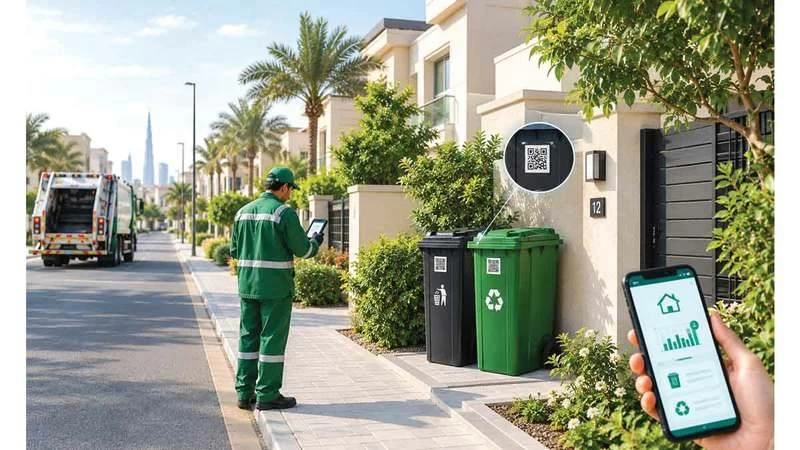
Dubai: Dubai Municipality has introduced a new waste collection approach in residential neighbourhoods as part of its ‘My City, My Environment’ project. Instead of shared community containers, each home will now have two dedicated bins — one for general waste and one for recyclables. Each container carries a barcode that allows the Municipality to track collections, monitor how much waste each household produces and measure how much it has reduced over time. Homes that achieve the greatest reductions will be recognised and honoured.
The Municipality explained that this approach aims to enhance environmental awareness, increase the rate of waste sorting at the source and helping in recycling, in order to support Dubai’s vision of achieving environmental sustainability. The move also addresses the challenges associated with shared containers in residential neighbourhoods, most notably the objection of some residents to their locations or their distance from their homes, and their use by people from outside the neighbourhood, which may affect the cleanliness of residential areas and their civilised appearance.
The initiative involves coordination with Tadbeer centres and the Ministry of Human Resources and Emiratisation (MOHRE) to train auxiliary workers on sorting waste and placing it in the designated containers.
In detail, the Executive Director of the Waste and Sewerage Agency in Dubai Municipality, Engineer Adel Al Marzouqi, said that the Municipality is working on developing the household waste collection system through the ‘My City, My Environment’ project, which includes replacing grey community containers with dedicated containers in front of homes, similar to the system implemented in a number of areas of the emirate, including Jumeirah, Al Barsha North, and Al Mizhar 1 and 2.
During an interview on the live broadcast programme on Noor Dubai Radio, he explained that the new system relies on providing two containers in front of each house, the first of which is designated for general waste, while the second is designated for recyclable waste, which encourages residents to sort waste inside the house before taking it out, and contributes to enhancing community participation in sustainability efforts and reducing waste that needs to be collected and treated.
He pointed out that the Municipality has begun distributing the new containers in the Al-Mazhar Fourth District, explaining that the move to allocate containers to each house aims to address the challenges faced by the shared container system, as some residents objected to placing them in front of their homes, while others complained about their distance from their residences, which raised concerns about their distribution locations within residential neighbourhoods.
Executive Director of the Waste and Sewerage Agency in Dubai Municipality, Engineer Adel Al MarzouqiHe added that the community containers also allowed people from outside the area to use them to dispose of their waste, which could increase the pressure on the containers and affect the cleanliness and civilised appearance of the neighbourhoods. He stressed that allocating containers to each house would contribute to organising waste collection operations and reducing the problems associated with shared container locations and their use.
Al-Marzouqi explained that the new containers will include electronic barcodes that the operating companies will scan when emptying and loading waste, with the process being documented through photography. This will allow the Municipality to monitor collection operations and track the quantities of waste generated by homes.
He explained that the data resulting from these operations will help in monitoring changes in the quantities of household waste and measuring the success of efforts to reduce it. He noted that the Municipality aims to honour the homes that are most successful in reducing waste during the next phase, and will announce additional details about the programme and its implementation mechanisms soon.
He pointed out that the Municipality allows for the possibility of modifying the capacity of household containers according to the needs of the residents, as homeowners can contact it to request larger containers if it turns out that the available capacity is not sufficient for the amount of waste produced by the home.
This ensures the suitability of the containers for daily use, and the importance of raising awareness among residents about how to sort waste and place it in the appropriate container, noting that the success of the new system depends on the participation of community members and their commitment to separating general waste from recyclable materials before taking it out of the homes.
He revealed that the Municipality is coordinating with Tadbeer centers and MOHRE to train domestic workers on waste sorting, which will enhance the application of this practice within homes, especially given the presence of domestic workers in a large number of families in the emirate. He pointed out that the Municipality is working in coordination with Dubai neighbourhoods to implement awareness programs and field visits to introduce residents to the new system, explain the mechanisms for sorting waste, using containers, and communicating with the Municipality regarding related services.
These steps come as part of Dubai Municipality’s efforts to develop household waste management, promote sorting at the source and recycling, and encourage residents to reduce waste resulting from daily consumption, which supports environmental sustainability and contributes to maintaining the cleanliness of residential neighbourhoods and the civilised appearance of the emirate.