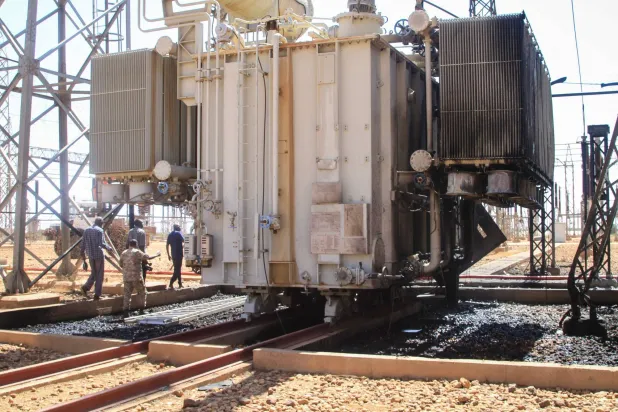
Sudan’s Rapid Support Forces (RSF) have continued drone attacks on electricity infrastructure in army-controlled areas, targeting power generation plants and substations across the country, causing widespread electricity and water outages and raising fears of a partial collapse of the national grid. The escalating strikes have also threatened hospital operations and agricultural projects, with warnings of severe consequences if the attacks continue at their current pace. Reports indicate that around 15 stations were targeted between October 20 and November 1, while the Emergency Lawyers group said Sunday that 15 facilities had been attacked in October alone. Early Sunday, drones launched simultaneous strikes on the Abu Hamad substation in River Nile State and the Al-Dabbah station in Northern State, according to eyewitnesses. Local sources said fuel facilities in Northern State were also hit. River Nile State Governor Mohammed al-Badawi said after inspecting the site that a drone strike had completely destroyed the Abu Hamad substation, cutting electricity supplies across the state. The attacks came less than 24 hours after drones targeted the Haya substation, still under construction in Red Sea State, along with oil transportation facilities. Warnings of a Nationwide Blackout Former Sudanese Energy Minister Adel Ibrahim warned that most major electricity substations had been bombed and taken out of service, leaving, by his estimate, only three principal stations: Merowe Dam and Atbara in northern Sudan, and Maranjan in Wad Madani, the capital of Al-Jazira State. “If electricity stations continue to be targeted at this rate, complete darkness will engulf the country,” Ibrahim told Asharq Al-Awsat. He cautioned that repairing the damage and restoring operations could take considerable time, while replacing destroyed transformers and other equipment would involve substantial costs. Substations play a critical role in connecting power generation facilities to consumers. Their destruction can therefore leave entire cities and states without electricity even when generating plants remain operational. Ten States Affected Reports show that the attacks have spread to 10 of Sudan’s 18 states, with White Nile and Gedaref recording the highest number of targeted facilities, at three each. Five states in Darfur under RSF control were not targeted. In White Nile State, drones struck the Tendelti, Mashkoor and Um Dabakir thermal power stations. In Gedaref, attacks hit Al-Hawata and Al-Faw, along with other electricity facilities cited in reports. Al-Jazira State saw strikes on the Al-Junayd and Al-Managil stations, while Shendi and Abu Hamad were targeted in River Nile State. In Sennar State, the Singa station came under attack. Other strikes hit Al-Markhiyat, northwest of Omdurman in Khartoum State; Haya in Red Sea State; and Al-Dabbah in Northern State. There were also reports of an attack on an electricity facility in Kadugli, South Kordofan State. White Nile and Gedaref thus topped the list in terms of sites mentioned in the reports, although the absence of standardized technical data makes it impossible to rank states by the scale of damage or duration of outages. The wave of attacks began on October 20 with a strike on Tendelti before expanding on October 26 to Singa, Al-Hawata, Al-Faw, Mashkoor and Al-Junayd. Al-Markhiyat was hit the following day, followed by Al-Managil on October 28, Um Dabakir on October 29, Shendi on October 30 and Haya on October 31. The latest strikes targeted Abu Hamad and Al-Dabbah early Sunday. Accusations Against Ethiopia The Sudanese government has accused the RSF of carrying out the attacks and Ethiopia of allowing its territory to be used to launch drones against facilities inside Sudan. On Saturday, the Foreign Ministry briefed diplomatic missions on the allegations, identifying locations inside Ethiopia that it said were being used to support drone operations. During a recent visit to Moscow, Sudanese Foreign Minister Mohieddin Salem also accused Ukrainian military personnel of assisting the RSF and training its members to operate drones. The expanding geographical reach, frequency and precision of some strikes suggest that the paramilitary group possesses substantial numbers of long-range drones and increasingly sophisticated operational capabilities. Emergency Lawyers said the attacks had disrupted electricity and water supplies and threatened healthcare services, worsening civilian suffering. On Saturday, UN Secretary-General Antonio Guterres condemned the escalation of drone attacks by both sides in Sudan’s war, expressing shock at their devastating impact on civilians. His spokesperson, Stephane Dujarric, said the strikes had killed hundreds of civilians, including women and children, across Sudan and the Abyei region. Guterres stressed the need to protect civilians and critical infrastructure, including healthcare facilities, and urged both parties to immediately cease hostilities and engage seriously in mediation efforts to end the war. The attacks have raised growing concerns about hospitals’ ability to operate medical equipment, maintain drinking water supplies and keep irrigation projects running, particularly as the winter agricultural season approaches. Sudan’s electricity sector has suffered extensive damage since the war erupted in April 2023, affecting thermal generation units, transmission stations, transformers and power lines. The latest strikes have placed further strain on an already weakened grid struggling with equipment shortages, maintenance difficulties and limited funding.