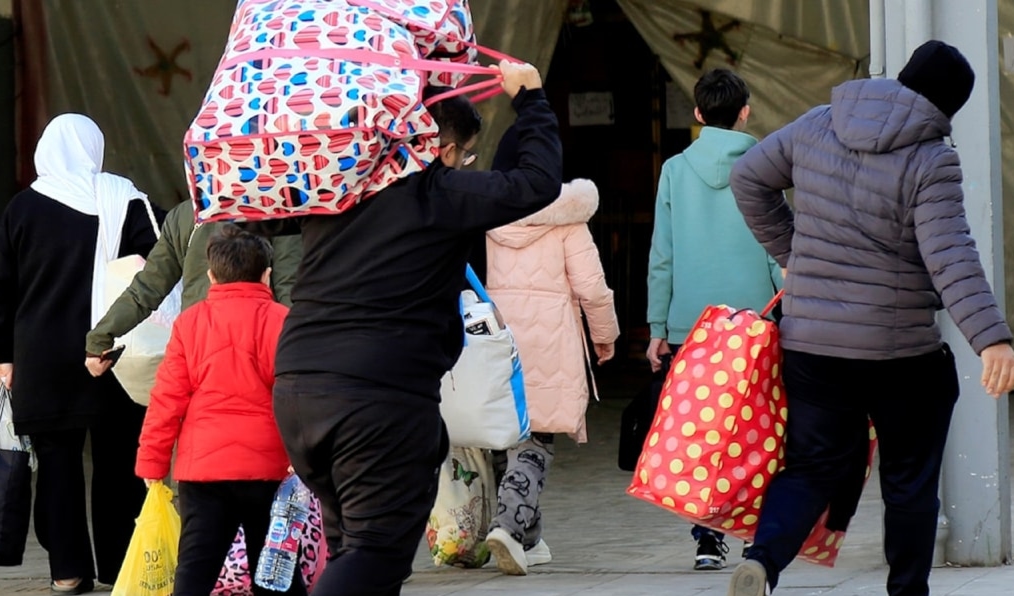
Between rent, electricity and medicine costs, southern Lebanese families displaced to the Bekaa Valley face an increasingly difficult question. How can they cover basic needs while leaving enough income to educate their children? With winter approaching and heating costs expected to add to the burden, the crisis facing dozens of displaced families is worsening.
Many have lost jobs and sources of income while facing rising living costs in host communities already struggling with poverty, the effects of war and a prolonged economic crisis.
The displacement of southern families to the Bekaa began as Israeli attacks eased. With the ceasefire still fragile, some chose to remain in or relocate to villages and towns in Baalbek-Hermel and the Bekaa for various reasons. Some moved closer to relatives to reduce housing and living costs. Others considered the area “safer” for now, while some chose villages where they had stronger social or ideological ties, particularly after facing harassment during displacement elsewhere.
But relocating to the Bekaa has brought these families into one of Lebanon’s most economically vulnerable regions. As the war drags on, many displaced people have lost their livelihoods, while rising living costs have placed demands on host communities that are themselves struggling to cope.
Around 40 southern families have relocated to Nabi Chit. Some have relatives there, while others chose it because it is considered a “home for the resistance.” Yet the town itself emerged from the war with economic damage and new burdens. Commercial activity has declined as purchasing power has fallen, while some local residents have also left and have not returned.
The situation is similar in several Bekaa villages hosting displaced southern families. Newcomers need assistance, while host families are facing financial hardship.
“I asked them to find me work. I pay rent, but I need to avoid having the landlord knock on my door at the start of every month and say, ‘Just like you, without this rent I would have nothing to eat,’” said Ahmad, a displaced southerner.
Ahmad needs $200 at the beginning of each month to pay his rent but has only $50. Electricity comes next. His landlord, he said, “gave me one light bulb so we can see each other in the house.”
For many southern families in the Bekaa, the real struggle has become figuring out how to preserve the minimum conditions for survival.
Other families told Al-Akhbar that they face similar difficulties. One local official said there were not enough resources to cover electricity subscriptions for displaced families. Efforts are underway to raise donations from wealthy individuals to install solar panels and reduce part of the burden.
The problems extend beyond rent and electricity. Several families still lack adequate furniture. In some homes, mattresses are the only furnishings, worn down by prolonged use and nearly touching the floor.
Displaced families also report a declining presence of aid organizations. Some told Al-Akhbar that their last food package arrived about two months ago. Organizations contacted by the newspaper said aid priorities had increasingly turned toward the south due to scarce resources.
Some groups also complained of “restrictions and obstacles to their work in the Bekaa.” They said aid distribution is divided geographically among organizations, with each responsible for specific areas, allowing agencies to blame one another when assistance falls short.
Education is another growing problem. Some families have been unable to enroll their children because of high tuition fees or missing documents and school records.
Abu Ali, displaced from Qatrani, could not enroll his two sons after being unable to obtain a school certificate because of unpaid fees from a previous year. His son instead took a job at a supermarket, earning 350,000 Lebanese pounds a day to help support the family.
For many southern families in the Bekaa, the real struggle has become figuring out how to preserve the minimum conditions for survival. They increasingly find themselves outside aid priorities, as the gap widens between their needs and what aid organizations can provide in a region already burdened by chronic crises.
This is an edited translation for a report published in Arabic.