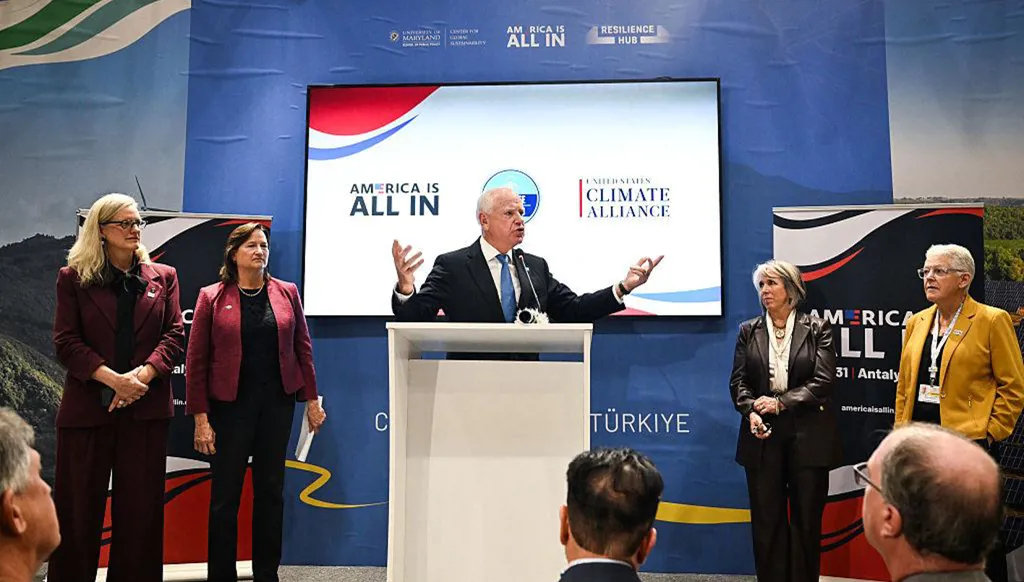
Echoes of the Democrats' electoral victory reached Antalya, Turkey, where a delegation of 18 U.S. House members arrived on Saturday to participate in the United Nations Climate Change Conference, COP31. Their presence carries a political message at odds with the White House's direction, as the Trump administration remains absent from the negotiations.
The Democrats' participation takes on particular significance following their victory in the midterm elections, which secured them control of both houses of Congress and will grant them broader legislative and oversight powers starting in January 2027. However, this shift does not transfer the president's authority over foreign relations to Congress.
Despite efforts to reassure international partners about the future of U.S. climate cooperation, the Democrats' ability to translate their electoral victory into concrete commitments remains constrained by the White House's position. What impact, then, can their participation have on American climate policy?
The Democratic representatives are participating in the conference from November 14 to 16, according to the Sustainable Energy and Environment Coalition (SEEC), which announced their arrival in Antalya on Friday. Their program includes meetings with international officials and negotiators, business representatives, and civil society members to discuss climate financing, energy security, trade, climate change adaptation, and the future of U.S. cooperation.
U.S. Representative for Arizona Yassamin Ansari told Annahar in an exclusive statement that "the discussion about climate ultimately concerns people, families, and the future of our communities." She noted that the world is at a critical stage that requires stronger international dialogue, particularly amid the rapid development of artificial intelligence in the United States and around the world.
On the role of Democrats in American politics, Ansari emphasized that "Congress plays an important role in shaping our country's long-term priorities and determining the nature of its international engagement through legislation, oversight, and financial appropriations." She stressed that this responsibility "extends beyond any particular presidential administration."
She added that "regardless of who occupies the White House, our commitment to the citizens we represent and our engagement with the world must continue," expressing her eagerness to listen, exchange experiences, and build partnerships that contribute to developing practical solutions.
However, Congress's ability to turn these aspirations into concrete action remains limited by the president's constitutional powers. Michael Gerrard, a law professor and faculty director of the Sabin Center for Climate Change Law at Columbia University, explained to Annahar that the next Congress, despite being under Democratic control, cannot do much to prevent Trump from withdrawing from the United Nations Framework Convention on Climate Change or reverse Washington's withdrawal from the Paris Agreement.
Meanwhile, Michael Burger, executive director of the Sabin Center for Climate Change Law, told Annahar that parliamentary oversight will be the Democrats' strongest tool. Through hearings and investigations, they could lay the groundwork for future legislation, hold the administration accountable, and limit the president's authority.
Burger shares Gerrard's assessment of the Democrats' limited room for action, ruling out the passage of major climate legislation before the next presidential elections. He also warned of a potential gap between the programs Congress can legally maintain and what the administration implements on the ground, stressing that the congressional delegation has no authority to make legally binding climate commitments on behalf of the United States.
The U.S. presence in Antalya extends beyond members of Congress. A delegation of more than 120 state and city officials is also attending, including the governors of California, Minnesota, and New Mexico.
In this context, Thomas Hale, a professor of Global Public Policy at the University of Oxford, told Annahar that 21 U.S. states have set targets to achieve net-zero emissions. He noted that none of the states that adopted these goals before Trump's return to the White House have abandoned them.
Meanwhile, the U.S. withdrawal from the international climate system continues. The country's exit from the Paris Agreement took effect on January 27, 2026, while the Trump administration notified the United Nations of its decision to withdraw from the Framework Convention on Climate Change, a move set to take effect on February 27, 2027.
Until then, the United States retains its legal membership in the Framework Convention, along with the rights and obligations that come with it, despite the absence of an official Trump administration delegation from the conference negotiations.
Navraj Singh Ghaleigh, senior lecturer in Climate Law at the University of Edinburgh, told Annahar that Washington retains the right to participate, vote, and negotiate until its withdrawal takes effect, alongside its legal obligations. However, he downplayed the practical value of these rights and responsibilities in addressing climate change.
Ghaleigh stressed that representatives can send political signals about their future legislative priorities but lack the authority to bind the United States internationally. He advised European governments to verify any commitments made by a duly authorized executive representative, as well as the basis for those commitments in an internationally recognized legal instrument or formal domestic legal procedure.
His reservations extend beyond the delegation's authority to the effectiveness of climate negotiations themselves, as emissions continue to rise and the gap between political commitments and actual implementation widens.