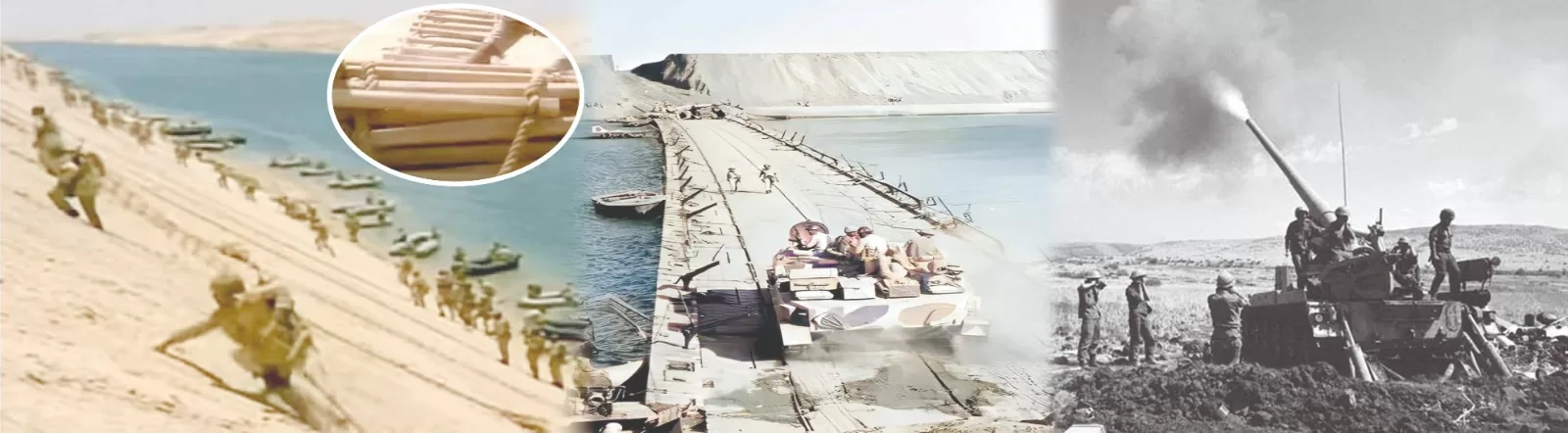
What the secret files finally reveal The pages of The Egyptian Gazette reveal documents and records that were kept strictly secret for decades. They include papers signed by Field Marshal Mohamed Abdel Ghani El-Gamasy, then Deputy Chief of Staff of the Armed Forces and Chief of the Operations Authority, as well as official reports sent to the Military Intelligence and Reconnaissance Administration and the Ministry of War. The Gazette publishes these records to tell the story as it was documented at the time, from attacks on Egyptian villages and cities to the strategic planning behind the crossing and detailed combat records. Attacks on civilians and vital facilities Egyptian villages, cities and public facilities across several governorates were hit by Israeli air and artillery attacks. Secret telegrams documented details of these attacks. Israeli forces launched machine-gun attacks and air raids using bombs and booby traps against the villages of Sheikh Gabil, Beni Ayoub, Al-Wafin, Muslim, Al-Hamaida, Al-Rifai, Al Wishah and Kafr Hafez in Abu Hammad, Sharqia Governorate. The attacks killed and wounded men, women and children and set fire to agricultural land. The records listed six 700-pound bombs and one 1,000-pound bomb that failed to explode. Residents of the villages of Manshiyet Abu Omar, Om El-Hosn, Om Azzam and Kafr El-Husseiniya were also killed or wounded in an air raid on El-Salheya in Faqous. Two houses in Faqous were destroyed, killing a woman and her three children. Bombs were also found buried in rice fields following raids on El-Salheya and El-Husseiniya. In Daqahlia Governorate, the village of Manshiyet Abdel Rahman in Dikirnis was hit by an air raid that destroyed 30 houses, started fires and killed and wounded civilians. Bombs also exploded in Al-Abrak village in Mansoura, causing deaths and injuries and damaging telephone lines. Air raids targeted Lake Manzala, hitting a number of fishermen and civilians. Other attacks caused deaths and injuries in the areas of El-Senbellawein and Baltas. In Beheira Governorate, bombs were dropped on Ezbet Gelousa in Shubrakhit, damaging houses and telephone lines. Missiles and unidentified objects that failed to explode fell on the villages of Al-Qaraya Al-Bahariya, Wakae, Danal and Al-Sharatwa in Abu Hommos. Shells also fell near Kafr El-Zayat. Israeli forces bombed Ismailia, particularly the village of Nafisha, where four houses were destroyed. Houses in the Ain Ghosain area were also bombed. The areas of Al-Dawawis and Al-Basalwa were targeted with bombs and surface-to-surface missiles, causing deaths and injuries and damaging agricultural land. The air raids were particularly heavy, followed by low-level flights and machine-gun fire against civilian targets. In Port Said and Port Fouad, the bombing damaged and cut the main drinking-water lines supplying Port Said near El-Gamil and along the Ismailia road. Continuous air and artillery attacks lasting 11 hours, using 1,000-pound bombs and incendiary missiles, targeted the Investment Tunnel, the petroleum station, the naval shipyard dock and the General Hospital. Fire broke out at the Minya Police Station, while buildings in the Arab District were destroyed. In Port Fouad, heavy bombing destroyed two fire engines and wounded firefighters and civilians. In Gharbia and Menoufia governorates, 750-pound bombs fell on agricultural land in Mahalla El-Kubra. Bombs also hit Kafr El-Zayat and Basyoun, while civilians were killed in Tanta and Mahalla El-Kubra. In Quesna, Menoufia, 30 time bombs were found. Their fragments had been designed to cause maximum human casualties. The bombing also caused deaths and injuries. In Damietta, enemy missiles targeted Ezbet El-Borg, Sheikh Dargham and Ras El-Bar, destroying bakeries, ambulances and Ras El-Bar Hospital. A wooden box containing jars of sulfuric acid was also found on the Damietta coast. The substance released toxic gas when heated. Two aircraft fired four missiles at the Zaafarana area in the Red Sea, causing deaths and injuries. Suez was also subjected to heavy bombing, which damaged El Nasr Fertilisers Company, petrol stations and the Suez cold-storage facility. Enemy tanks advanced as the bombing continued, while ambulances were prevented from entering the area. Israeli forces also stopped the water supply and filled in the Ismailia Canal in an attempt to put pressure on the city. They seized vehicles belonging to the Suez Canal Authority and the petroleum company and forcibly displaced residents from the villages of El-Ganayen, Geneifa, Fanar and Abu Sultan. Breaking the myth of the Bar Lev Line Documents from the Operations Authority reveal the military planning behind overcoming the complex defensive barriers. The objective was not limited to a military operation. It also involved creating political and economic conditions by using oil and economic relations, isolating Israel internationally, deepening its disputes with Washington and strengthening Arab unity. The aim was to force Israel to abandon its theory of “secure borders.” The ceasefire period that began in August 1970 was also used to build a network of anti-aircraft missiles. The Suez Canal presented a unique water obstacle. It was 180 to 220 metres wide and 16 metres deep, with a current reaching 90 metres per minute in the southern sector. Israeli forces had built earth embankments six to 10 metres high. They were supported by 30 fortified positions made of concrete, surrounded by minefields extending 200 metres and equipped with pipes for napalm. The engineering solution came as a surprise. Gaps were opened in the earth embankments using water pumps, removing 1,500 cubic metres of soil for each gap within five hours. A strategy of deception and absolute secrecy was also adopted to prevent the enemy from launching the first air strike. The enemy’s plan to rely on Sharm El-Sheikh to control the Red Sea was also thwarted. The area was declared an operational zone, while the enemy’s transport routes and oil supplies were disrupted and cut off. From the crossing to victory The secret documents trace the development of the fighting on the ground through four main stages. First stage, 6-13 October: The crossing of the canal began with a preparatory air strike involving 260 aircraft, followed by heavy artillery fire from more than 2,000 guns and a surface-to-surface missile brigade. Some 8,000 soldiers crossed in the first waves. The number of troops deployed later reached 80,000. Fifteen fortified positions were captured, while 10 heavy bridges and five light bridges were built. The Tal Salam position was captured and the Egyptian flag was raised there. The Deversoir position and the broadcasting position were also captured without losses. Egyptian forces cleared the Port Tawfik promontory and seized 27 tanks. Second stage, 14 October: Orders were issued at 6.30am to develop the offensive eastward towards the mountain passes. The operation was supported by artillery fire and armoured and mechanised formations moving towards the Tasa and Gidi passes and along the central and northern axes. Third stage, 15-17 October: Egyptian forces repelled the enemy’s counterattacks. Israeli forces committed nine brigades, including six armoured brigades. Fourth stage, 18-25 October, battles west of the canal: The enemy took advantage of its limited success on 14 October and assembled two armoured columns on the night of 15-16 October. A small force crossed to the western bank and attacked missile battalions in an attempt to open a gap in the air-defence system. The Egyptian command contained the infiltrating forces using the 6th Mechanised Infantry Division and the 4th Armoured Division, preventing them from expanding southward. The enemy failed to threaten the bridgeheads of the Third Army until the ceasefire on 22 October. However, it violated the agreement and attempted to enter Suez City on 23 and 24 October. Egyptian armed forces confronted the attack and destroyed a large number of enemy tanks. The records also document US aerial reconnaissance flights by an SR-71 aircraft on 13 October to provide the enemy with data and modern equipment. Interrogation of prisoners An urgent, highly classified telegram issued by the then Director of Military Intelligence and Reconnaissance, Major General Ibrahim Fouad Nassar, said field interrogations of prisoners showed that strategic and tactical surprise had been achieved completely, resulting in heavy enemy losses. The prisoners’ statements indicated widespread dissatisfaction among airbase crews and rising levels of despair among Israeli personnel. The interrogations also revealed heavy losses suffered by the Israeli Air Force as a result of concentrated attacks. Ten aircraft were destroyed at Ramat David Air Base, while six Phantom aircraft were destroyed at El-Maliz Air Base. This forced the enemy command to move Phantom squadrons towards Ras El-Naqab and Tel Aviv to protect the remaining aircraft. The records said the ratio had reached “one pilot for each aircraft,” while the enemy’s morale had sharply deteriorated. Air battles and air defence Air-defence combat reports and intelligence records provide details of the response to enemy air attacks and the losses suffered by its aircraft. A report dated 18 October 1973 said air-defence forces confronted 128 enemy Mirage aircraft. The 107th Missile Brigade destroyed 12 enemy aircraft. Seven Egyptian pilots were rescued, while two were killed. Five enemy pilots were also taken prisoner and held at the headquarters of the 18th Infantry Division. Port Said reconnaissance reports on 20 October 1973 recorded the landing of an enemy pilot by parachute. He was immediately captured and given medical care using the available resources. Another pilot was captured in the same area. In the Katameya and Port Said sectors, a pilot identified as M/2 Varam Brik was captured on 16 October and transferred to the Mansoura command by reconnaissance vehicles. The records also confirmed the death of an enemy aircraft crew whose bodies were recovered after the aircraft crashed on 18 October. They were buried on the morning of 20 October. The documents also recorded the Egyptian forces’ response to the effects of an air raid on Katameya Airport. The attack caused a crater and left shrapnel on the main runway. Repairs were carried out and the secondary runway was reopened within a few hours. The central axis and the sectors of the 16th and 2nd Infantry Divisions witnessed some of the fiercest fighting. Records from the Military Intelligence Operations Room and the naval and land operations log show how Egyptian forces worked together to repel attempts to break through the lines. The enemy attempted a counterattack with two armoured brigades against the right flank of the 16th Infantry Division, supported by artillery, in an attempt to reach the artillery position and the Chinese Farm. Through close coordination on the ground, Egyptian forces launched a counterattack and recaptured the position and the previous sites. The enemy suffered heavy losses, including five tanks and four armoured vehicles destroyed on the tunnel road axis southeast of the Chinese Farm. More than 30 soldiers and officers from the 600th Armoured Brigade and the 360th Brigade were captured, while the remaining enemy forces were forced to withdraw. Documents from the Naval Operations Division recorded the movement of troops and the deployment of commando and intelligence units to clear the waterways. Coordination between Ras El-Esh and Abu Sultan was carried out to secure movements and reconnaissance activities in the Sinai Peninsula. On the southern front, commando units and the 11th Infantry Brigade continued to strike enemy concentrations. Field reports confirmed steady progress towards Jabal El-Galal and the defeat of enemy armoured forces. In the Ras Sedr area, Egyptian forces destroyed nine tanks and jeep vehicles equipped with 106mm guns. They seized the position and its equipment and captured all of its crews. The command of the Third Field Army ordered the area to be reinforced with additional combat companies and the mountain axis to be secured. Enemy weapons and equipment captured The scale of the victory was also reflected in the amount of military equipment captured by the Egyptian Army from enemy strongpoints and battle positions. Official documents from Loot Depot No. 1/A, up to 18 October, recorded a large stockpile of weapons and equipment. The inventory included 75 machine guns, 65 of them operational and 10 damaged; 33 MAG machine guns, including 21 operational and 12 damaged; and 19 FN machine guns, including 17 operational and two damaged. It also included 23 rifles, 17 of them operational and six damaged, and 23 heavy half-inch machine guns, including 21 operational and two damaged. The captured equipment also included eight bazookas of different calibres, six of them operational and two damaged. There were also 22 mortar tubes and bases for 81mm and two-inch mortars, 20 of them operational and two damaged. In addition, 53 pieces of accessories and other equipment were recorded, including flamethrowers, signal pistols and machine-gun barrels. Daily instructions issued to field formations stressed the need to secure all wireless equipment, maps and technical equipment. They also ordered the captured equipment to be stored securely so it could be analysed and used for intelligence purposes, while prisoners were to be treated with full care. Fall of fortified positions and the raising of the Egyptian flag Documents on the victories of 6 October 1973 record the clearing of the Tal Salam position and the raising of the Egyptian flag as enemy forces collapsed. Repeated attacks forced the enemy to withdraw from its positions under the pressure of continuous fighting and the fear that had spread among its troops. The documents also recorded infantry operations to capture the fortified Deversoir position by soldiers of the 16th Infantry Division. Egyptian forces also gained full control of the Tal Salam position without casualties among their ranks, securing the entire sector. The ground forces continued their steady advance and succeeded in clearing the Port Tawfik promontory. They captured 27 enemy tanks, along with large quantities of small arms and various types of ammunition. The historical documents conclude with the Chief of the Operations Authority stressing that the decisive factor in the battle was the Egyptian soldier, his faith and his high morale. He cited former Israeli Defence Minister Moshe Dayan as saying: “Every war has its surprises. Their biggest surprise in this war was the efficiency of the Egyptian soldier, his determination, his willingness to sacrifice and the strong motivation he had.” The post Declassified records detail the planning, deception and 4 stages of fighting behind the 1973 War appeared first on Egyptian Gazette.