Dubai: Routine jobs are most affected by artificial intelligence, while humans remain essential in sensitive disciplines.
The UAE labour market has witnessed rapid transformations due to the development of artificial intelligence technologies, which are redrawing the map of jobs and changing the skills required in various sectors.
Researchers at the Institute of Technological Innovation confirmed that the expansion in the use of these technologies reduces the need for some professions based on routine and repetitive work, in contrast to the emergence of new specialisations related to the development, operation, and evaluation of performance of smart systems. However, the importance of the human element in supervising and directing their outputs continues, thus redistributing roles between humans and AI.
Research and technological innovations showcased by researchers at the Advanced Technology Research Council during the ‘From Lab to Market 2026’ exhibition revealed the expanding applications of artificial intelligence. These range from analysing digital evidence and extracting text from manuscripts and ancient documents, to developing models that understand the Emirati dialect and transform conversations into organised minutes and meetings.
Other innovations included autonomous robots operating indoors without GPS, advanced water desalination technologies, and rocket propulsion systems supporting aviation and space applications. These innovations reflect the features of a new job market where the need for AI, data science, and engineering skills is growing, while human expertise and specialisation remain crucial for reviewing and verifying results and making decisions.
Researchers confirmed that jobs based on routine and repetitive tasks will be the most affected by artificial intelligence, while the future of the labour market is heading towards reshaping jobs rather than their disappearance, through automating some tasks, enhancing cooperation between humans and technology in accomplishing others, in addition to creating new roles and professions.
They pointed out that office work supported by AI will combine human and computer capabilities, with the human role continuing as the main element in supervision and guidance, especially in sensitive specialties, which requires workers to acquire new skills and keep pace with rapid transformations.
Sadeed project
Nouf Al-Musafri: The Sadeed project represents an innovative technical solution that utilises artificial intelligence algorithms to diagnose malfunctions and predict their occurrence before they happen. Picture credit: SuppliedNouf Al-Musafri, a researcher in the field of predictions and artificial intelligence at the Space Research and Propulsion Systems Center at the Institute of Technological Innovation, said that the Sadeed project represents an innovative technical solution that relies on artificial intelligence algorithms to diagnose malfunctions and predict their occurrence before they happen, which enables appropriate maintenance decisions to be made in a timely manner, and enhances the efficiency of asset management and the safety of workers.
Al-Musafri explained that the project aims to reduce reliance on traditional maintenance methods and shift to predictive maintenance, which contributes to saving time, effort and costs, and reducing operational risks. She pointed out that Sadeed includes multiple designs that suit various applications in the energy, oil and gas, space and other sectors that rely on large numbers of assets and equipment.
She emphasised that the solution was developed entirely in Abu Dhabi, using AI algorithms based on data, which contributes to keeping pace with the development of the labour market, and reducing reliance on traditional maintenance teams, as the system allows for monitoring and fixing faults before problems worsen.
Real estate platform
Abdullah Al Majali, Director of Project Construction at Venture One, a subsidiary of the Advanced Technology Research Council, presented an innovative digital platform for fractional real estate investment, which allows property owners in the UAE to divide their properties and offer shares of them to investors, enabling individuals to invest in a part of the property instead of buying the entire property.
Al Majali explained that the platform will be launched next year with the aim of moving from the traditional brokerage company model to the smart investment model to keep pace with the rapid development in the UAE real estate market, by expanding the investor base and providing the opportunity for different segments of society to participate in the growth of the real estate sector, through investments starting from one thousand to two thousand dirhams, thus opening the way for those with limited capital to enter the market.
An intelligent mind
Sarah Al-Ali talked about an 'intelligent mind' that can be integrated into various robots, reducing reliance on human labour in areas such as sorting, warehousing, and inventory management. Picture credit: SuppliedSarah Al-Ali, a senior research assistant at the Autonomous Robotics Research Center at the Institute of Technological Innovation, presented smart algorithms that enable robots to move and work independently inside buildings and enclosed spaces, without the need to rely on the Global Positioning System (GPS), whose signals are affected or become inaccurate in indoor environments.
Al-Ali explained that the technology is a ‘smart brain’ that can be integrated with various robots, reducing reliance on human labour in the areas of sorting, storage, and inventory. It relies on sensors that use laser beams to scan the surrounding environment and measure the distances between the robot and objects around it, and then create three-dimensional digital maps of the place, enabling the robot to determine its location, understand its surroundings, and move around it independently. Among its most prominent applications are scanning warehouses and inventory counting, and providing detailed data on the locations of boxes and stored materials, which enables the preparation of orders automatically.
She noted that the team expanded the use of the technology to include robots equipped with high-resolution cameras, which can be employed in inspecting metal structures and huge cranes in ports, and monitoring cracks, defects and technical observations during periodic inspections. She pointed out that these solutions contribute to reducing reliance on the human element to enhance worker safety and reduce occupational risks, in addition to reducing operational costs and losses resulting from work stoppages, especially in warehouses where traditional inspection processes require temporarily halting their activities.
Digital evidence analysis
Aisha Ali Al-Dahmani, a researcher in the Artificial Intelligence Department at the Institute of Technological Innovation, also reviewed an AI-powered digital platform that aims to help investigators and lawyers analyse digital evidence extracted from electronic devices and media, and deal with huge amounts of data that may include thousands of files, calls, pictures and videos, thus facilitating access to information related to cases and investigations.
Al-Dahmani explained that the platform works to automatically analyse and organise investigation data, extract important information, and highlight links and relationships that may help the investigator access relevant evidence, instead of manually reviewing files in a time-consuming manner.
She noted that the platform also includes a smart assistant that allows the investigator to ask in-depth questions about specific points in the case and obtain answers supported by the evidence and information on which the system is based, enabling him to refer to the sources of the answers and verify them. This contributes to reducing the time and effort required to review digital data, speeding up investigation procedures, as well as helping investigators document their work steps more efficiently.
Water desalination
Dr. Noura Al Marzouqi: Developing a new generation of water desalination membranes using nanotechnology provides them with greater durability and superior operational efficiency. Picture credit: SuppliedDr. Noura Al Marzouqi, principal researcher at the Renewable and Sustainable Energy Research Center at the Institute of Technological Innovation, revealed the development of a new generation of reverse osmosis desalination membranes based on nanotechnology.
These membranes modify the surfaces of ceramic membranes using nanomaterials, giving them greater durability and higher operational efficiency, and extending their lifespan to four times that of traditional membranes currently used in the markets. This enhances the efficiency of desalinated water production and reduces energy consumption.
She confirmed that the research team tested the technology using seawater and achieved promising initial results, which included purifying the water from salts and unwanted materials by 99%, reducing energy consumption by about 30%, and increasing production efficiency by 70% compared to traditional technologies. She stressed that this development represents a step towards improving water desalination technologies, raising the efficiency of fresh water production, and reducing operational burdens.
Three Emirati smart models
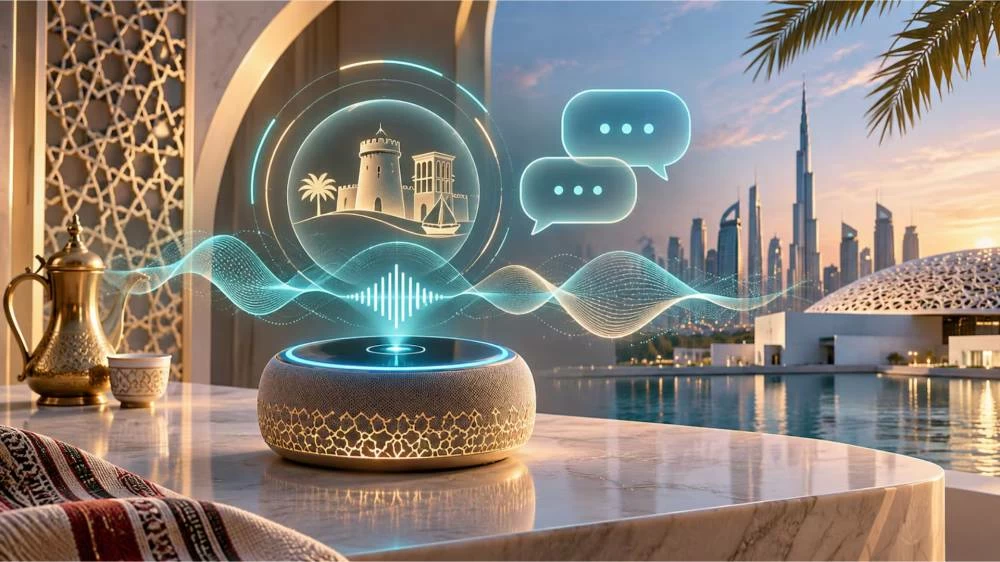
Dr. Basma Al-Amal Bousaha, a principal researcher at the Institute of Technological Innovation, reviewed three specialised models that were fully developed in the UAE. These include a model for extracting texts from manuscripts, books, and old documents; a linguistic model that understands and speaks the Emirati dialect; and a model for automatic speech recognition and conversion to text, which supports governmental and institutional uses and maintains data privacy.
Bousaha explained that the first project, named Arab Astronomy, focuses on extracting texts from old books, manuscripts, and documents written in Arabic and English, with its ability to handle complex document formats, including tables, mathematical equations, and Arabic texts with diacritics. She noted that the model is characterised by its small size and the ability to run on personal devices or the digital infrastructure of institutions, without the need to send data to external cloud computing platforms. Contact has been made with a number of government agencies and institutions interested in employing the model and developing its applications.
She noted that the second project is the Emirati Falak model, which is a linguistic artificial intelligence model designed to understand and interact with the Emirati dialect, taking into account the cultural and social specificities of the country, including local customs, traditions and history, and not just converting texts from English to Arabic, as is the case in some linguistic models.
She noted that the third project is a model for automatic speech recognition and conversion of spoken conversations into written texts. It supports the Emirati dialect and Modern Standard Arabic, in addition to English, French, Portuguese, and Spanish. It can be operated without an internet connection or used for direct transcription of conversations and meetings. It can also be integrated with digital meeting platforms such as Teams and Skype to provide instant transcription of conversations, prepare meeting minutes and summaries, and extract the tasks and procedures to be carried out.
This enhances the efficiency of institutional work and saves time, effort, and manpower. She emphasised that the three models allow institutions to operate artificial intelligence technologies within their own infrastructure, ensuring that sensitive data remains within their systems and does not have to be shared with external platforms.
Bousaha stressed that AI does not aim to completely replace the human element, but rather represents a tool to facilitate tasks and accelerate their completion, emphasising the continued need for human expertise, especially in specialised and sensitive fields, such as the medical sector, where the role of the doctor and his professional expertise in reviewing results, verifying their accuracy and making decisions cannot be dispensed with, as well as the police, judicial and legal sectors and other sectors in which humans play the most prominent role.
Reshaping the labour market
Researchers agree that artificial intelligence has begun to reshape the labour market, as evidenced by the decline of some jobs that rely on routine and repetitive tasks, such as data entry, writing, translation, customer service, secretarial work, administrative assistance, and some banking jobs, in contrast to the creation of new specialisations and professions related to the development, operation, and performance evaluation of these technologies.
They explained that this transformation requires human resources with advanced skills in formulating instructions directed to artificial intelligence models, analysing their outputs, verifying their quality, and improving their performance. This opens up new professional opportunities that require a combination of technical and analytical skills to fill them.
They emphasised that artificial intelligence and big data systems will not eliminate the role of humans or replace their skills, but will enhance the integration between human capabilities and modern technologies, in parallel with the emergence of specialised jobs, most notably artificial intelligence specialists, data scientists and engineers, big data developers, data and insights analysts, data and analysis consultants, and artificial intelligence systems business developers, in addition to data commentators responsible for classifying digital information, artificial intelligence managers, and engineers concerned with applying these technologies and guiding their use.
They stressed that the UAE is moving steadily towards building a knowledge-based economy by investing in digital transformation and skills development, which enhances demand for specialisations in artificial intelligence, data science, cybersecurity, engineering, energy, sustainability, healthcare and other future fields.