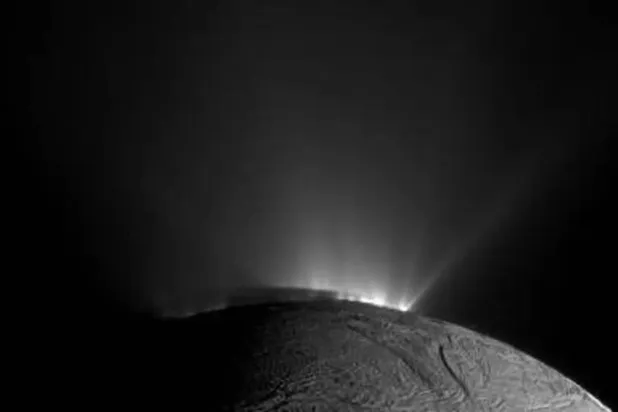
Aliens could live on a moon in our solar system, scientists have announced. Researchers have long been particularly excited about the possibility of life on Enceladus, one of Saturn’s moons. It not only is one of few places in our celestial neighborhood to have conditions that could provide a home for aliens, but also shoots out jets that mean that it could be easier for future spacecraft to examine. Now, new research has found that specific organisms would actually be able to live there. It suggests that Enceladus might be even more supportive of life than we had realized, according to The Independent. Enceladus is one of 293 moons around Saturn, and does not immediately appear hospitable. It is icy cold and has little oxygen, for instance. But researchers have long been excited about what might be lying beneath the icy crust that encircles the planet. There is a vast ocean underneath it, leading researchers to believe that it could be one of the few places in our solar system that could actually support life. In the new research, scientists conducted experiments to understand how specific organisms might be able to survive in that ocean. They recreated the conditions that are thought to exist on its seafloor in a laboratory – and found that a microorganism called archaea were able to adapt to live there. “Enceladus is considered to be one of the most promising places to search for extraterrestrial life,” said Vanessa Helmbrecht, lead author of the study, in a statement. “Our experiments show that its unique geochemistry could create conditions that are even more favorable for microbial life than we had previously thought.” The researchers were keen to stress that the study doesn’t prove that life exists on the moon. But it does show that the planet’s conditions are able to support one of Earth’s most ancient microorganisms, boosting their hopes that something could be found living there. They hope that the study will give a further boost to attempts to head to Enceladus and bring back samples from its ocean that can be studies, they said. The European Space Agency plans to do that with a space mission named L4 that is expected to launch in 2042. The work is reported in a new paper, ‘Enceladus-like geochemistry fuels methanogenesis under extreme CO2 limitation’, published in the journal Science Advances. It comes at the same time as another set of research that suggests that Enceladus could be a particularly convenient place to search for alien life. It found that as water is sent out through the jets that spew out of the moon, its different parts separate – which would make it easier for future spacecraft to detect as they fly through those plumes. Caption: NASA’s Cassini spacecraft captured this image of Enceladus on Nov. 30, 2010. The shadow of the body of Enceladus on the lower portions of the jets is clearly visible (NASA/JPL-Caltech/Space Science Institute)