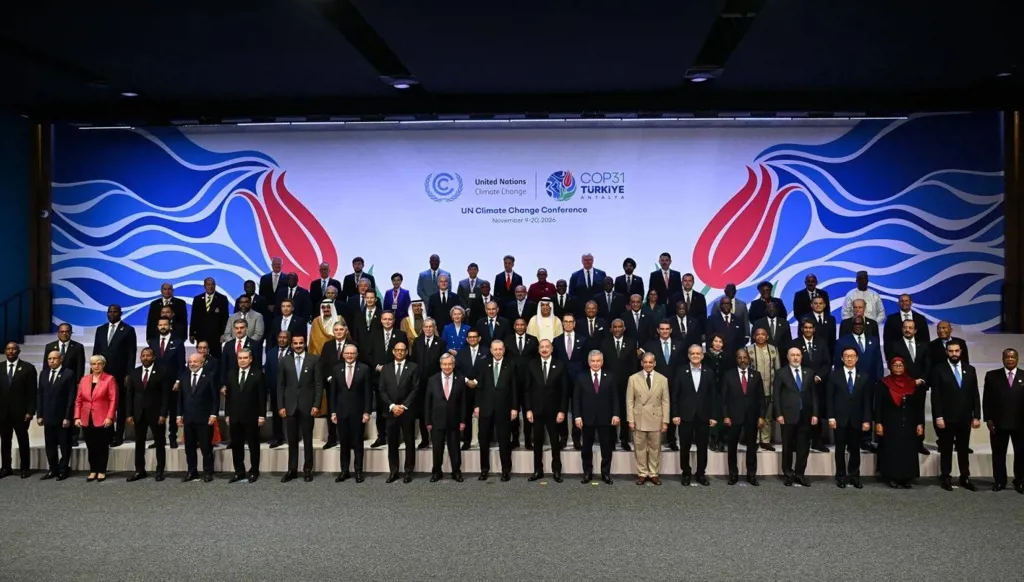
WORLD LEADERS gathered on Wednesday at the climate summit in Antalya, facing a recurring question: How can pledges be translated into funded and implemented decisions? In their opening speeches at COP31, a shared concern emerged over wars and energy crises overshadowing climate issues on the agenda, while the losses these conferences are meant to prevent continue to accelerate.
Among the notable speeches, five stood out for offering different answers to the implementation dilemma: Guterres defined scientific limits, Lula called for continuity in commitments, Erdoğan focused on financial responsibility, Albanese advocated for achievable progress, and Abiy Ahmed questioned when support would reach those in need.
UN Secretary-General Antonio Guterres delivered the most direct speech in diagnosing the danger. He warned that the climate crisis was outpacing the international response, stating that surpassing the 1.5-degree threshold was inevitable, but that the extent, duration, and impacts of this overshoot depended on decisions being made now.
The importance of this approach lies in resisting the use of failure as an excuse for inaction. Every additional fraction of a degree increases the damage, while every reduction in emissions helps limit it. Guterres called for a new climate justice pact aimed at ensuring a fair transition away from fossil fuels, protecting populations, and supporting developing nations. He also rejected the contradiction between declaring a commitment to the 1.5-degree threshold and continuing to expand fossil fuel production.
Lula: Don't Start from Zero After Belém
Brazilian President Luiz Inácio Lula da Silva distinguished his speech by defending continuity in the climate process. He criticized the major powers' preoccupation with arms and tariffs, urging that the planet's fate not become hostage to geopolitical competition.
He brought demands linked to the legacy of the Belém summit to Antalya: increasing climate finance to $1.3 trillion annually, accelerating the transition away from fossil fuels, and halting deforestation. He urged Turkey and Australia to incorporate roadmap recommendations into the upcoming global stocktake of the Paris Agreement, announcing that Brazil would establish national pathways to reduce dependence on fossil fuels and protect forests.
These are goals and proposed pathways, not funds spent or reductions achieved. But their political value lies in rejecting the idea that each conference presidency should start afresh while previous commitments remain suspended.
In his speech, Turkish President Recep Tayyip Erdoğan acknowledged that the consensus reflected in climate decisions had not been matched equally by implementation. He called on developed nations to take greater responsibility for financing climate responses, expressing Turkey's ambition to make the Antalya summit one focused on implementation.
This diagnosis targets the main point of contention: countries can agree on a general direction, but differ over who pays, the cost of borrowing, and the conditions for accessing funds. The success of the Turkish presidency will be measured by its ability to turn this acknowledgment into actionable arrangements, with clear figures, dates, and responsibilities.
Australian Prime Minister Anthony Albanese delivered a speech defending the value of international cooperation. He emphasized that the possibility of exceeding 1.5 degrees does not diminish the importance of preventing any additional warming, and called for tangible results in clean energy, electrification, and financing for the countries most in need.
The importance of his speech is underscored by Australia's role in leading negotiations. Albanese also focused on Pacific Island nations and their regional resilience mechanism, placing the availability of funding for vulnerable countries at the heart of the test of international cooperation.
Abiy Ahmed: Funding Before Catastrophe
Ethiopian Prime Minister Abiy Ahmed's speech was among the most closely connected to people's everyday lives. He linked climate issues to economic policy, crops, electricity, and recovery from droughts and floods. Abiy called for predictable and accessible funding before disasters strike, working alongside early warning systems.
He summed up his demand with three practical questions: How much money will be provided, when, and under what conditions?
Tomorrow, Thursday, national speeches will continue, with meetings focusing on more actionable issues: accelerating electricity networks, the second decade of the Paris Agreement and access to finance, urban resilience and adaptation, and clean cooking in Africa. The agenda also includes non-CO2 greenhouse gases, glaciers, and financing resilience in Pacific communities.
The leaders' summit is scheduled to conclude at 5 PM Antalya time, while the climate conference continues until November 20. Therefore, the end of the speeches will not mark the end of negotiations, but rather an assessment of the political direction they have set.
What is worth watching tomorrow, on the second day of the leaders' summit, is the content of any new declarations: Do they introduce additional funding? Do they set a timeline for spending and identify beneficiaries? Do they link the expansion of electrification to reduced reliance on fossil fuels? The notable speeches explained why action is necessary. What Antalya now requires is a measurable answer on how and when to act.