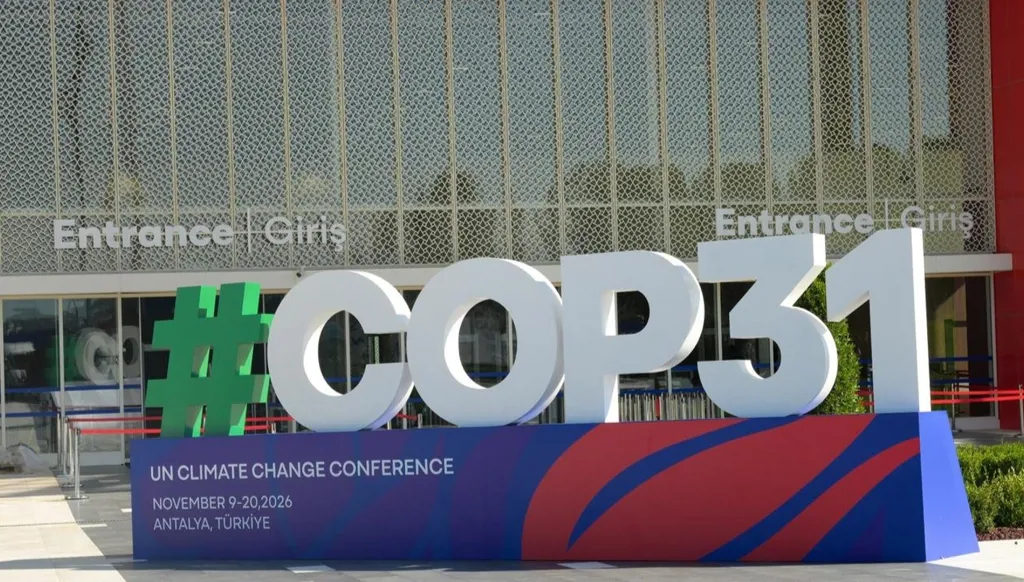
The city of Antalya, Turkey, will host the annual UN Climate Conference (COP31) from November 9 to 20, 2026, with Turkey hosting the conference and Australia leading the negotiations. Several parallel meetings will take place during the conference, most notably the eighth session of the Conference of the Parties to the Paris Agreement, the twenty-first session of the Conference of the Parties to the Kyoto Protocol, and the sessions of the Subsidiary Bodies for Implementation and Scientific and Technological Advice.
In this article, we present the main issues on the negotiation table in simplified language, before focusing on those that directly affect Arab countries and the concerns of Arab citizens amid extremely difficult economic and regional conditions.
The Antalya Conference takes place at a time of global turmoil. The year 2026 has witnessed widespread humanitarian suffering and economic decline, primarily due to wars in the Middle East that have triggered energy and food crises. Prices have soared in many parts of the world, sparking protests over the cost of living in several countries.
These crises have forced developing-country governments to divert limited resources away from social services and development priorities to secure alternative energy sources. Experience has shown that moving away from fossil fuels, while important, cannot succeed unless the process is fair, gradual and equitable, ensuring that poor and vulnerable groups do not bear its costs. This requires significantly greater climate financing than is currently being proposed.
Meanwhile, the effects of climate change continue to worsen. Last October, devastating floods struck Nepal and China, linked to accelerated glacial melting and claiming thousands of lives. These events serve as reminders that the risks associated with rising temperatures are growing and that the loss and damage agenda is becoming increasingly urgent.
The latest synthesis report from the UNFCCC on nationally determined contributions presents a mixed picture. While climate considerations have been integrated into national policies, collective efforts to reduce emissions remain far below the levels required by science to keep the 1.5°C target within reach. The report also notes that adaptation and resilience-building have become essential components of national plans, alongside efforts to address loss and damage.
A significant part of the discussions is expected to revolve around responsibility. Many developing countries argue that developed countries have failed to reduce emissions sufficiently, despite having consumed the majority of the available carbon space. They maintain that the repeated emphasis on the importance of the 1.5°C target conceals a gap between rhetoric and action, both in terms of emissions reductions and the financial support provided.
One major issue is the work program on climate financing, a two-year program established in last year's final decision in Belem. The program addresses Article 9.1 of the Paris Agreement, which obliges developed countries to provide financial resources to help developing countries reduce emissions and adapt to climate change.
Negotiations in Bonn last June revealed significant disagreements over the program's scope and working process. The Group of 77 and China rejected the work plan drafted by the co-chairs because the parties had not yet agreed on its scope. The Arab Group and the Group of Like-Minded Developing Countries insisted on including the item on the Paris Agreement meeting agenda, adopting the G77's position and formally addressing COP30's presidency on the matter. Conversely, developed countries such as the EU, Switzerland, Canada, Norway, New Zealand, Japan and the UK argue that the Belem decision settled the scope and that implementation has already begun.
This issue is becoming increasingly important because resources from climate funds, such as the Green Climate Fund, the Global Environment Facility and the Loss and Damage Response Fund, remain insufficient, while their replenishment prospects are uncertain. Concerns have grown following announcements by the UK, Canada and Germany of reductions in climate financing, as well as the US withdrawal from the framework agreement and the Paris Agreement. The item is already on the provisional agenda, but some developed countries continue to oppose it, making the adoption of the agenda itself a potential first political confrontation in Antalya.
Additionally, new proposed agenda items include three put forward by the African Group: tripling adaptation financing, periodically reviewing the financial needs of the Green Climate Fund, and launching discussions on trade and climate change. Mountainous countries have also proposed items addressing mountains and climate change, as well as warming in mountain regions.
Established in 2021 and scheduled to last until this year's meeting, the mitigation work program will be up for review in Antalya, where parties will decide whether it should continue beyond this year and, if so, in what form. The disagreement in Bonn was not over its continuation, but rather the principles that should govern any future mandate.
The Arab Group, alongside the African Group, China, India, South Africa and other developing countries, insists on maintaining existing safeguards, including national sovereignty, nationally determined contributions and the absence of new targets. Meanwhile, the AILAC and AOSIS groups, with EU support, are calling for a rapid increase in ambition during this decade.
Many developing countries fear that the program could pressure them into adopting additional commitments, such as "moving away from fossil fuels," without receiving corresponding financial support, technology and capacity-building assistance from developed countries. These concerns have been heightened by proposals to establish new bodies, such as a "Standing Mitigation Committee," a "Mitigation Advisory Committee" or a "Mitigation Facilitative Mechanism."
A stalemate emerged at the 2024 Baku Conference over additional guidance on the characteristics of nationally determined contributions (NDCs), with further discussions postponed until Antalya.
At the time, the Arab Group, Egypt and other developing countries argued that these characteristics were already stipulated in the Paris Agreement and that national determination was essential. They called for any new guidance to include adaptation, financing, technology transfer, capacity building and the impact of response measures in developed countries on developing nations, while maintaining differentiation between developed and developing countries.
Conversely, developed countries, alongside AOSIS, are seeking measurable, economy-wide emissions reduction targets for all nations, aligning NDCs and long-term strategies with the 1.5°C goal, and specifying clear baselines and peak-emissions years. Given the wide divergence between the positions, the outcome remains uncertain.
Antalya's agenda includes several adaptation-related items: the global adaptation goal, the Adaptation Committee's report and review, national adaptation plans, and guidelines for adaptation communications.
The most important issue is the follow-up to the Belem decision on the global adaptation goal, which adopted a list of 59 "Belem Adaptation Indicators" and established a two-year process to develop operational guidelines. These indicators are based on the Global Resilience Framework adopted at the 2023 Dubai Conference.
Work by the technical task force faltered in Bonn, as the final draft text leaned towards the positions of developed countries, excluding party involvement in the team, omitting equity principles and weakening the language on adaptation financing. Discussions will restart in Antalya, while the subsidiary bodies will establish the reference for reviewing the Emirates framework.
Regarding national adaptation plans, recent data indicates that 81 developing countries had submitted their plans by October 20, 2026, including 29 least developed countries and 17 small island developing states. Parties will also review an overview prepared by the Least Developed Countries Expert Group on financial flows for preparing and implementing these plans.
Discussions will focus on activating the "Just Transition Mechanism" approved in Belem, alongside reviewing the just transition work program and defining its future. In Bonn, parties agreed on the review framework and held additional consultations, including an informal workshop organized by Australia in Sydney in late September and early October.
The main disagreement concerns governance. Developing countries want an independent body dedicated to the mechanism, although they differ on its precise form. They agree, however, on the need for implementation tools and measures to address international structural barriers to the transition.
Most developed countries, on the other hand, oppose establishing a new body due to financial constraints. They argue that existing efforts and resources are sufficient and prefer a streamlined mechanism that coordinates separate initiatives, focuses on local implementation and attracts private financing. The full report on the monitoring and inventory processes used by developed countries, in contrast to developing-country proposals, is also anticipated.
The Antalya Conference will consider the governance of the "Warsaw International Mechanism for Loss and Damage," as well as the annual joint report by its Executive Committee and the "Santiago Network," which is tasked with avoiding, reducing and addressing loss and damage. The adequacy of the financial resources required to support these bodies' work and replenishment may also be raised.
The technical phase of the second Global Stocktake is expected to begin in Antalya, without negotiations. This process will start by collecting information from parties, international organizations and the scientific community.
Two coordinators will be selected for the technical dialogue: one representing developing countries through the G77 and China, and another representing developed countries. Technical dialogues are scheduled for June and November 2027 and June 2028, with parties set to review the outcomes in 2028.
The agenda includes several financial items, such as the Standing Committee on Finance, guidelines for the Green Climate Fund and the Global Environment Facility, the Loss and Damage Fund report, the Adaptation Fund and Article 2.1(c) of the Paris Agreement.
It also includes items specific to the Conference of the Parties, such as long-term finance and the seventh review of the Financial Mechanism, for which guidelines have remained stalled since the 2021 conference.
Within the "Verdas Dialogue" on Article 2.1(c), which concerns directing financial flows towards low-emission pathways, developing countries emphasize the need to comply with the safeguards established in Belem. These include ensuring that implementation is nationally driven, non-obligatory and respectful of national, fiscal and monetary sovereignty, without imposing new burdens. These countries fear that developed nations may push for unified or global implementation.
The "Shingo Talks" on financing were held in Bangkok on October 13, alongside the IMF and World Bank meetings. Discussions focused on expanding fiscal space for climate investment and reducing capital costs through risk-sharing and guarantees.
For the Adaptation Fund, three contentious issues remain: arrangements serving the Paris Agreement exclusively, Board membership and the fifth review. The main disagreement concerns whether to issue three separate decisions, as developing countries prefer, or a single decision, as developed countries want. Membership is politically sensitive because changing the terminology from "Annex I and non-Annex I" to "developed and developing" could alter the Board's structure, giving developing countries greater representation than in any other climate fund. These countries consider this a non-negotiable issue.
Hosting the Climate Technology Center is a priority for developing countries. The Subsidiary Body for Implementation recommended UNEP as the center's host in Bonn and requested that the Secretariat prepare a memorandum of understanding to be discussed in Antalya.
Parties will review the joint annual report of the Technology Executive Committee and the Climate Technology Center and Network, as well as the network's third independent performance review. Developing countries seek to preserve its national, needs-based approach and call for adequate, sustainable and predictable funding from developed nations, while redirecting efforts towards the "Belem Technology Implementation Program."
Bonn negotiations witnessed intense discussions over the need to incorporate equity principles into future climate models. India, the Arab Group and Kenya support this approach, while the EU and the UK oppose it.
In Antalya, negotiations will focus on how the outcomes of "Earth Information Day" are reflected in decision texts, reviewing the state of the Global Climate Observation System, linking monitoring to assessments, models, early warning systems and climate services, and ensuring equitable access to data and techniques.
Antalya will host the second session of the "Global Implementation Accelerator," a voluntary initiative launched by the COP30 Presidency to accelerate the implementation of solutions and keep the 1.5°C target within reach. The COP30 and COP31 presidencies are working on the initiative together. The eighth session of the "1.5 Belem Mission" will conclude with a summary report by the three presidencies.
Roadmaps for transitioning away from fossil fuels and addressing deforestation will not be included in formal negotiations due to the lack of consensus in Belem. However, they will be discussed in high-level dialogues led by the COP30 Presidency.
The Turkish presidency has proposed an electrification target as part of its climate action agenda, aiming to increase electricity's share of final energy demand from around 20% today to 35% by 2035. Since the climate action agenda is not part of formal negotiations, the target could spark debate if some parties attempt to include it in negotiated decisions. The presidencies have expressed a desire to issue an "inclusive decision" that could incorporate the target, with significant debate expected over both its procedure and content.
Arab countries negotiate in Antalya through the Arab Group, in coordination with the G77 and China, and with other groups on certain issues. Their circumstances vary, ranging from oil and gas producers to middle-income countries burdened by debt and living-cost pressures, as well as least developed countries facing fragility and conflicts. However, they share several common concerns, most notably:
Notably, the Arab region is not a bystander in these matters. Egypt hosted the Sharm El Sheikh Conference, which paved the way for establishing the Loss and Damage Fund, while the UAE hosted the Dubai Conference, which resulted in the Global Climate Resilience Framework that forms the basis of the adaptation indicators being discussed today.
Behind the technical language of negotiations lie everyday concerns that can be summarized as follows:
Water and Food: Water scarcity is a daily reality in most Arab countries, and climate change is worsening the situation through reduced rainfall, increased evaporation and saltwater intrusion into coastal lands. Amid this year's turmoil in food markets, Arabs fear direct impacts on the prices of bread, oil and vegetables.
Heat and Health: Heatwaves, sandstorms and dust storms are becoming increasingly severe, affecting the elderly and children, the health of outdoor workers, work productivity and electricity consumption.
Coasts and Cities: The Nile Delta, coastal cities and islands face threats from rising sea levels and coastal erosion, as well as unexpected flash floods for which infrastructure is unprepared.
Living Costs and Energy: Rising fuel and electricity prices are placing additional pressure on families, forcing governments to choose between energy subsidies and investments in clean alternatives. The question people are asking is: Who will bear the costs of the transition?
Jobs and the Future: Arab youth are concerned about whether renewable energy, smart agriculture and the green economy will create real job opportunities or come at the expense of traditional sectors without providing alternatives.
Funding That Truly Reaches People: There is legitimate concern that financial promises will remain mere rhetoric without reaching affected communities. Transparency in tracking funding and the involvement of civil society, women, youth and local private sectors in designing projects are crucial.
The success of the Antalya Conference will be judged by one criterion: the willingness of developed countries to provide the funding, technology transfers and capacity-building support that developing countries, including Arab nations, need in sufficient quantity and quality.
The Arab region cannot afford to wait, and Arab citizens want to see the impact of these negotiations on water, food, living costs and future employment opportunities.
*Climate Change Consultant at the United Nations Framework Convention on Climate Change (UNFCCC) and member of the Intergovernmental Panel on Climate Change (IPCC)