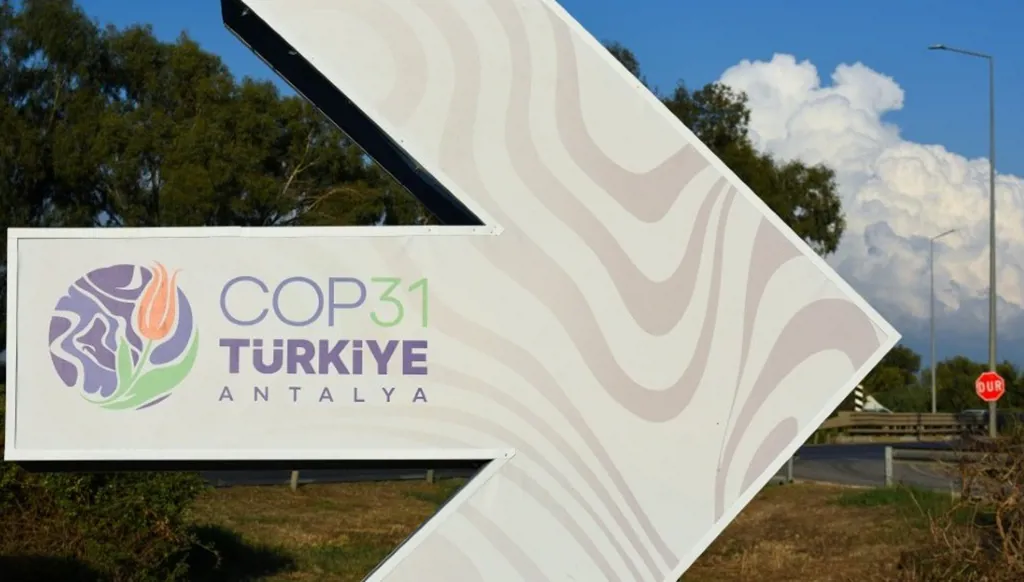
How can climate commitments be translated into decisions that transform people's lives? This is the most pressing question today, as the second week of the COP31 climate conference in Antalya, Turkey, gets underway, with a focus on negotiations. The practical outcome expected is a set of agreements that make financing more accessible, link emissions reductions more closely to investment, and make the impact of adaptation more measurable. Describing Antalya's conference as the "Implementation Summit" places the responsibility on negotiators to prove that the Paris Agreement can deliver tangible results through national budgets and projects.
The figures illustrate the scale of this challenge. According to the Emissions Gap Report (2026), issued by the United Nations Environment Program, current policies could lead to global warming of 2.8 degrees Celsius this century, while the full implementation of nationally determined contributions, alongside similar efforts, would limit warming to 2.6 degrees compared with pre-industrial levels. Existing plans, therefore, require a significant increase in ambition and implementation.
The same report estimates that keeping warming below 1.5 degrees, or returning it to that level or lower by 2100 with approximately a 50% probability, would require a 45% reduction in global emissions by 2035 compared with 2025. Current national plans, however, would achieve only an estimated 11% to 15% reduction. This pathway allows for warming to peak at 1.8 degrees by mid-century, with an increasing reliance on carbon dioxide removal. This is why Antonio Guterres summed up the situation by saying that "overshooting does not mean surrender."
This underscores the importance of determining the future of the Mitigation Work Program, whose mandate expires in 2026. The disagreement centers on its role: should it send political signals to raise ambition, or focus on sharing experiences in implementation? The OECD has presented several options, including multi-year planning, higher-value outputs and more specialized investment meetings. Its renewal would be beneficial if it helped countries overcome barriers to electricity, transport and industrial projects, linking technical expertise to financing while respecting the national nature of climate plans.
The credibility of progress should be assessed against the commitments established at the first Global Stocktake during COP28 in Dubai in 2023: a just and orderly transition away from fossil fuels in energy systems, tripling global renewable energy capacity, and doubling the rate of improvement in energy efficiency by 2030. Antalya's ability to link these objectives to measurable policies and investments will be a significant indicator of the seriousness of implementation.
Financing will largely determine the scope of any agreement in other areas. The agreement reached at COP29 in Baku in 2024 aims to mobilize at least $300 billion annually by 2035 for developing countries, led by developed nations, within a broader call to increase funding from all public and private sources to $1.3 trillion annually. These are interconnected levels of the financing goal and should not be treated as separate commitments. Antalya's challenge is to clarify how these resources will be mobilized, under what conditions, and how their use will be monitored.
Negotiations also include defining the scope of a two-year Finance Work Program and continuing calls to triple adaptation finance by 2035, alongside arrangements for transitioning the Adaptation Fund to serve the Paris Agreement exclusively. Mahlet Eyassu Melkie of the Rocky Mountain Institute describes this financial work program as "one of the most difficult issues due to its scope and relation to Article 9 of the Paris Agreement." This explains why even drafting a procedural framework could become a focal point of political contention.
The scale of the funding gap is evident in the 2026 Adaptation Gap Report. International public flows for adaptation from developed to developing countries stood between $28.2 billion and $31.7 billion in 2024, compared with estimated needs of approximately $305 billion annually by 2035. Even tripling these flows would cover no more than 20% to 29% of those needs, taking inflation into account. These figures relate specifically to adaptation, whereas the $300 billion target covers climate finance overall. Inger Andersen, Executive Director of the United Nations Environment Program, warns that "the world is unprepared for current climate conditions."
Genuine progress requires clarifying the baseline against which the tripling of financing will be assessed, establishing interim milestones before 2035, and increasing grants and concessional financing where borrowing capacity is limited. This also means simplifying financing applications and helping local institutions prepare projects. The value of financial commitments depends not only on the amounts pledged, but also on how long a municipality or water authority must wait to access them and how much funding actually reaches vulnerable communities.
The challenge extends beyond adaptation. The same report indicates that the first round of the Loss and Damage Response Fund received requests totaling $2.8 billion, against an initial funding envelope of $342 million. Requests therefore exceeded available resources by approximately eight times. Although this comparison concerns only that round, it illustrates the pressure involved in responding to actual losses and the importance of improving access to support while increasing available resources.
On adaptation, the transition to the execution of the 59 Belem Indicators approved in COP30 and linked to "UAE Global Resilience Framework" goals is anticipated. Negotiations will focus on technical work and methodologies and leveraging information in the second Global Stocktake. Pilar Bueno Rubial of "Argentina 1.5" emphasizes expanding countries' participation in the technical process and balancing it with experts and stakeholders. What is measured dictates practically the efforts that appear in the assessment and those that may stay outside.
The core challenge is establishing the impact of adaptation: to what extent did water networks maintain service during droughts? Did early warning systems help reduce human losses? How far did protection reach the most vulnerable? Indicators can aid answering these questions, provided data and local capacities develop, and risks vary across countries. The evaluation should clarify the adequacy and effectiveness of actions alongside capturing plans and projects implemented.
The just transition file presents a direct social test. Agreed in Belem to establish a mechanism for international cooperation, technical assistance, capacity building, and knowledge sharing; Antalya is expected to define its operation and connection to the just transition program under review. Its utility will depend on its capability to support worker retraining, social protection, and involving affected communities in decisions. Transitioning to a low-emission economy requires a socially defensible distribution of its benefits and costs.
The labor market provides concrete reasons for this focus, with IRENA and ILO estimating 16.6 million global renewable energy jobs in 2024. However, their report highlights ongoing barriers to women's employment and career advancement, and the need for investment in education and training. Therefore, cooperation on the just transition should translate into opportunities genuinely accessible to workers and underrepresented groups.
Finally, COP31 launches the second "Paris Agreement" Global Stocktake, expected to conclude in 2028. This collective progress review should guide national plan improvements and international cooperation. Kaveh Guilanpour of the Center for Climate and Energy Solutions emphasizes that if the world is serious about implementation, it must cease viewing action agendas as a side event. The practical meaning is that the review should benefit from governments', cities', companies', and communities' results and help its outputs change economic decisions.
What we want from Antalya, therefore, is progress that can be tested starting from the moment the conference ends: a more beneficial emission reduction program, a clearer path to obtaining financing, methods that measure adaptation impacts, a just transition mechanism with specific functions, and a global outcome grounded on actual implementation. Success may take the form of incremental agreements in these areas, while financial and political differences persist. Its most important criterion is the extent to which these agreements empower countries and communities to reduce emissions and protect development before the cost of delays rises further.