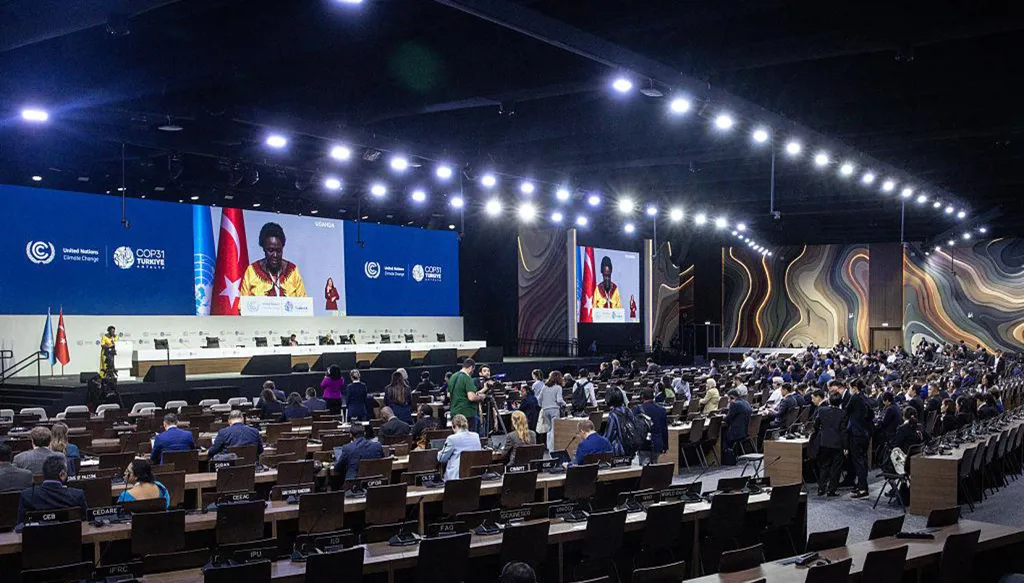
ANTALYA: Negotiators did not leave Antalya empty-handed, but they also failed to deliver the political outcome the Turkish presidency had hoped to achieve at the conclusion of the conference. After days of intense negotiations and an extension beyond the summit's official closing date, COP31 ended with fragmented results: some sectoral decisions were approved, while others, foremost among them the comprehensive resolution known as the "Antalya Charter," fell through.
According to the final report by the "Earth Negotiations Bulletin" (IISD), countries managed to reach consensus on specific issues, notably the global adaptation goal, the Adaptation Fund, and the Just Transition Programme. However, they failed to adopt the overarching political decisions that were supposed to provide a comprehensive framework for the conference's outcomes. Other issues related to emissions mitigation, response measures, and environmental financing also stalled.
Thus, Antalya's failure was not a complete failure to produce decisions, but rather an inability to bring them together under a shared political vision outlining the direction of international climate action in the coming phase.
Adaptation to climate change was one of the key areas in which tangible progress was made. Countries adopted a decision on the global adaptation goal, continuing the path initiated at COP30 in Belem, where 59 indicators were agreed upon to measure the progress of countries and communities in addressing the impacts of climate change.
The importance of these indicators lies in their attempt to move adaptation beyond general commitments and toward a framework that is more measurable and easier to evaluate. They would allow progress to be assessed in areas such as water, agriculture, food security, health, infrastructure, and resilience to climate disasters.
However, the agreement reached in Antalya did not resolve all disputes surrounding these indicators. Countries decided to establish a task force of national experts to review and improve them and develop guidelines for their use, with its work to be presented by October 2027.
This means that countries agreed to continue the technical work but did not conclude discussions on how the indicators should be used, their technical readiness, or how they should be linked to the funding needed to implement adaptation plans.
This is where one of the major gaps in the conference's outcomes becomes apparent: measuring countries' needs and adaptation capacities does not necessarily mean providing the financial resources required to support them.
During the negotiations, developing countries had called for clarification on how the commitment to triple adaptation funding by 2035 would be implemented, demanding a clear baseline and mechanisms for monitoring and accountability. However, the conference failed to provide a decisive response to these demands or establish a clear financial pathway to ensure that funds reach the countries most vulnerable to climate change. As a result, the adaptation file saw institutional and technical progress but remained surrounded by questions over financing and implementation.
The decision concerning the Adaptation Fund was among the limited achievements preserved despite the failure to reach a broader political agreement.
Countries agreed on arrangements allowing the fund to serve the Paris Climate Agreement exclusively once the first share of revenues from the Article 6.4 mechanism is converted into actual revenue for the fund.
This step is significant given the fund's role in financing adaptation projects in developing countries, particularly those with limited financial resources and weak resilience to climate disasters.
However, the decision does not mean that the fund's financing challenges have been resolved. It continues to face a funding shortfall and needs longer-term, more predictable resources to sustain its support for climate projects.
Thus, what Antalya delivered was progress in institutional arrangements and the prospect of a future revenue source, rather than new and immediate funding on the scale required by developing countries.
In the just transition file, countries managed to adopt a decision extending the Just Transition Work Programme for another three years, with improvements intended to make its dialogues more inclusive and practical.
This decision is significant because the transition to low-emission economies is not simply about changing energy sources or shutting down fossil fuel plants. It also concerns the future of jobs, industries, and communities whose economies depend on carbon-intensive activities.
A just transition should ensure that the most vulnerable groups, workers, and impoverished communities do not bear the greatest costs of climate transformation. It should also ensure that environmental policies are accompanied by new economic opportunities, vocational training, and social protection.
However, the progress achieved remained limited. Negotiations failed to finalize the operational arrangements for the just transition mechanism, which had been agreed upon for development at COP30. Disagreements persisted over the nature of this mechanism, its institutional structure and authority, and whether it should provide direct implementation support or merely coordinate existing initiatives.
Consequently, decisions on the mechanism's role and operational arrangements were postponed until COP32 in 2027. This means that countries agreed to keep the just transition programme active and develop its dialogues, but have yet to agree on the institutional tool intended to turn its principles into concrete action.
On the other hand, the biggest political setback was the failure to adopt the overarching decisions that were supposed to provide a framework for the conference's outcomes, linking emissions, fossil fuels, financing, adaptation, and just transition.
The dispute revolved around three main points:
The lack of an adequate response to scientific warnings about exceeding the 1.5-degree Celsius warming threshold, and the absence of a clear pathway for addressing the resulting implications.
The absence of an explicit reference to transitioning away from fossil fuels, a commitment first included in the outcomes of COP28 in Dubai, which many had hoped to build upon in Antalya.
Insufficient financial guarantees for developing countries, both in terms of adaptation funding and the fulfillment of climate commitments.
The diverging positions showed that the disagreement was not simply about the wording of certain statements. It extended to the nature of the commitments countries should undertake, the distribution of financial responsibilities, and governments' willingness to move beyond previous pledges toward more concrete action.
The difficulties were not limited to the Antalya Charter. Countries also failed to adopt draft decisions on the emissions mitigation programme, response measures, and the Global Environment Facility.
The failure to reach an agreement on the emissions mitigation programme was particularly significant, as countries could not agree on extending it beyond 2026. According to the International Institute for Sustainable Development, this means that, at least for the time being, there will be no dedicated negotiating track for emissions mitigation within the Paris Agreement framework until the issue can be revisited at COP32.
The final outcome of COP31 reveals a fundamental paradox: while countries made progress on certain technical and sectoral issues, they failed to reach political consensus on the questions that will shape the future of global climate action.
This was not merely a procedural disagreement. The negotiations reflected a broader crisis of trust among countries, amid geopolitical tensions, concerns over energy security, and disagreements about the responsibility of industrialized nations to finance the climate transition in developing countries.
According to the International Institute for Sustainable Development, Antalya saw the adoption of important decisions but concluded without a comprehensive agreement, marking one of the longest rounds of international climate negotiations.
The unresolved issues will now move to the next stages of negotiations, notably the Bonn meetings in June 2027, ahead of COP32 in Addis Ababa in November of the same year.
The next presidency's primary task will be to rebuild trust and resume discussions on unresolved issues, particularly fossil fuels, climate financing, the mitigation programme, and the just transition mechanism.
Ultimately, not all of COP31's achievements were lost, but what remains falls short of the scale of the challenges the conference was supposed to address. Countries secured decisions that allow work on certain issues to continue, yet failed to agree on a political direction connecting these efforts under a common goal. Between technical decisions that can serve as a foundation for future progress and the absence of a political agreement, the world leaves Antalya with additional tools to combat climate change, but without the consensus needed to determine how to use them, who will finance them, and at what pace.