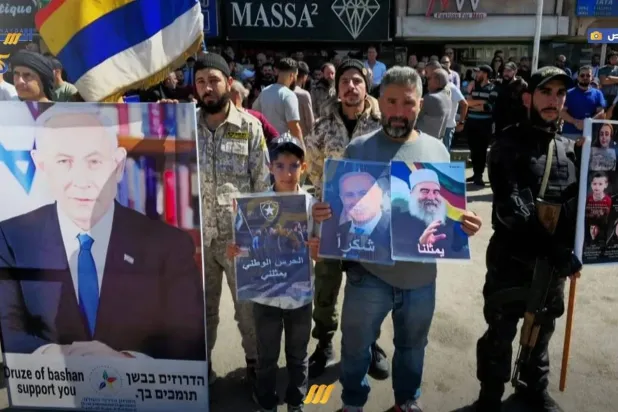
Sources in Syria’s predominantly Druze province of Sweida condemned rallies held by followers of Druze spiritual leader Sheikh Hikmat al-Hijri on Wednesday in solidarity with Israel on the anniversary of the Oct. 7 attacks. A Druze figure mediating between the Syrian government and the Druze told Asharq Al-Awsat that an alternative to Hijri’s movement had been formed. Demonstrators and a car procession in Sweida city displayed Israeli flags and portraits of Israeli Prime Minister Benjamin Netanyahu and Hijri, whose affiliated “National Guard” controls much of the province, including the city. Hijri previously announced what he called the “State of Bashan.” The rallies marked the anniversary of the Oct. 7, 2023, attacks that triggered the Gaza war. Sources in Sweida city described participants as “Hijri’s thugs,” telling Asharq Al-Awsat the events were another way of throwing themselves into Israel’s arms. Solidarity, they said, would have been better directed toward the thousands of children Israel has killed in Gaza. Separately, a Druze source mediating an end to Sweida’s crisis, which has persisted since the bloody events of July 2025, said an “Emergency Committee” had 15 members and a broad advisory body representing families, sheikhs, academics and cultural figures in the province. The source requested anonymity to protect the mediation’s confidentiality at this stage and the safety of those involved. The committee brings together Druze figures living in Sweida, elsewhere in Syria and abroad, the source said. A Syrian-led solution The government and Sweida residents share a tacit understanding that Hijri has become part of the problem and is no longer part of the solution, the source said. Both sides agree in principle that “any solution must be Syrian-led. There will be no compromise on that.” The source said Sweida residents knew the government had accepted almost all their demands before the July 2025 events and remained ready to offer more to safeguard their security and dignity. Both sides share the same interests, the source said: preserving Syrian sovereignty over all its territory and ensuring the Druze have a voice in national decisions, particularly those affecting their areas. But the source faulted the government for sidelining strong, patriotic Druze figures who disagreed with it on some aspects of how to resolve Sweida’s crisis. “The Syrian government backed figures from the province whom the Druze see as unable to truly represent them and firmly demand their rights from Damascus,” the source said. “It therefore failed to engage with leaders who represent the community’s concerns, interests and fears.” The government must correct that, the source said, and work with Druze figures who are “neither agents of foreign powers nor subservient to the government, and who firmly defend the interests of both the country and the community.” “There is considerable hope of resolving Sweida’s crisis, but the problem lies with Israel,” the source said. “The two issues are closely linked. They must be separated, and Sweida’s crisis resolved through a Syrian-led solution.” Mediation now centers on what the government will offer and what Sweida residents will accept. The government has responded positively to the demands, the source said. The two sides broadly agree that their interests as Syrians are inseparable: what harms the Druze harms Syria, and what harms Syria harms the Druze. But progress hinges on how to deal with those blocking any solution in the province — the leaders of the “Security Office,” run by Hijri’s son Salman, the source said. The security obstacle Many solutions are on the table, the source said. Agreement will come when mediation gives way to direct negotiations at the same table. “The talks have shown that the political and social issues have been resolved, with understandings reached on many matters,” the source said. “The only remaining obstacle is purely a security one: who will deal with the ‘thugs,’ and how to support and strengthen that patriotic group with funding, equipment and media backing.” For the committee to go public, the source said, the influence of those “the U.S. envoy and the international community have described as gangs” must end. “That is the problem now being examined, and this is where the Israeli factor comes in.” The source added, however, that “Israel has sent no financial support to Hijri since the beginning of 2026.” The United States is putting enormous pressure on Israel over Syria as a whole, the source said, with Sweida only a small part of Syrian-US-Israeli relations. The source repeatedly distinguished between those described as “gangs and thugs” and those whose hands were not stained by treason, direct collaboration with foreign powers or collusion against the country. The latter would have a place in Sweida and, in the future, in state institutions. Rifts within the “National Guard” Signs of growing divisions among “National Guard” factions emerged when Bassem Abu Fakhr, a leader of the Men of Dignity Movement, accused Hijri and his supporters of dragging Sweida’s residents into a “project of bloodshed,” without naming them. The movement is one of Sweida’s largest local armed factions, with an estimated 8,000 fighters. “They dragged people into a project of bloodshed and mobilized hundreds of accounts to provoke others, promote the vilest people and smear honorable ones, until they turned truth into falsehood and falsehood into truth in the minds of those they had misled,” Abu Fakhr wrote on Facebook. Asharq Al-Awsat learned that families belonging to the Abu Fakhr clan were asked to disavow the statements made in their name in the post. Most refused.