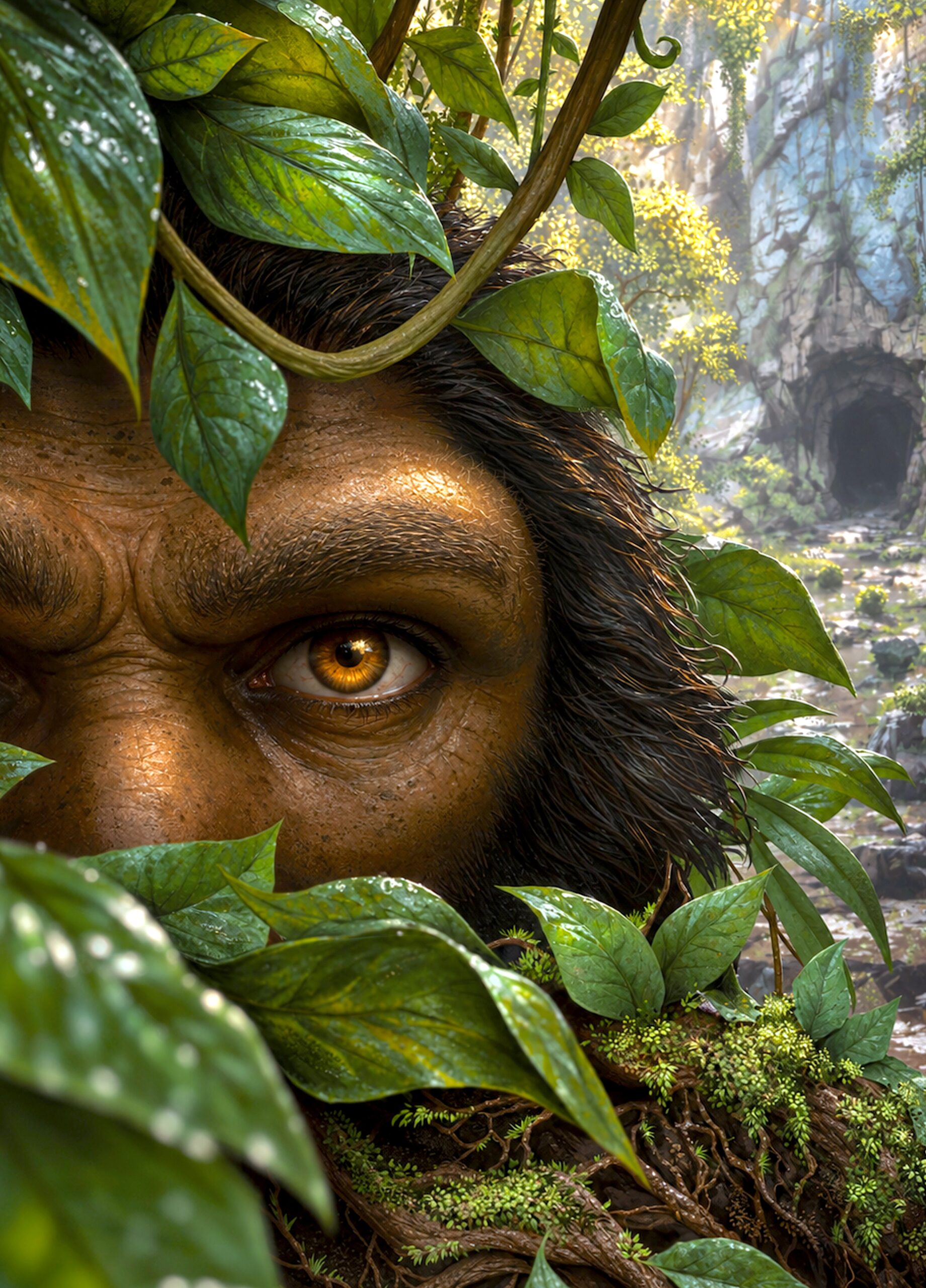
More than 200,000 years ago, southern China looked very different from the landscapes scientists have traditionally associated with Homo erectus. Dense rainforests covered vast areas, providing habitats for elephants, rhinoceroses, monkeys, and predators. Among these animals lived ancient humans who left behind just a handful of teeth in two caves about 15 kilometres apart.
Now, two complementary studies published in Nature reveal that most of these teeth belonged to Homo erectus, whose owners inhabited the region between approximately 324,000 and 184,000 years ago. The findings extend the clearly documented presence of the species in China by more than 200,000 years.
Environmental evidence also suggests that these ancient humans did more than simply survive in tropical rainforests. They obtained food and water within these forests, while some individuals may have travelled considerable distances during childhood.
Homo erectus was one of the most successful early human species. Emerging around 1.9 million years ago, it spread from Africa across large parts of Asia and survived for nearly two million years. However, scientists have traditionally associated the species with savannas, grasslands, and open woodlands. Dense tropical rainforests, by contrast, have been proposed as environments whose expansion may have contributed to its disappearance from Southeast Asia.
Kira Westaway, an associate professor in the School of Natural Sciences at Macquarie University in Australia and co-lead author of one of the studies, said what surprised her most was the discovery of a late Homo erectus population that was “flexible and adaptable enough to successfully exploit rainforest environments”, despite the species often being portrayed as less capable of adapting to environmental change.
She said the finding “turns the narrative on its head”, showing that rainforests were not necessarily a barrier to Homo erectus, as many researchers had previously assumed.
Teeth reveal who lived in the caves
In the first study, researchers examined nine teeth recovered from Naxian and Baxian caves in the Chongzuo region of southern China. They compared their external shapes and the internal structures of their enamel and dentine with those of Homo erectus, Homo sapiens, Neanderthals, and other ancient Asian human populations.
The team then collected tiny samples from five teeth to search for ancient proteins preserved in the enamel. These molecules can survive much longer than DNA and serve as biological fingerprints when genetic material has already degraded.
The analyses showed that eight teeth had features consistent with Homo erectus. Four of the five teeth subjected to molecular analysis also contained a distinctive variation in an enamel protein previously identified only in older Homo erectus specimens from East Asia.
However, the teeth also suggest that the region’s human history may have been more complex than previously thought.
The ninth tooth, labelled PA1796, lacked the protein signature characteristic of Homo erectus and did not match the dental morphology of Homo sapiens.
Westaway said the researchers classified a tooth as belonging to Homo erectus only when the ancient protein evidence agreed with its morphology. This criterion was met by eight of the nine teeth, but not by the remaining specimen.
She added that researchers currently lack sufficient comparative dental samples from Homo longi, a group linked to the Denisovans, to make a definitive identification. Rather than declaring the tooth Denisovan, the team prefers to leave its identity unresolved.
Its presence alongside Homo erectus raises the possibility that more than one human lineage inhabited this part of Asia at roughly the same time.
Ancient humans inhabited and moved through rainforests
The second study investigated how these ancient humans lived. Researchers used five independent dating methods to establish the ages of the teeth and surrounding sediments. They also analysed human and animal teeth, together with the chemical signatures preserved in them, to reconstruct the ancient environment.
A total of 43 dating results, combined into a single model, showed that Homo erectus occupied the region between 324,000 and 184,000 years ago. Animal teeth pointed to a humid environment dominated by dense forest cover.
More importantly, three Homo erectus teeth preserved chemical signatures consistent with their owners consuming food and water within the forest environment itself.
Westaway said this provided direct evidence that the ancient humans exploited these environments, even if rainforests were not necessarily their preferred habitat.
She added that scientists had previously “simply assumed” that Homo erectus could not cope with tropical rainforests because direct evidence from the crucial periods was missing.
The teeth may also preserve evidence of long-distance movements during childhood.
Strontium isotope ratios in some of the teeth do not match the geological signatures of the rocks surrounding the caves.
Strontium enters the body through food and water, and developing teeth preserve its chemical signature. By comparing these signatures with the geological characteristics of different regions, researchers can identify possible locations where individuals spent their early years.
Westaway said some of the closest matches were found in distant areas, including northern Vietnam, potentially as far as 250 kilometres away. However, she cautioned that this estimate depends on the resolution of local strontium isotope maps.
Even without identifying a precise location, she said the evidence still strongly suggested that some individuals “were not born around the cave area or were highly mobile”, pointing to substantial movement during their early years.
The findings also challenge a longstanding explanation for the disappearance of Homo erectus from Southeast Asia.
Previous research suggested that the expansion of tropical rainforests in places such as Java may have contributed to the species’ extinction by replacing the open habitats it had traditionally occupied.
However, Westaway said the new evidence complicated that explanation, as the southern Chinese population clearly demonstrated an ability to adapt to closed-canopy forests.
If late Homo erectus populations in Java possessed similar abilities, researchers may need to look for another environmental shift or event to explain their extinction.
Testing this possibility at Ngandong in Java, however, presents a practical challenge. The known remains from the site consist mainly of skull fragments and a leg bone, with no Homo erectus teeth currently available for the same isotope analyses.
Westaway therefore believes the question may remain unanswered until new techniques make it possible to extract comparable information from bones.
Findings point to further questions
Both studies have important limitations. Ancient proteins were analysed in only five teeth, while comparisons with Denisovans remain constrained by the scarcity of reference specimens. The identity of tooth PA1796 therefore cannot yet be established with confidence.
Direct evidence that Homo erectus obtained food and water within the rainforest comes from just three teeth, while conclusions about mobility are based on a small number of individuals.
Strontium isotope signatures alone also cannot establish that these individuals undertook a continuous journey of 250 kilometres. Nor do scientists yet know whether the ability to exploit tropical rainforests was widespread among different Homo erectus populations or represented a local adaptation unique to the late inhabitants of southern China.